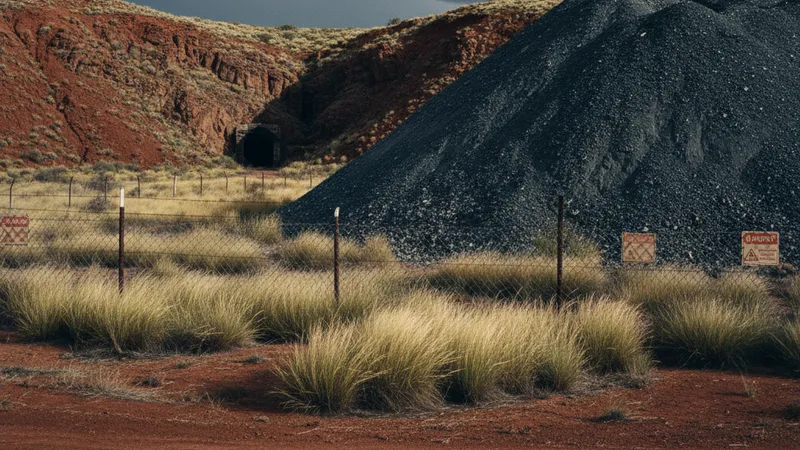
The traditional owners of Wittenoom, one of the most contaminated asbestos sites in the Southern Hemisphere, have filed a $1.5 billion compensation and remediation claim against the Western Australian government. The Banjima Native Title Aboriginal Corporation (BNTAC) lodged the case in the Federal Court in Melbourne on February 24.
The claim targets decades of government inaction over millions of tonnes of blue asbestos (crocidolite) waste left behind at three abandoned mines near the former Pilbara town, located about 1,400 kilometers northeast of Perth.
What the Claim Seeks
BNTAC has asked the court to split the case into two phases. The first focuses on orders to clean up Banjima country. Specifically, BNTAC is seeking:
- Sealing of three abandoned mines
- Removal of three tailings dumping grounds
- Demolition of the asbestos-built Wittenoom racecourse and airport
- Remediation of gorges, rivers, and creeks polluted by asbestos runoff
The corporation expects remediation costs to reach $1.5 billion or more, subject to expert evidence.
The second phase will address damages for asbestos contamination and what BNTAC’s lawyers allege was the WA government’s knowing participation in the dispossession and disadvantage of Banjima people.
Contamination History
Blue asbestos was mined at Wittenoom from the late 1930s until 1966. Colonial Sugar Refining Company (CSR) operated the mines. At its peak, several thousand people lived in the town.
The town was shuttered in 1978 and formally struck from maps in 2007. In 2023, the remaining structures were demolished. But no action has been taken to remove the asbestos tailings. The WA government’s own reporting shows the contamination continues to spread.
An exclusion zone covering 46,000 hectares of Banjima native title land remains in place. That area is eight times the size of Sydney Harbour.
WA government reports indicate the asbestos tailings at Wittenoom are not stable. Waste material continues to seep into the surrounding landscape, including waterways that flow through adjacent Karijini National Park, one of Western Australia’s major tourist destinations.
Health Impact on Banjima People
The statement of claim argues the contamination has had a disproportionate health impact on traditional owners. A 2016 report by WA Senior Scientific Officer Peter Franklin found that Banjima people had the highest per capita rate of mesothelioma incidence in the world.
More than 4,000 deaths across Australia have been attributed to asbestos exposure at Wittenoom, according to the Asbestos Diseases Society of Australia. The toll continues to rise.
Banjima woman Johnnell Parker told ABC News that “there is not one family that hasn’t been touched by this mesothelioma.” Her uncle, Banjima elder Maitland Parker, died in 2024 after an eight-year battle with the disease. He never worked in the mines. He served as a ranger in the adjacent Karijini National Park.
Government Response
WA Premier Roger Cook said he was not surprised by the claim, noting he had been in contact with Banjima representatives and their legal team.
“I would prefer a negotiated outcome, but I respect, absolutely and fundamentally respect their right to seek justice,” he told reporters.
BNTAC chief executive Ed Armstrong said previous discussions with the WA government had failed to progress. “We believe that if there’s no legal action taking place, they’ll continue to defer or delay this and just kick it down the road,” he said.
Legal Precedent
CSR, which held the mining leases, has paid tens of millions in damages to former employees who contracted asbestosis and mesothelioma. The same legal team behind several of those cases, led by lawyer Peter Gordon, is representing BNTAC.
The key legal question is whether responsibility for the tailings passed to the WA government after the mines closed. Gordon argues the state “has owned, occupied and been responsible for the land upon which this contaminated waste has sat since 1979.”
A 1992 WA parliamentary inquiry recommended removing the asbestos tailings. More than three decades later, the waste remains.
Wittenoom was Australia’s only blue asbestos mining town. Crocidolite, the type of asbestos mined there, is considered the most dangerous form of asbestos. A single fiber can cause mesothelioma. The town’s story is detailed in our full Wittenoom feature.
Why are the Banjima people suing the WA government and not the mining company?▼
CSR, the company that operated the mines, has already paid tens of millions in damages in separate cases. The Banjima claim targets the WA government because the state has owned and controlled the contaminated land since 1979. BNTAC argues the government had the means and the obligation to clean up the waste and failed to act.
How does this case affect people with mesothelioma from Wittenoom exposure?▼
This is a native title and environmental claim by the Banjima people as a group. It doesn’t replace individual mesothelioma claims. People diagnosed with mesothelioma from Wittenoom exposure may still pursue separate compensation through personal injury or wrongful death claims.
Has the WA government ever attempted to clean up Wittenoom?▼
The government demolished the remaining town structures in 2023. However, the asbestos tailings, which represent millions of tonnes of waste, have never been removed. A 1992 parliamentary inquiry recommended removal, and multiple government investigations since then have flagged the extreme danger. No remediation has occurred.
What is crocidolite and why is it so dangerous?▼
Crocidolite, or blue asbestos, is considered the most hazardous form of asbestos. Its thin, needle-like fibers are easily inhaled and can penetrate deep into lung tissue. Exposure to crocidolite carries a higher risk of mesothelioma than other asbestos types.
References
ABC News Australia. (2026). Wittenoom traditional owners launch $1.5b asbestos contamination claim against WA government.
https://www.abc.net.au/news/2026-02-25/banjima-traditional-owners-launch-billion-dollar-wittenoom-claim/106358598
ABC News Australia. (2025). Peter Gordon returns to Wittenoom for Banjima asbestos case.
https://www.abc.net.au/news/2025-11-13/peter-gordon-returns-to-wittenoom-for-banjima-asbestos-case/105985052
ABC News Australia. (2025). Wittenoom asbestos litigation documentary.
https://www.abc.net.au/news/2025-10-17/wittenoom-asbestos-litigation-documentary/105886444