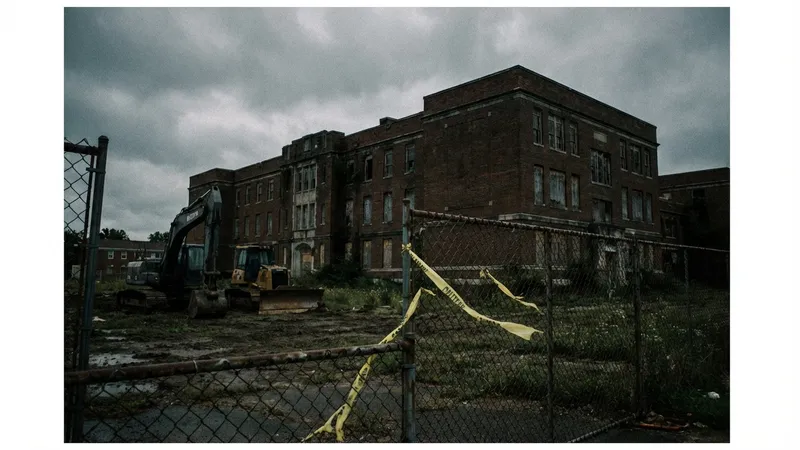
Federal employees at the Department of Homeland Security’s St. Elizabeths West Campus in Washington, D.C., say they are breathing asbestos dust from demolition work ordered by Secretary Kristi Noem. The workers report receiving no masks, no respirators, and minimal warning about the hazard.
The exposure is occurring on a 176-acre National Historic Landmark campus where asbestos-abatement crews in full protective gear operate yards away from federal office workers told to carry on as normal.
What Workers Describe
DHS staff assigned to offices near the cluster of 19th- and early 20th-century buildings targeted for demolition describe a two-tiered safety standard. Contracted demolition and abatement crews wear respirators and full hazmat suits. Federal employees in adjacent occupied buildings say they have not been offered masks, air-quality testing results, or remote-work options.
“They basically just said ‘Good luck,’” one DHS official told the Payday Report.
Several workers say they received only vague, after-the-fact notices about “construction activity” on campus, with no mention of asbestos or specific health risks. Some learned that abatement was underway only after seeing sealed doorways and workers in protective suits entering buildings they had previously used.
One employee described the scene: “There’s one small sign in a side entrance indicating the area is a health hazard. If you come in the main way you’d never know you’re walking into a demolition zone with asbestos in the air.”
The Emergency Demolition Order
Secretary Noem issued an emergency declaration on December 19, 2025, to demolish 17 vacant buildings on the West Campus. GSA notified D.C. officials two days before Christmas.
In her memo to the General Services Administration, Noem wrote that the buildings “present a risk to life and property” and that “demolition is the only permanent measure that resolves the emergency conditions.” DHS cited concerns about unauthorized access, active-shooter scenarios, and “malicious insiders” who could exploit vacant structures.
DHS Assistant Secretary for Public Affairs Tricia McLaughlin stated: “Several of these structures cannot be safely accessed or cleared by law enforcement or first responders, creating security blind spots adjacent to senior leadership and critical operations.”
GSA told reporters it is complying with “all applicable laws and regulations.”
Prior Asbestos Failures at the Campus
The current exposure reports follow documented asbestos management failures at St. Elizabeths.
In May 2024, the GSA Inspector General published audit report A230046, which found that GSA’s Public Buildings Service mismanaged asbestos in Building 40 on the West Campus. Specific findings included:
- PBS did not conduct a pre-alteration assessment before a carpet replacement project
- The project was not designed to avoid asbestos-containing material or prevent its accidental release
- PBS did not notify the contractor of the presence of asbestos before work began, violating OSHA standards
The PBS National Capital Region Commissioner concurred with the findings and three recommendations for improvement. Critics say those recommendations have not translated into better day-to-day practice at the campus.
Regulatory Requirements
Under OSHA regulations, contractors removing asbestos must establish regulated areas, monitor air quality, and provide appropriate respirators. Employers with staff in adjacent offices must either relocate those employees or verify that asbestos is fully contained and that exposure limits are not being exceeded.
DHS has not publicly confirmed whether airborne asbestos levels at the campus have exceeded federal safety thresholds.
ADAO Response
The Asbestos Disease Awareness Organization issued a statement on February 20 in response to the reports. ADAO President Linda Reinstein said that ensuring compliance with occupational and environmental safeguards “is both a legal requirement and a public health imperative,” and that federal workplaces “must meet the same standards required in any setting where asbestos abatement occurs.”
Historic Preservation Concerns
The demolition has drawn opposition from the National Trust for Historic Preservation and the D.C. Preservation League, which argue DHS has not shown evidence of an actual emergency. The campus was established by Congress in 1855 as the “Government Hospital for the Insane,” was listed on the National Register of Historic Places in 1979, and certified as a National Historic Landmark in 1990.
Preservation groups say the emergency declaration bypasses required historic-preservation review procedures for National Historic Landmarks and could set a precedent for other federal sites.
The Health Risk
Asbestos exposure causes mesothelioma, an aggressive cancer of the lung or abdominal lining that typically takes 20 to 60 years to develop after initial exposure. Mesothelioma has a median latency period of 34 years. Between 12,000 and 15,000 Americans die each year from asbestos-related diseases.
There is no known safe level of asbestos exposure.
What is happening at St. Elizabeths?▼
DHS is demolishing 17 historic buildings on its 176-acre West Campus under an emergency order from Secretary Kristi Noem. Federal employees in nearby occupied buildings report breathing asbestos dust from the demolition without receiving masks, air monitoring results, or the option to work remotely.
Did a previous audit identify asbestos problems at the campus?▼
Yes. A 2024 GSA Inspector General audit (report A230046) found that GSA’s Public Buildings Service failed to properly manage asbestos in Building 40, including not notifying contractors of asbestos before work began and not conducting pre-alteration assessments.
What are the health risks of asbestos exposure?▼
Asbestos exposure can cause mesothelioma, lung cancer, and asbestosis. Mesothelioma has a latency period of 20 to 60 years, meaning health effects may not appear for decades. There is no known safe level of asbestos exposure.
What is OSHA's role in this situation?▼
OSHA regulations require employers to establish regulated areas during asbestos removal, monitor air quality, and either relocate workers in adjacent spaces or verify that asbestos is fully contained. DHS has not publicly confirmed whether it has met these requirements.
References
Payday Report. DHS Workers Exposed to Asbestos as Noem Expands DC HQ.
https://paydayreport.com/dhs-workers-exposed-to-asbestos-as-noem-expands-dc-hq/
Asbestos Disease Awareness Organization. DHS Workers Raise Health Concerns Over Legacy Asbestos Abatement at St. Elizabeths.
https://www.asbestosdiseaseawareness.org/newsroom/blogs/dhs-workers-asbestos-dc/
GSA Office of Inspector General. Audit of PBS National Capital Region's Asbestos Management in Building 40.
https://www.gsaig.gov/content/audit-pbs-national-capital-regions-asbestos-management-building-40-st-elizabeths-west
Fox News. DHS fast-tracks demolition of historic St. Elizabeths campus buildings.
https://www.foxnews.com/politics/dhs-looks-demolish-historic-st-elizabeths-buildings-due-unacceptable-risks
Washington Post. Homeland Security seeks emergency demolition of historic buildings in D.C..
https://www.washingtonpost.com/dc-md-va/2025/12/30/homeland-security-plan-demolish-buildings-st-elizabeths/