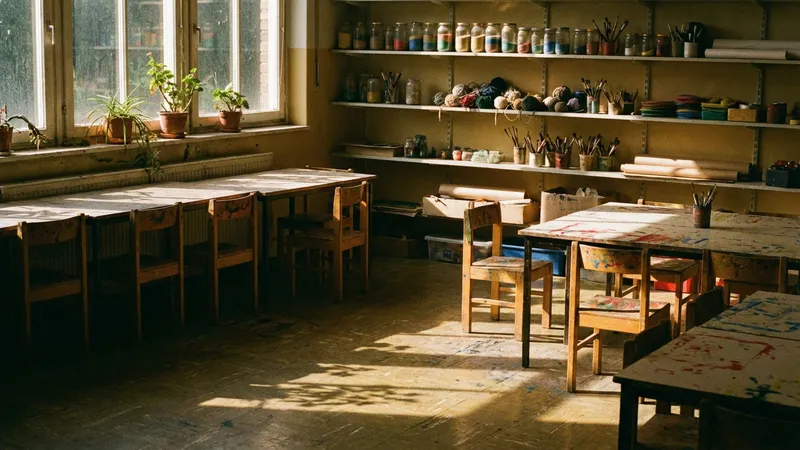
More than 450 schools across Australia shut down temporarily in late 2025 after laboratory testing confirmed tremolite asbestos in popular colored craft sand used in classrooms. The contamination, traced to products imported from China, prompted the largest school-related asbestos response in recent Australian history.
In New Zealand, the crisis followed within days. By mid-November 2025, at least 150 schools and 90 early learning services had contacted the Ministry of Education after identifying recalled sand brands on their premises.
How the Contamination Was Discovered
Laboratory testing in Australia in late 2025 detected tremolite asbestos, a needle-shaped amphibole fiber considered more hazardous than the more common chrysotile form. The findings initially reached New Zealand authorities through a podcast, prompting rapid checks at schools nationwide.
The contaminated products include:
- Educational Colours Rainbow Sand (1.3 kg)
- Creatistics Coloured Sand (1 kg)
- Kadink Decorative Sand (10-gram six-pack and 1.3 kg)
These brands were sold through Kmart, Officeworks, and Woolworths, and had been in use in classrooms since at least 2020. The sand was used in art classes, sensory play, and craft projects. In some schools, spilled sand had been ground into classroom carpets over months or years.
School Closures and Cleanup
The scale of closures was significant. In Australia, 69 schools in Canberra alone fully shut for decontamination. More than 40 schools in Tasmania closed or partially closed. Across both countries, WorkSafe conducted inspections at more than 150 sites.
Cleanup required licensed asbestos removalists. Classrooms where sand had been spilled needed professional decontamination, including carpet removal in some cases. The cost per school averaged approximately $11,000.
Schools that had the sand in sealed, unused containers were cleared more quickly. Those where sand had been opened, used in projects, or spilled required more extensive remediation.
In New Zealand, parents and educators can contact the Ministry of Education at 0800 323 323 for school-specific advice. In Australia, the ACCC provides product recall information and guidance on safe disposal procedures.
Health Risk Assessment
Health authorities in both countries emphasized that the risk from brief, low-level exposure is low. Tremolite asbestos is dangerous primarily through repeated inhalation over time. A child using contaminated sand in a single art class faces a different risk profile than a construction worker exposed daily for years.
That said, any asbestos exposure carries some degree of risk, and children face a longer lifetime in which disease could potentially develop. Mesothelioma has a latency period of 20 to 50 years between initial exposure and diagnosis. Health officials advised parents not to panic but to seek medical advice if they had specific concerns about repeated exposure.
No illnesses have been reported in connection with the contaminated products. Authorities recommended that parents and schools document any known exposure for future medical records, even if no symptoms are present.
Questions About Import Controls
Both Australia and New Zealand have comprehensive bans on asbestos. The contamination raised questions about how products containing a banned substance entered the market and reached children.
The sand was imported from China, where asbestos mining and use continue in some regions. Natural asbestos can occur in sand deposits, and without routine testing of imported raw materials, contaminated products can pass through customs and reach retail shelves.
Regulators in both countries have launched investigations into supply chain oversight. The Australian Competition and Consumer Commission (ACCC) issued product recalls, while New Zealand’s Ministry of Business, Innovation and Employment expanded testing to other imported sand products.
What is tremolite asbestos?▼
Should I be worried if my child used colored sand at school?▼
How are schools being cleaned?▼
How did asbestos-contaminated sand get into schools?▼
References
Reuters. (2025-11-17). Asbestos contamination forces schools in Australia, New Zealand to close.
https://www.reuters.com/world/asia-pacific/asbestos-contamination-forces-schools-australia-new-zealand-close-2025-11-17/
New Zealand Ministry of Education. (2025-11-12). New Zealand Ministry of Education response to asbestos in craft sand.
https://www.education.govt.nz/
Australian Competition and Consumer Commission. (2025-11-15). ACCC Product Safety Recall: Colored Sand Products.
https://www.productsafety.gov.au/