Celotex Has Paid 7% Since 2023. Carey Canada Mined the Fiber. Construction Trades Carry the Cohort.
Celotex pays 7% of scheduled value since June 2023. The 1990 Chapter 11 anchored the Hillsborough Holdings reorganization. Construction-trades workers file.


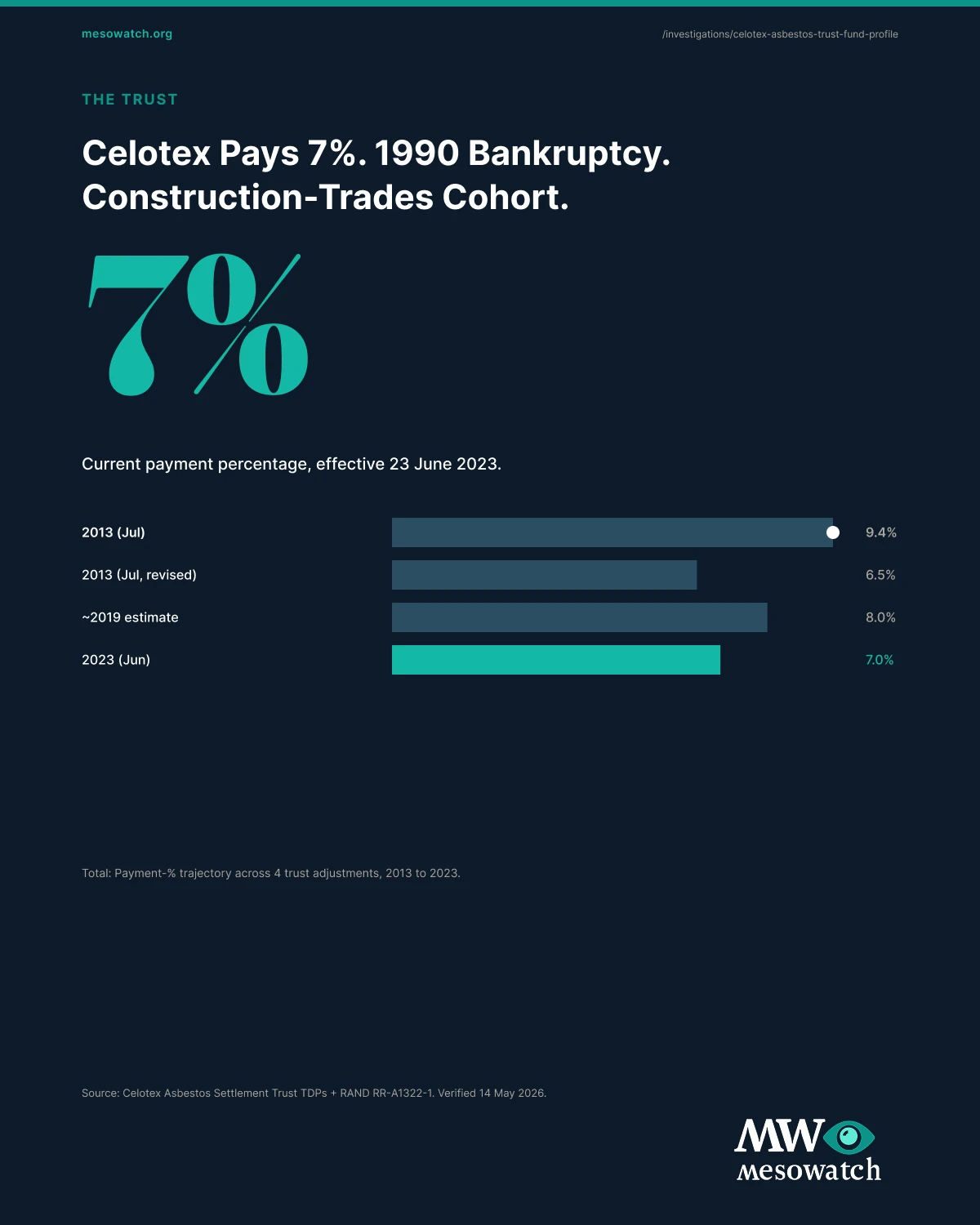
The Celotex Asbestos Settlement Trust has paid 7% of scheduled tier values since 23 June 2023, when the trustee issued a Notice of Payment Percentage Adjustment reducing the rate from 8% to 7%. A claim approved at Level VIII for mesothelioma at scheduled value $X receives $X × 0.07.
The trust covers personal injury claims from products manufactured by Celotex Corporation and its wholly owned subsidiary Carey Canada Inc. Both companies filed joint Chapter 11 petitions in the United States Bankruptcy Court for the Middle District of Florida on 12 October 1990.
The trust was created 1 February 1998 under 11 USC section 524(g), following the Bankruptcy Court’s 6 December 1996 confirmation of the Second Amended Joint Plan of Reorganization. This is the profile.
How 524(g) and the 1990 Filing Built This Trust
The Celotex case is one of the canonical 524(g) outcomes Congress was looking at when it wrote the statute in 1994. The 1990 joint Chapter 11 filing landed at the peak of asbestos personal-injury litigation, before Congress had built a trust mechanism into the Bankruptcy Code.
Section 524(g) was added in 1994 to give debtor companies a structured way to channel current and future asbestos claims into a trust funded by the reorganization estate.
The Celotex reorganization carried two corporate layers. Celotex Corporation was a Delaware corporation reincorporated in 1964, manufacturing roofing and building products.
Hillsborough Holdings Corporation was the post-1987 leveraged-buyout entity that took ownership of Celotex stock and is now known as Walter Industries Inc. The bankruptcy proceedings ran in parallel under both case styles in the Middle District of Florida.
The trust that emerged was structured for a long claim flow. Mesothelioma has a 20 to 50 year latency between asbestos exposure and diagnosis.
Workers exposed to Celotex products in the 1960s and 1970s, the peak years of US asbestos use, are still being diagnosed today. The trust has paid claims continuously since 1998.
The Supreme Court visited the Celotex case in 1995, before the trust was established.
Celotex Corp v Edwards ruled on the scope of bankruptcy court jurisdiction over related-to proceedings, standing for the proposition that the Bankruptcy Court’s reach extended to disputes that could affect the debtor’s estate.
Celotex and Carey Canada filed petitions under chapter 11 of the Bankruptcy Code on October 12, 1990.
See the asbestos trust funds compensation overview for the broader 524(g) system, and the 2026 trust fund payouts coverage for recent payout patterns.
Companion profiles cover the Owens Corning Fibreboard trust and the Vanderbilt Minerals talc trust.
See also the ongoing J&J talc bankruptcy track.
What Celotex and Carey Canada Manufactured
The product portfolio drives the exposure cohort. Celotex Corporation made building products across four categories:
- Built-up roofing systems with asbestos felt
- Sprayed acoustical surfaces and ceiling materials
- Spray-applied fireproofing for structural steel
- Insulation for commercial and industrial applications
Carey Canada operated upstream. The Celotex trust’s own history describes Carey Canada as “formerly engaged in the mining, milling and processing of asbestos fiber.”
The Minnesota Supreme Court’s asbestos-property decision in 80 South Eighth Street Limited Partnership v Carey-Canada Inc, 486 N.W.2d 393 (Minn. 1992), traces the asbestos fireproofing in the IDS Center in Minneapolis, constructed in 1972. The court’s opinion centers on the Monokote fireproofing made by W.R. Grace. Carey-Canada and Celotex made an earlier fireproofing, Firebar, applied to some floors, but both dropped out of the suit when they filed Chapter 11 in October 1990.
The product mix puts construction trades workers at the center of the exposure cohort:
- Insulators applying spray fireproofing on structural steel
- Roofers installing built-up roofing systems with asbestos felt
- Sheet metal workers cutting and fitting acoustical panels
- Drywallers and finishers working on ceiling systems
- Plasterers spraying acoustical finishes
- Demolition and renovation crews disturbing installed product
The exposure was concentrated during installation and during demolition or renovation when the products were disturbed.
See the construction workers asbestos profile, the boilermakers profile, and the drywall workers profile for the broader trades-by-trades exposure patterns.
Asbestos pipe insulation is documented separately.
The Disease Level Structure and the Payment Percentage Math
The Celotex Trust Distribution Procedures organizes claims into disease levels, each with a scheduled value. The trust’s public glossary defines a Scheduled Value as “the values established during bankruptcy proceedings for each disease category with similar injuries and exposure.”
The same glossary entry adds that these values “reflect the average tort litigation values and the amounts paid historically by Celotex and Carey Canada as compensatory damages.”
The published trust documents on celotextrust.com do not list the full disease level count or the per-tier scheduled dollar values in the public glossary or resources section. The complete Trust Distribution Procedures schedule is filed and accessed through the claim portal.
The tier hierarchy in trust-published materials runs from mesothelioma at the highest tier with the largest scheduled value, asbestos-related lung cancer below it, asbestosis with documented impairment lower still, and non-malignant pleural disease at the lowest tier.
Whatever the published scheduled value at a given tier, the actual payment to a claimant is that value multiplied by the trust’s current payment percentage. The math at 7% is straightforward: a scheduled value of $X produces a payment of $X × 0.07.
The Celotex payment-percentage trajectory in primary-source notices:
- 23 July 2013: 9.4% reduced to 6.5%, per the trust’s 2013 Notice of Payment Percentage Change to All Claimants and Counsel
- Date not surfaced: increase from 6.5% to 8% (the trust’s current public notices reference the 8% baseline immediately prior to June 2023 but do not document the intermediate change date)
- 23 June 2023: 8% reduced to 7%, per the trust’s 2023 Notice of Payment Percentage Adjustment
The payment percentage is set by the trustee based on the trust’s actuarial position: projected future claim volume, remaining assets, and reserves needed for future claimants.
KCIC’s annual asbestos litigation reports track payment-percentage changes across the major 524(g) trusts. Across the active system, current payment percentages range from low single digits at the most depleted trusts to roughly 25% at the better-funded trusts.
Effective June 23, 2023, the Trustee of the Celotex Asbestos Settlement Trust decreased the Payment Percentage from 8% to 7%.
What Goes Into a Celotex Claim
Filing a Celotex trust claim requires three categories of documentation: medical evidence of disease, exposure history showing contact with Celotex or Carey Canada products, and supporting documentation per the TDP requirements.
Medical evidence for a mesothelioma claim typically includes the pathology report confirming the diagnosis, treating physician records, and imaging studies. The TDP specifies the required documentation at each disease level.
Mesothelioma claims carry the most stringent diagnostic requirements because the disease’s severity and the corresponding scheduled value are highest at that tier.
Asbestos-related lung cancer claims require medical evidence of asbestos exposure plus the lung cancer diagnosis. Asbestosis claims require radiographic evidence and pulmonary function testing meeting specific criteria.
Exposure history connects the claimant to the trust’s covered products. For Celotex, the exposure history identifies which Celotex or Carey Canada products were present at the claimant’s worksites, when, and through what work activities the claimant was exposed.
A construction worker who installed Celotex roofing on commercial buildings in the 1960s and 1970s, for example, documents the worksites, time periods, products handled, and specific work activities such as cutting felt, installing built-up systems, or removing existing roofing during replacement.
Supporting documentation can include:
- Union work records and dispatch slips
- Employment records from contractors and subcontractors
- Social Security earnings records showing employer history
- Military service records for veterans with construction-trade ratings
- Co-worker witness statements identifying products at worksites
The strength of the exposure history affects whether a claim qualifies for expedited review or individual review under the TDP. Most claims are handled through expedited review when the documentation clearly meets the criteria for a specific disease level.
Individual review is available for claims that do not fit the expedited criteria but for which the claimant believes the trust should pay an individualized amount.
Multi-Trust Filing for the Construction Trades Cohort
The Celotex trust is one filing destination among many for construction-trades workers. A worker active in commercial and industrial construction during the 1960s and 1970s was typically exposed to products from multiple manufacturers across multiple worksites.
The exposure history often supports parallel claims with several 524(g) trusts.
The construction-trades multi-trust pattern commonly includes:
- Celotex Settlement Trust: roofing, insulation, fire protection, acoustical materials
- Owens Corning Fibreboard Asbestos PI Trust: pipe and equipment insulation (see the Owens Corning profile)
- Babcock and Wilcox Asbestos PI Trust: industrial and naval boiler insulation
- Combustion Engineering 524(g) Trust: industrial boiler insulation exposure
- Armstrong World Industries Asbestos PI Trust: ceiling tile and flooring
- WR Grace Asbestos PI Trust: vermiculite and chemical products
- Manville Personal Injury Trust: asbestos products from the largest pre-trust manufacturer
Claims proceed in parallel. Once an exposure history is developed with an attorney, claims are filed with each applicable trust and any solvent defendant in civil litigation.
The Government Accountability Office counted 60 asbestos personal injury trusts established since 1988, holding a combined total of over $36.8 billion in assets as of 2011. The exact figure varies by methodology and projection horizon.
The talc-track trusts run on a parallel arc.
The Vanderbilt Minerals bankruptcy talc trust and the J&J talc bankruptcy three-strikes record cover the cosmetic and industrial talc cohort.
That cohort is distinct from the construction-trades pattern Celotex anchors.
The Madison County asbestos filings docket shows where active civil cases land in parallel with trust filings.
Carey Canada, a wholly owned subsidiary of Celotex, was formerly engaged in the mining, milling and processing of asbestos fiber.
Filing Deadlines and Statute of Limitations
Trust claim deadlines generally follow the statute of limitations of the state where the claimant lives or where exposure occurred. For mesothelioma, most state statutes run from the date of diagnosis under the discovery rule, not the date of exposure. The exact deadline varies by state.
Filing earlier than the deadline matters for two reasons. First, trust claim review takes time. Filing close to a statutory deadline risks the claim being deemed untimely if the trust’s review process surfaces additional documentation requirements.
Second, payment percentages can be reduced by subsequent actuarial reviews. A claim approved at the current payment percentage will be paid at that rate even if a future reduction takes effect, but a claim still in review at the time of an adjustment may be paid at the lower rate.
The practical timeline for new mesothelioma diagnoses involves diagnosis confirmation, medical record assembly, exposure history development with an attorney, trust claim filing, trust review and approval, and payment.
The full process can take six months to a year or more depending on the trust’s processing volume and the completeness of the documentation package.
See the mesothelioma legal options overview for the broader framework that integrates trust claims with civil litigation against solvent defendants. The asbestos trust funds compensation guide maps the active 524(g) system at a glance.
What This Profile Anchors
The Celotex profile is one of three trust-fund pieces in the construction-trades cohort coverage.
The Owens Corning Fibreboard Asbestos PI Trust profile covers the pipe and equipment insulation track.
The Vanderbilt Minerals talc trust profile covers the industrial talc track that crosses into cosmetic-talc litigation.
Together with the J&J talc bankruptcy three-strikes investigation, they map the active trust system that handles asbestos and asbestos-talc personal-injury claims today.
Each profile follows the same template: bankruptcy filing date, trust establishment date, current payment percentage, covered product line, disease-level structure, and claim-filing process.
The goal is for people with mesothelioma and their families to be able to identify which trusts apply to a specific exposure history.
The trusts are public entities operating under court-approved Trust Distribution Procedures. Their Notices of Payment Percentage Adjustment, annual financial reports, and TDP filings are public documents.
The information needed to evaluate trust claim eligibility exists. What is typically missing is the structured presentation of how the trusts work, and how to connect a personal exposure history to the trust system.
That is what these profiles are for.
Reader Q&A
Frequently Asked Questions
What is the current Celotex trust payment percentage?
Seven percent. The Trustee of the Celotex Asbestos Settlement Trust decreased the payment percentage from 8% to 7% effective 23 June 2023, per the trust's published Notice of Payment Percentage Adjustment. The payment percentage is the share of each scheduled tier value that the trust actually pays. A claim approved at a Level VIII scheduled value of $X receives $X multiplied by 0.07. The percentage is reviewed periodically and can be adjusted up or down based on the trust's actuarial position.
When did Celotex file for Chapter 11 and what was the case style?
Celotex Corporation and Carey Canada Inc filed joint Chapter 11 petitions in the United States Bankruptcy Court for the Middle District of Florida, Tampa Division, on 12 October 1990. The bankruptcy court's case docket lists the proceeding as In re The Celotex Corporation, Case No. 90-10016-8G1 (also referenced as 8:90-bk-10016). The broader corporate reorganization that captured the Celotex case was styled In re Hillsborough Holdings Corporation, the post-1987 leveraged buyout entity that held Celotex stock and is now known as Walter Industries Inc.
What is Carey Canada and what does the trust say about its products?
Carey Canada Inc was a wholly owned subsidiary of Celotex Corporation. The Celotex Asbestos Settlement Trust's own history describes Carey Canada as 'formerly engaged in the mining, milling and processing of asbestos fiber.' The trust covers personal injury claims arising from Carey Canada products on the same footing as Celotex products. In 80 South Eighth Street Limited Partnership v Carey-Canada Inc, 486 N.W.2d 393 (Minn. 1992), the Minnesota Supreme Court reviewed asbestos fireproofing in the IDS Center; the fireproofing at issue was Monokote made by W.R. Grace, while Carey-Canada and Celotex made an earlier fireproofing called Firebar and dropped out of the case after their 1990 Chapter 11 filing.
When was the Celotex trust established and under what authority?
The Celotex Asbestos Settlement Trust was established on 1 February 1998 pursuant to 11 USC section 524(g), following the United States Bankruptcy Court for the Middle District of Florida's 6 December 1996 confirmation of the Debtors' Second Amended Joint Plan of Reorganization. Section 524(g) was added to the Bankruptcy Code by Congress in 1994 to give debtor companies a structured way to channel current and future asbestos personal injury claims into a trust funded by the reorganized estate.
Who can file a claim with the Celotex trust?
People diagnosed with mesothelioma, asbestos-related lung cancer, asbestosis, pleural disease, or other asbestos-related conditions can file with the Celotex trust if they have documented exposure to Celotex or Carey Canada products. Common exposure pathways include direct work with Celotex roofing, insulation, fire protection materials, and acoustical materials, as well as bystander exposure at construction sites. Family members exposed through household contact with workers' clothing have also brought claims under the trust's exposure categories. The Trust Distribution Procedures specifies the medical and exposure documentation required for each disease level.
Can someone file claims with multiple asbestos trusts at the same time?
Yes. The Celotex trust is one of more than 60 active 524(g) asbestos personal injury trusts. Construction-trades workers exposed across multiple worksites and product lines may be eligible to file with additional trusts depending on the documented exposure history, including the Owens Corning Fibreboard Asbestos Personal Injury Trust, the Babcock and Wilcox Asbestos Personal Injury Trust, the Armstrong World Industries Asbestos Personal Injury Trust, the Combustion Engineering 524(g) Asbestos PI Trust, the WR Grace Asbestos Personal Injury Trust, and others. An attorney who handles asbestos personal injury cases can identify which trusts apply to a specific exposure history.
How are payment percentages set, and have they changed over time?
Trust payment percentages are set by the trustee based on the trust's actuarial position: projected future claim volume, remaining assets, and reserves needed for future claimants. The Celotex trust's documented payment-percentage trajectory in primary-source notices: a reduction from 9.4% to 6.5% effective 23 July 2013, then an increase to 8% (date not surfaced in the trust's current public notices), then the reduction from 8% to 7% effective 23 June 2023. The KCIC asbestos annual reports and the trust's own Notices of Payment Percentage Adjustment publish each change.
What is the deadline to file a Celotex trust claim?
Trust claim deadlines generally follow the statute of limitations of the state where the claimant lives or where the exposure occurred. For mesothelioma, most state statutes run from the date of diagnosis under the discovery rule, not the date of exposure. The Celotex Trust Distribution Procedures includes specific filing deadlines for different claim types. Filing earlier than the deadline is preferred because trust claim review takes time and because subsequent actuarial reviews can reduce the payment percentage applied to a claim.

The full the celotex asbestos trust pays 7% report, in one image.
Every claim sources to a primary government regulator or named investigative outlet. The composite is free to embed with credit. No modification of the image.
Press inquiries: editorial@mesowatch.org (MesoWatch Editorial Team)
Want to reach the desk, request the dataset, or subscribe to data drops? Jump to the newsroom