One Illinois County Holds 42% of America's Mesothelioma Filings. A 1995 Court Order Explains How.
Madison County's asbestos docket is 92% mesothelioma and holds 42% of all US meso filings. A 1995 standing order auto-expedites every mesothelioma case.


Why Madison County: A 1995 Standing Order That Auto-Expedites Every Mesothelioma Case

Madison County, Illinois leads US asbestos litigation, and the reason is not its location. It is a court order.
The explanation is mechanical and primary-verifiable: the Third Judicial Circuit has run its entire asbestos docket under a single Standing Case Management Order since November 17, 1995, last revised September 5, 2024, and that order guarantees any plaintiff with a mesothelioma diagnosis an automatic expedited trial setting.
That one rule, applied for three decades, is why this county’s docket is 92% mesothelioma, and why those 809 mesothelioma filings amount to 42% of every mesothelioma case filed in the entire United States in 2024.
The Mechanism: One Order, One Judge, One Fast Lane
The Madison concentration is administered, not accidental. The Third Judicial Circuit’s Standing Case Management Order Governing the Asbestos Docket, originally entered November 17, 1995 and carried forward through a revision dated September 5, 2024 and signed by Chief Circuit Judge Stephen Stobbs and Associate Judge Andrew Carruthers, creates the office of Presiding Asbestos Judge with control of the entire asbestos docket.
The order’s load-bearing provision is the expedited-setting rule: a diagnosis of mesothelioma qualifies a case for an expedited trial setting, with an age preference. Mesothelioma is the highest-value disease category in asbestos litigation. A venue that guarantees it the fastest path to trial is a venue that the firms handling those cases will route them to.
Illinois venue law is the second half of the mechanism. Under 735 ILCS 5/2-101 and 735 ILCS 5/2-103, an action may be filed where a defendant has its principal place of business or where the tort occurred. National asbestos defendants have Illinois business contacts, so an out-of-state plaintiff can file in Madison if a named defendant sold products into Illinois. The standing order makes Madison attractive; the venue statute makes it reachable.
Madison County filings are mostly (92%) mesothelioma cases. The 809 mesothelioma lawsuits filed there equate to 42% of all mesothelioma lawsuits filed nationally in 2024.
The Filing Numbers
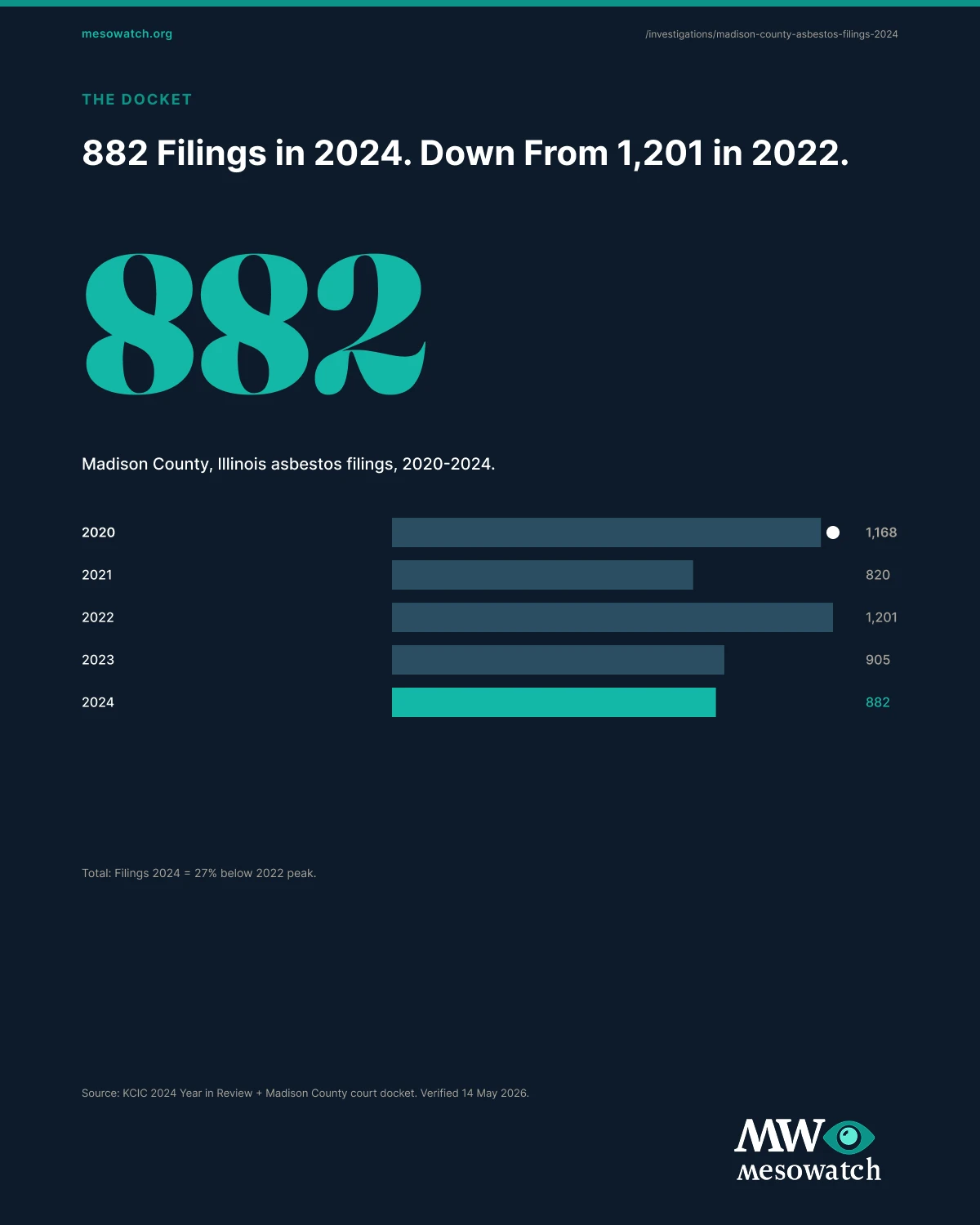
Madison’s filing volume has declined steadily even as it held the national lead. Per the KCIC report, Madison recorded 979 filings in 2022, 909 in 2023, and 882 in 2024.
Madison was rank 1 nationally every one of those years. In 2024 its 882 filings were 22% of the national total of 3,931, and its 809 mesothelioma filings were rank 1 and up 2.4% year over year even as national mesothelioma filings fell 1.7%. St. Clair County, the adjacent Illinois venue, ranked second nationally with 820, so the two counties together held about 43% of all US asbestos filings.
The Firm Side of the Mechanism
The standing order pulls; a small set of firms push. Per the KCIC 2024 firm table, the national plaintiff bar is highly concentrated, and the firms that file most of the country’s mesothelioma cases concentrate them in Madison.
The Gori Law Firm was the rank-1 US filer overall, 788 cases, about one in five US asbestos suits, and is the Madison local anchor. Simmons Hanly Conroy was the rank-1 US mesothelioma filer at 381, the majority filed in Madison County. KCIC attributes Madison’s 2024 mesothelioma increase mostly to Simmons Hanly Conroy and Maune Raichle Hartley French and Mudd. The expedited-setting order is the reason those filings have a destination; the firm concentration is the reason there are so many of them to route.
What Limits It
The venue is not unbounded, and the limit is a named Illinois Supreme Court case. In Fennell v. Illinois Central Railroad Co., 2012 IL 113812, decided December 28, 2012, the Illinois Supreme Court held that a trial court abused its discretion in denying an interstate forum non conveniens motion where a Mississippi plaintiff’s work and exposure occurred outside Illinois, and that an out-of-state plaintiff’s choice of an Illinois forum is entitled to far less deference.
Fennell is the controlling Illinois limit on out-of-state forum selection in this docket, the one named case that constrains how much deference an out-of-state plaintiff’s choice of an Illinois forum receives.
A Closing Thesis
Madison County’s lead is the most explainable number in US asbestos litigation, once you stop treating it as geography. A 1995 standing order, still administered by a single Presiding Asbestos Judge, guarantees mesothelioma plaintiffs the fastest trial in the country. Illinois venue law lets out-of-state plaintiffs reach that courtroom. The handful of firms that file most of the nation’s mesothelioma cases send them there. The result is a single county that is 92% mesothelioma and holds 42% of every US mesothelioma filing.
The national venue-migration investigation carries the country-wide concentration and the year-over-year movement; this report carries the Madison mechanism that the national table cannot, by itself, explain.
Corrections, 2026-05-17. (1) An earlier version carried a ten-year Madison filing trend with a 2020 peak of 1,168 and 1,201 filings in 2022; those figures are not in the cited KCIC report. Madison’s actual recent series is 979 (2022), 909 (2023), and 882 (2024). (2) An earlier version cited a statute, 735 ILCS 5/2-101.5, that does not exist. (3) An earlier version miscited the Fennell venue precedent as a 2018 Seventh Circuit case; it is a 2012 Illinois Supreme Court decision (Fennell v. Illinois Central Railroad Co., 2012 IL 113812). (4) An earlier version asserted 2025 mid-year jurisdiction figures with no primary citation; those were removed, and the 2025 national picture is left to the companion venue-migration investigation that sources it.
Reader Q&A
Frequently Asked Questions
Why does Madison County lead US asbestos litigation?
Per the Third Judicial Circuit's Standing Case Management Order, in force since November 17, 1995 and last revised September 5, 2024, the entire Madison County asbestos docket is run by a single Presiding Asbestos Judge, and any plaintiff with a mesothelioma diagnosis automatically qualifies for an expedited trial setting. Combined with Illinois venue law (735 ILCS 5/2-101 and 735 ILCS 5/2-103) that lets an out-of-state plaintiff file where a defendant has Illinois business contacts, this produces a single county whose docket is 92% mesothelioma and which absorbed 42% of all US mesothelioma filings in 2024. It is a court-administration mechanism, not a geographic accident.
How many asbestos cases did Madison County receive recently?
Per KCIC's 2024 Asbestos Litigation Year in Review, Madison County received 979 filings in 2022, 909 in 2023, and 882 in 2024, the rank-1 jurisdiction every year and 22% of the 2024 national total of 3,931. St. Clair County, Illinois ranked second nationally in 2024 with 820 filings, so the two adjacent Illinois counties together held about 43% of all US asbestos filings.
What is the 'Presiding Asbestos Judge' and the expedited-setting rule?
The Third Judicial Circuit Standing Case Management Order creates the office of Presiding Asbestos Judge, who controls the asbestos docket for Madison County. The September 5, 2024 revision is signed by Chief Circuit Judge Stephen Stobbs and Associate Judge Andrew Carruthers. The order states that a diagnosis of mesothelioma qualifies a case for an expedited trial setting and applies an age preference (age 67). It also sets a structured annual trial-setting cap. The practical effect is that the disease category with the highest case value, mesothelioma, is guaranteed the fastest path to trial in this venue.
Which firms file the mesothelioma cases in Madison County?
Per the KCIC 2024 Year in Review, the national plaintiff-firm docket is highly concentrated, and the firms that file most of the country's mesothelioma cases route them into Madison. The Gori Law Firm was the rank-1 US filer overall (788 cases, about 20% of all US asbestos suits) and is the local Madison anchor. Simmons Hanly Conroy was the rank-1 US mesothelioma filer (381), the majority of which were filed in Madison County. KCIC attributes Madison's 2024 mesothelioma increase mostly to Simmons Hanly Conroy and Maune Raichle Hartley French and Mudd.
Has the venue been challenged in court?
Yes. The Illinois Supreme Court's decision in Fennell v. Illinois Central Railroad Co., 2012 IL 113812 (decided December 28, 2012), held that an Illinois trial court abused its discretion in denying an interstate forum non conveniens motion where a Mississippi plaintiff's work and exposure occurred outside Illinois, and that an out-of-state plaintiff's choice of an Illinois forum receives far less deference. Fennell is the controlling Illinois limit on out-of-state forum selection.
Does filing in Madison County affect a mesothelioma case's value?
Venue affects settlement dynamics because defendants weigh trial risk in the filing jurisdiction, and Madison's expedited mesothelioma path and verdict history factor into that. But for an individual case, the primary value drivers are diagnosis type (pleural versus peritoneal), the strength and number of exposure sources, disease stage, and work and age history. Venue is one factor among several. An attorney who handles mesothelioma cases can assess whether Madison County is the appropriate venue for a specific exposure history. The companion national venue-migration investigation covers the country-wide concentration picture; this report covers the Madison mechanism itself.
How long does a mesothelioma lawsuit take?
Many mesothelioma lawsuits begin paying out in about 60 to 90 days, particularly when claims are resolved through settlements or asbestos trust funds. Multiple sources report that most people with mesothelioma see their cases largely resolved within about 12 to 18 months, although some lawsuits conclude faster and others take several years. Timelines often depend on factors like the strength of the evidence, the number of companies being sued, and whether the case settles or goes to trial. Statutes of limitations in most states range from 1 to 3 years after diagnosis or death, which strongly influences when a lawsuit can even begin.

The full why madison county report, in one image.
Every claim sources to a primary government regulator or named investigative outlet. The composite is free to embed with credit. No modification of the image.
Press inquiries: editorial@mesowatch.org (MesoWatch Editorial Team)
Want to reach the desk, request the dataset, or subscribe to data drops? Jump to the newsroom