Three J&J Talc Bankruptcies Failed in 41 Months. The 67,000 Cases Now Going to Trial.
J&J ran the Texas Two-Step three times in 41 months. Three federal judges rejected it. The dismissal of Red River Talc forces the MDL pipeline open.

Three federal courts have now rejected Johnson & Johnson’s Texas Two-Step talc bankruptcy strategy. The March 31, 2025 dismissal of Red River Talc LLC sends approximately 67,000 pending cases in MDL 2738 back to the trial pipeline.
U.S. Bankruptcy Judge Christopher M. Lopez issued a 57-page memorandum decision denying confirmation of the prepackaged plan that would have funded a $9 billion trust to resolve current and future ovarian and gynecological cancer talc claims.
The pattern is now visible across three filings and three jurisdictions. Each filing failed for substantively similar reasons. The debtor entity lacked genuine financial distress. The plan structure tried to extend bankruptcy protections to non-debtor parent and affiliate companies.
The Supreme Court’s June 2024 decision in Harrington v. Purdue Pharma narrowed the legal space for the third-party releases that were a structural feature of all three filings.
For people with mesothelioma and for ovarian cancer claimants whose cases were paused for years through three bankruptcy attempts, the dismissal returns those cases to active litigation.
Mesothelioma has no cure and an average survival of 12 to 21 months from diagnosis. The procedural delay has real consequences for the people whose claims this strategy was designed to channel.
The Three Filings
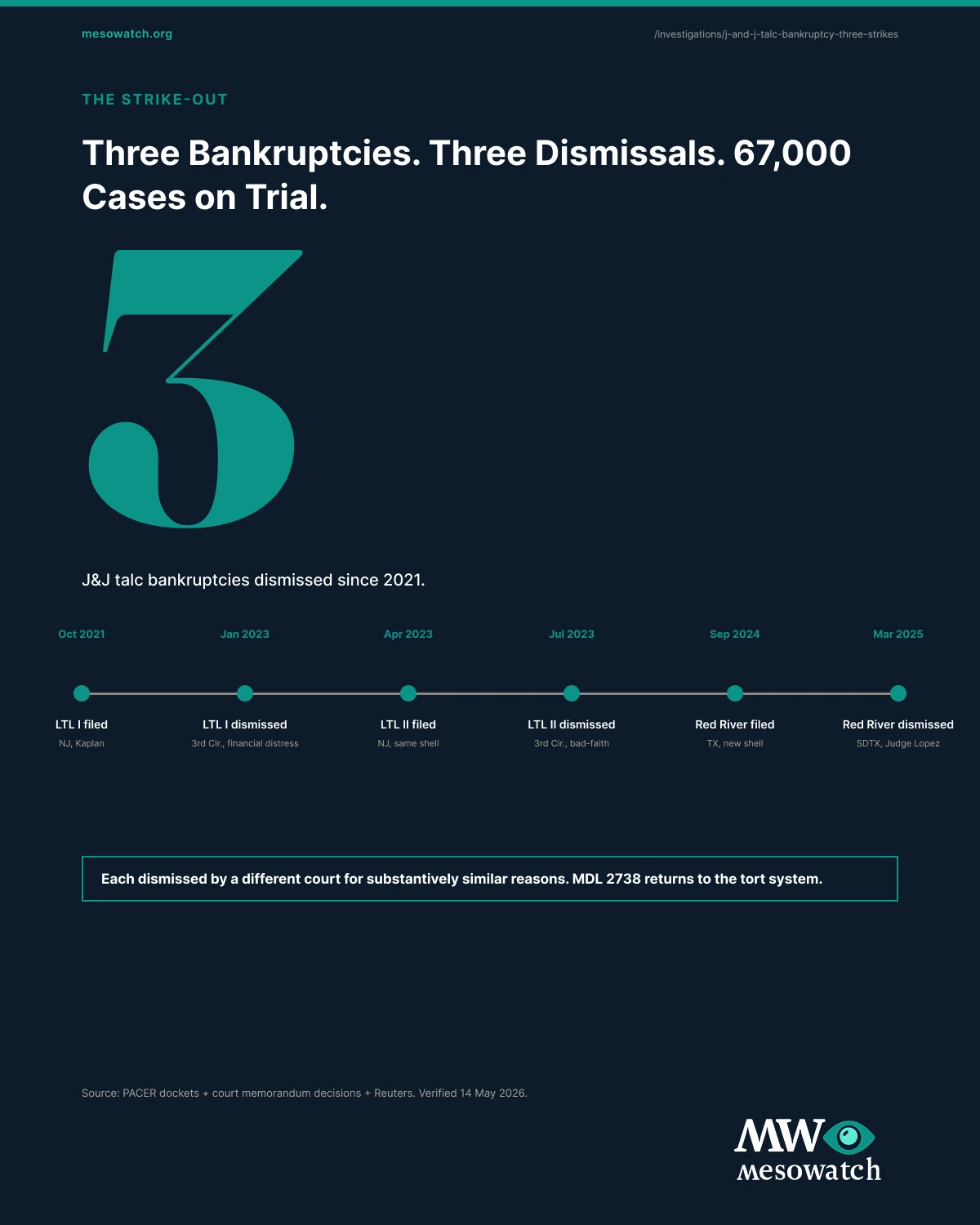
Three filings, three jurisdictions, three dismissals across 41 months. The legal architecture differed in details. The structural defect did not.
LTL Management I: Filed October 2021, Dismissed January 2023
The first filing came in October 2021. J&J used Texas’s divisive merger statute to split its consumer-products subsidiary into two entities.
The new entity, LTL Management LLC, absorbed all current and future talc liabilities while operating assets stayed with the J&J parent.
LTL Management filed Chapter 11 in the Western District of North Carolina, where the case was promptly transferred to the District of New Jersey.
The Third Circuit Court of Appeals dismissed it on January 30, 2023 in Case No. 22-2003. The court held that good faith under 11 U.S.C. Section 1112(b) requires actual financial distress, which a newly created liability-only subsidiary cannot show.
LTL Management II: Filed April 2023, Dismissed July 2023
The second filing came on April 4, 2023. J&J refiled LTL Management Chapter 11 in the District of New Jersey, this time with a larger settlement structure attached.
The bankruptcy court dismissed it again in July 2023, and the Third Circuit affirmed the dismissal on June 25, 2024. Same reasoning, same outcome.
Red River Talc: Filed September 2024, Dismissed March 2025
The third filing took the case south. Red River Talc LLC, another J&J-created entity holding only talc liabilities, filed Chapter 11 on September 20, 2024 in the U.S. Bankruptcy Court for the Southern District of Texas as Case No. 24-90505.
The Houston filing chose a different circuit and a court with a heavily-trafficked complex bankruptcy bar.
The legal architecture differed in details but rested on the same structural premise: a liability-only debtor proposing a plan that would extinguish current and future claims against non-debtor parents and affiliates through a court-ordered trust.
After a two-week confirmation trial in February 2025, Judge Christopher M. Lopez issued his 57-page memorandum decision on March 31, 2025.
There is no real company or jobs to save here. This case is about whether voters will accept a deal. While the Court’s decision is not an easy one, it is the right one.
The Lopez Ruling: Three Grounds for Dismissal
Judge Lopez identified three principal grounds. Each ground would independently have supported dismissal. Together they form a doctrinal wall against the Red River structure.
Ground One: Voting and Solicitation Irregularities
A prepackaged Chapter 11 plan requires solicitation of votes from impaired creditors before the petition is filed. Section 524(g) of the Bankruptcy Code requires affirmative votes from 75% of the relevant claimants for an asbestos-related channeling injunction to issue.
The court found defects across the voting process. Thousands of claimants received what Judge Lopez described as an “unreasonably short” voting window. Plaintiff law firms cast votes on behalf of clients without direct authorization or a power of attorney.
In one instance, thousands of votes against the plan were switched to votes in favor in a manner that did not comply with the tabulation procedures set out in the solicitation materials.
The result, in the court’s words, was that “the entire vote cannot be certified” and the “Court cannot find that the class of talc claimants voted to accept the plan.” Without certified Section 524(g) vote, the channeling injunction could not issue and the plan could not be confirmed.
Ground Two: Overbroad Channeling Injunction
A Section 524(g) channeling injunction may be used only to enjoin actions against third parties that are derivative of claims against the debtor.
The court found that Red River’s proposed injunction reached far beyond that limit, shielding more than 700 non-debtor entities for potential liabilities wholly separate from Red River’s acts and not dependent on Red River’s liability.
The court held that the plan was not feasible without those non-debtor parties inside the injunction and therefore could not be confirmed in the form proposed.
Ground Three: Impermissible Nonconsensual Third-Party Releases
The Supreme Court’s 2024 decision in Harrington v. Purdue Pharma held that the Bankruptcy Code does not authorize a release and injunction that, as part of a Chapter 11 plan, seeks to discharge claims against a non-debtor without the consent of affected claimants.
Red River argued that Purdue Pharma did not apply because its plan was a “full pay” plan that satisfied the claims it released. Judge Lopez rejected the argument on two grounds.
First: “this is not a ‘full pay’ case,” because verdicts had been entered against J&J that exceeded the proposed payout.
Second: setting aside Purdue Pharma, the Fifth Circuit has stated “many times that nonconsensual third-party releases are not permissible.” Judge Lopez declined to create a “full pay” exception.
The Plaintiff-Side Trial Team
The Coalition of Counsel for Justice for Talc Claimants opposed the Red River plan through a two-week trial in Houston. Co-lead trial counsel was Bailey & Glasser founding partner Brian A. Glasser.
The trial team co-leads included:
- Brian A. Glasser, founding partner, Bailey & Glasser LLP (co-lead)
- David L. Selby, Mass Torts Practice Group Leader, Bailey & Glasser
- Katherine E. Charonko and Elizabeth L. Stryker, Bailey & Glasser
- Adam C. Silverstein, Melanie L. Cyganowski, and Sunni P. Beville, Otterbourg PC
- Nicholas R. Lawson and Avi Moshenberg, Lawson & Moshenberg PLLC
- Andy Birchfield and Leigh O’Dell, Beasley Allen
- Richard Golomb, Golomb Legal
The coalition included thousands of women injured by J&J’s talc products, some of whom died during the months before the confirmation trial. Law360 named the trial team “Legal Lions of the Week” the week after dismissal.
Judge Lopez did the right thing and followed the law. His opinion will be sustained on appeal.
What J&J Said It Will Do Next
The same day as the dismissal, Johnson & Johnson announced through Worldwide Vice President of Litigation Erik Haas that it will return to the tort system rather than appeal.
The press release was unambiguous. J&J said it had “no intent to settle or pay plaintiff lawyers on such meritless claims” and would reverse approximately $7 billion from amounts previously reserved for the bankruptcy resolution.
The company cited a record of 16 wins in 17 ovarian cancer cases tried over the prior 11 years.
In view of the learnings from the bankruptcy case, we are more confident than ever in our position in the tort system. We prevailed in 16 of 17 ovarian cases tried in the last 11 years and will devote our efforts to defeating these fake claims.
The bankruptcy approach had aimed to resolve all current and future claims through a single judicially-administered trust. The trial-system approach resolves cases one at a time, in dozens of state and federal courts, against thousands of individual claimants.
J&J argues the math favors them because of the trial-win record.
Plaintiffs argue the underlying Texas Two-Step strategy was always structurally improper, and the trial calendar will now test the strength of the underlying talc claims case by case.
The Cherie Craft mesothelioma verdict illustrates the variance in trial outcomes.
In December 2025 a state jury returned a $1.56 billion verdict against J&J, the largest single talc verdict on record, though much of that was punitive damages subject to constitutional caps on appeal.
A broader recap of the 2025 J&J trial calendar tracks the win-loss pattern in detail.
The MDL 2738 Pipeline
MDL 2738 returns to active pretrial proceedings after years of disruption. The case-count denominator depends on which docket is being measured.
MDL 2738 (In re: Johnson & Johnson Talcum Powder Products Marketing, Sales Practices, and Products Liability Litigation) is pending in the U.S. District Court for the District of New Jersey before U.S. District Judge Michael A. Shipp.
The MDL consolidates federal-court talc cases for pretrial proceedings, including bellwether trials that test theories and damages frameworks before remand to home districts.
The two denominators differ. The 67,000 figure is the MDL 2738 federal docket alone. The roughly 90,000 figure in Judge Lopez’s memorandum captured all current ovarian and gynecological cancer claims the Red River plan tried to channel, including state-court filings and future-claim categories.
Growth slowed during the Red River bankruptcy stay because new filings had been chilled by the prospect of channeled resolution. After the dismissal, the trackers report a renewed influx as plaintiffs moved cases from state-court venues to the MDL.
The pace and venue distribution depend in part on how state-court counterparts in Madison County, Illinois and other plaintiff-favored venues choose to handle their parallel dockets.
The contemporaneous Texas asbestos verdicts and settlements record shows the trial-side variance that now drives every defendant’s exposure calculus.
A related front opened on January 29, 2026, when the J&J Texas Two-Step fraud lawsuit was dismissed on procedural grounds, leaving the substantive merits questions to be resolved through individual trials.
Three Strikes and the Strategic Lesson
The takeaway from three failed filings is structural, not procedural. Two pillars of the J&J Texas Two-Step strategy are now gone.
The J&J implementation rested on two doctrinal assumptions. The first was that bankruptcy courts would accept that a newly created liability-only entity could file Chapter 11 in good faith. The Third Circuit’s 2023 LTL Management opinion rejected that.
The second was that bankruptcy courts could grant nonconsensual third-party releases extinguishing parent and affiliate liability. The Supreme Court’s 2024 Purdue Pharma decision rejected that.
Both pillars are gone. Future asbestos and talc defendants exploring bankruptcy as a liability-resolution path face a substantially narrower legal corridor.
The Vanderbilt Minerals Chapter 11 filing in February 2026 tests a different model: an operating debtor seeking a Section 524(g) trust process designed to channel asbestos liability through statutorily-authorized means rather than nonconsensual releases.
Existing trust frameworks offer the doctrinal contrast. The Owens Corning asbestos trust profile documents a Section 524(g) trust that survived because it sat inside the statutory boundary the Red River plan crossed.
For people who have filed talc claims, the procedural framing is now clear. The cases will be tried in the MDL and in state courts. The settlement structure that the Red River plan would have imposed is gone.
The next 24 months of bellwether outcomes in MDL 2738 will substantially shape the size and pace of any future global resolution. People considering legal options can review the attorney-selection guide for talc and mesothelioma claims before contacting counsel.
Reader Q&A
Frequently Asked Questions
What is the Texas Two-Step bankruptcy strategy?
The Texas Two-Step is a corporate restructuring technique that uses Texas's divisive merger statute to split a company into two entities. The original company moves all of its asbestos or talc liabilities into one new subsidiary while assets and operations stay with the other. The liability-loaded subsidiary then files Chapter 11 bankruptcy, attempting to channel all current and future claims into a trust funded by a parent-company settlement. Plaintiffs argue this misuses the Bankruptcy Code because the new subsidiary has no operating business and is not in genuine financial distress. The Third Circuit Court of Appeals adopted that view when it dismissed J&J's first LTL Management filing on January 30, 2023, holding that good faith under 11 U.S.C. Section 1112(b) requires actual financial distress. Read the J&J Texas Two-Step background for more detail.
How many Texas Two-Step bankruptcies has J&J filed for talc liability?
Johnson & Johnson has filed three. LTL Management LLC was filed in October 2021, originally in the Western District of North Carolina, then transferred to the District of New Jersey. The Third Circuit dismissed that filing on January 30, 2023. J&J refiled LTL Management Chapter 11 on April 4, 2023 in the District of New Jersey. The bankruptcy court dismissed it in July 2023, and the Third Circuit affirmed on June 25, 2024. The third attempt was Red River Talc LLC, filed September 20, 2024 in the Southern District of Texas as Case No. 24-90505. Judge Christopher M. Lopez denied confirmation and dismissed the case on March 31, 2025 in a 57-page memorandum decision.
Why did Judge Lopez dismiss the Red River Talc bankruptcy?
Judge Christopher M. Lopez issued a 57-page memorandum decision and order dated March 31, 2025 finding the prepackaged plan unconfirmable on three principal grounds. First, voting and solicitation irregularities, including an unreasonably short voting window for thousands of claimants and prepetition votes cast by plaintiff law firms without direct client authorization, meant the court could not certify the vote required under Section 524(g). Second, the plan's proposed channeling injunction was overbroad: it would have shielded more than 700 non-debtor entities for potential liabilities wholly separate from Red River's acts. Third, the plan's nonconsensual third-party releases ran afoul of the U.S. Supreme Court's 2024 decision in Harrington v. Purdue Pharma, which barred such releases absent explicit statutory authority. Judge Lopez declined to create a 'full pay' exception to the Purdue Pharma rule.
How much would the Red River Talc plan have paid talc claimants?
The prepackaged plan would have funded a trust at approximately $9 billion to resolve current and future ovarian and other gynecological cancer talc claims. Judge Lopez's memorandum decision identifies the figure as 'about $9 billion.' Some plaintiff-aligned sources rounded the figure to $10 billion to reflect a $1.1 billion fall 2024 plan increase, but the verified core trust funding from the court record was $9 billion. The plan was structured to channel all resolved and future ovarian cancer claims into the trust through nonconsensual third-party releases of J&J and affiliated entities. The releases were the legal mechanism Judge Lopez ultimately found impermissible under Purdue Pharma.
What happens to the 67,000 pending MDL 2738 cases now?
MDL 2738 (In re: Johnson & Johnson Talcum Powder Products Marketing, Sales Practices, and Products Liability Litigation) is pending in the U.S. District Court for the District of New Jersey before U.S. District Judge Michael A. Shipp. As of early 2026, multiple litigation trackers report the docket holding approximately 67,000 pending cases. After the Red River dismissal, J&J announced through Worldwide Vice President of Litigation Erik Haas that the company would return to the tort system to litigate cases on the merits rather than pursue a protracted appeal. J&J cited a record of 16 wins in 17 ovarian cancer cases tried over the prior 11 years and announced it would reverse approximately $7 billion previously reserved for the bankruptcy resolution. Trials will proceed in the MDL bellwether process and in parallel state-court dockets.
Did the Texas filing change the legal outcome compared to the New Jersey filings?
No. Each of the three filings was rejected by a different bankruptcy court for substantively similar reasons. The debtor entity lacked genuine financial distress, and the plan structure attempted to extend bankruptcy protections to non-debtor parent and affiliate companies. The Texas filing took advantage of Houston's bankruptcy bar and J&J's hope that a different circuit's good-faith standard might apply. Judge Lopez's March 31, 2025 ruling foreclosed that path. The Fifth Circuit had already stated, in Judge Lopez's words, 'many times that nonconsensual third-party releases are not permissible.' The Supreme Court's June 2024 Purdue Pharma decision further limited the third-party-release strategy that had been a structural feature of all three filings. The legal landscape now points away from bankruptcy as a talc-resolution vehicle and toward case-by-case litigation.
What is the Coalition of Counsel for Justice for Talc Claimants?
The Coalition of Counsel for Justice for Talc Claimants is a group of plaintiff law firms that opposed the Red River prepackaged plan during the two-week confirmation trial in Houston in February 2025. Co-lead trial counsel was Bailey & Glasser founding partner Brian A. Glasser. The trial team also included Bailey & Glasser Mass Torts Practice Group Leader David L. Selby, Otterbourg PC, Lawson & Moshenberg PLLC, Beasley Allen (Andy Birchfield, Leigh O'Dell), and Golomb Legal (Richard Golomb). After the dismissal, Brian Glasser stated that 'Judge Lopez did the right thing and followed the law' and predicted the ruling would be sustained on appeal.
How much will I get from Johnson and Johnson settlement?
No global Johnson & Johnson talcum powder settlement exists as of May 2026, with the latest $9 billion proposal rejected by a Texas bankruptcy judge in April 2025. There is no single, court-verified average payout for individual talc claims. Plaintiff-firm marketing pages publish estimates (commonly citing per-case figures in the $1 million range and overall settlement averages near $500,000), but those numbers are not drawn from a court record or a published dataset, so treat them as marketing estimates rather than verified amounts. What is on the public record are individual jury verdicts, which vary widely by case. An Illinois Cook County jury awarded $45 million in the mesothelioma case of Theresa Garcia in April 2024. A separate South Carolina jury awarded Michael Perry $63.4 million in August 2024, including $32.6 million in compensatory damages and $30 million in punitive damages. Verdicts can also be reduced on appeal, such as a California case dropping from $966 million to $16 million in March 2026. Factors such as injury severity, medical costs, lost wages, and case details influence amounts, settlement terms are often confidential, and companies settle without admitting liability.

The full j&j's 3 failed talc bankruptcies, 67,000 cases report, in one image.
Every claim sources to a primary government regulator or named investigative outlet. The composite is free to embed with credit. No modification of the image.
Press inquiries: editorial@mesowatch.org (MesoWatch Editorial Team)
Want to reach the desk, request the dataset, or subscribe to data drops? Jump to the newsroom