Vanderbilt Minerals Filed Chapter 11 With $117M in Talc Asbestos Liabilities. The 524(g) Trust Forming.
Vanderbilt Minerals LLC filed Chapter 11 February 16, 2026 with $117.2M in asbestos liabilities from industrial talc claims.

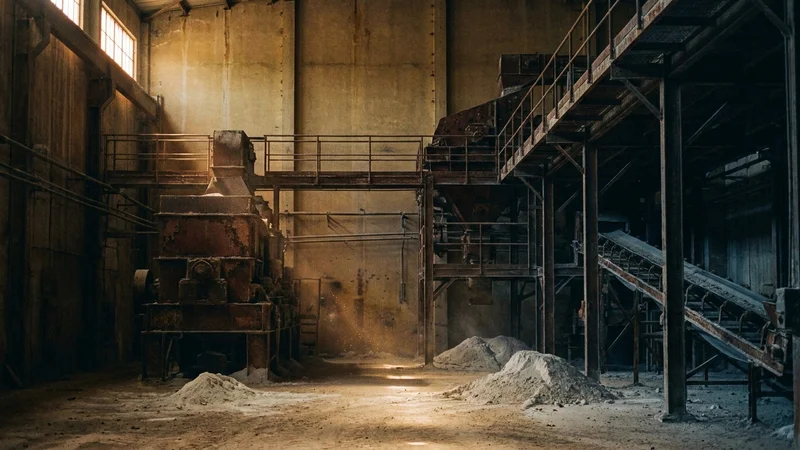
Vanderbilt Minerals LLC filed Chapter 11 bankruptcy in the U.S. Bankruptcy Court for the Northern District of New York on February 16, 2026 with approximately $117.2 million in accrued asbestos-related liabilities.
The case (No. 26-60110) is a different kind of talc bankruptcy than the three the courts have rejected from Johnson & Johnson, and the differences matter for how the case will proceed.
Vanderbilt’s industrial talc is not the cosmetic talcum powder that has driven J&J’s litigation. It is the mineral talc mined at the Gouverneur, New York deposit, used in floor tile, paint products, ceramics, plastics, and rubber manufacturing.
The asbestos exposure for affected workers came in factory and industrial settings rather than personal product use.
The bankruptcy structure also differs. Vanderbilt Minerals is the operating company itself filing under Chapter 11, not a liability-only subsidiary created through a Texas divisive merger.
The intended trust mechanism is Section 524(g) of the Bankruptcy Code, the standard asbestos channeling structure used since the 1980s. The Supreme Court’s 2024 Purdue Pharma decision did not affect Section 524(g) trusts because those trusts rest on different statutory authority.
What the Petition Discloses
Vanderbilt Minerals filed in the Northern District of New York with $117.2 million in accrued asbestos liabilities and total assets and total liabilities both reported in the $100 million to $500 million range.
The voluntary petition lists Vanderbilt Minerals LLC as debtor, headquartered in Norwalk, Connecticut, wholly owned by R.T. Vanderbilt Holding Company Inc. The case is being heard by Bankruptcy Judge Kinsella in NDNY.
The asbestos liabilities trace to industrial talc mesothelioma claims filed against Vanderbilt over decades.
Workers in ceramic factories, floor tile plants, paint production facilities, and other industrial settings where the Gouverneur talc was used as an additive have brought claims after developing pleural and peritoneal mesothelioma.
Settlement and verdict outcomes have varied. The Delaware Supreme Court reversed an October 2013 jury verdict of $2,864,583.33 in Galliher v. R.T. Vanderbilt Co. (No. 510, 2013) on appeal in 2014, remanding for a new trial on jury-instruction and evidentiary grounds.
The case captures the kind of facts that have driven Vanderbilt’s accumulating liability.
Vanderbilt’s filing is the latest in a wave of talc and mineral bankruptcies. Imerys Talc America filed Chapter 11 on February 13, 2019; Whittaker Clark & Daniels filed in April 2023; and J&J’s most recent attempt proposed a trust of roughly $9 billion. Vanderbilt’s own petition reports about $117.2 million in accrued asbestos liability, a fraction of J&J’s proposed figure, though the structural pattern across these cases is the same.
The Gouverneur Talc Story
The Gouverneur mine in St. Lawrence County, New York produced industrial talc with both tremolite and anthophyllite asbestos for the better part of a century, and the federal record on its mineral composition stretches back to 1975.
R.T. Vanderbilt took over the Gouverneur Talc deposit by the mid-20th century and ran it through its minerals business for decades.
The mine produced industrial talc, distinct from cosmetic talc in its end uses: ceramics, paint, vinyl flooring, plastics, rubber, roofing materials, and other industrial applications. The mineral composition of the deposit drove decades of scientific and regulatory attention.
A 1975 federal analysis by Walter McCrone Associates examined seven talc samples from the Vanderbilt mine and found tremolite asbestos in all of them.
The 1980 NIOSH report on occupational exposure to talc containing asbestos identified both tremolite and anthophyllite asbestos fibers in Vanderbilt industrial talc.
The presence of both regulated asbestos types in the same deposit complicated industrial-hygiene controls and created decades of disputed exposure litigation.
Definitely asbestiform by any definition of the word.
OSHA began requiring tremolite talc to be treated as asbestos in 1972, when the agency’s first asbestos standard for general industry took effect (29 CFR 1910.1001).
Workers handling Vanderbilt’s Gouverneur talc were entitled to the same exposure controls as workers handling any other form of asbestos.
How the 524(g) Trust Process Works
Section 524(g), enacted in 1994, authorizes asbestos liability trusts inside Chapter 11 reorganizations and is the path Vanderbilt’s case is on.
When a debtor has substantial asbestos liability, the plan can provide for a trust funded under the plan that takes responsibility for current and future asbestos claims.
The court issues a channeling injunction directing all current and future asbestos claims into the trust.
To qualify, the plan must meet statutory requirements. At least 75% of voting asbestos claimants must approve the plan. A future claims representative must be appointed and consulted on the trust’s design.
The plan must demonstrate that the trust will treat current and future claimants equitably. The court must find that the trust is in the best interests of the asbestos claimants and that the channeling injunction is necessary to enable a successful reorganization.
Section 524(g) trusts have been the standard structure for asbestos defendant bankruptcies since the late 1980s and the formalization in 1994. The trust system now holds roughly $30 billion in remaining assets across legacy defendants, including:
- Owens Corning Fibreboard (pipe and equipment insulation)
- Johns-Manville (insulation, building products)
- Babcock & Wilcox (industrial boilers)
- Celotex Asbestos Settlement Trust (roofing, fire protection, acoustical)
- Combustion Engineering (industrial boiler insulation)
- Eagle-Picher (insulation, industrial products)
- Armstrong World Industries (ceiling and floor)
Each trust operates under its own Trust Distribution Procedures (TDP) document, which sets disease-tier categories, claim documentation requirements, and payment percentages.
For people with mesothelioma whose exposure traces to Vanderbilt’s industrial talc, the trust process (if completed) would establish a defined claims pathway.
The TDP would specify medical evidence (typically a pathology-confirmed mesothelioma diagnosis), exposure documentation (work history with Vanderbilt-supplied talc), and payment matrices by disease tier.
Actual payment percentages depend on trust funding and claim volume. Many older asbestos trusts pay only 1% to 5% of scheduled values because of long-running claim demand, a pattern documented across the trust-fund payout data.
How This Differs From the Texas Two-Step
Vanderbilt’s filing avoids the two pitfalls that doomed each of J&J’s three Texas Two-Step bankruptcies: a liability-only subsidiary with no operating business, and nonconsensual third-party releases of non-debtor affiliates.
J&J created liability-only subsidiaries (LTL Management twice, then Red River Talc) using Texas’s divisive merger statute. Each subsidiary had no operating business and no genuine financial distress.
Third Circuit, January 2023: LTL Management dismissed for lack of good faith
The Third Circuit ruled that good faith under 11 U.S.C. Section 1112(b) requires actual financial distress, dooming the LTL Management filings. The opinion zeroed in on the absence of any real operating debtor behind the liability-only shell.
Good intentions, such as to protect the J&J brand or comprehensively resolve litigation, do not suffice alone. What counts to access the Bankruptcy Code’s safe harbor is to meet its intended purposes. Only a putative debtor in financial distress can do so.
Southern District of Texas, March 2025: Red River Talc dismissed on the same reasoning
Bankruptcy Judge Christopher M. Lopez applied the same Third Circuit reasoning to dismiss the third J&J subsidiary, Red River Talc, on March 31, 2025. Three Texas Two-Step filings, three dismissals on financial-distress grounds.
Supreme Court, June 2024: Purdue Pharma rejects nonconsensual non-debtor releases
J&J’s plans also relied on nonconsensual third-party releases of J&J and affiliated non-debtors. The June 2024 Supreme Court decision in Harrington v. Purdue Pharma rejected that structural move as outside the Bankruptcy Code’s authority absent an explicit statutory grant.
The bankruptcy code does not authorize a release and injunction that, as part of a plan of reorganization under Chapter 11, effectively seeks to discharge claims against a nondebtor without the consent of affected claimants.
That ruling narrowed the bankruptcy path J&J had attempted. It did not affect Section 524(g) trusts, which Congress wrote into the Bankruptcy Code with explicit authority for asbestos-specific channeling injunctions backed by future-claims-representative protection.
Vanderbilt’s filing avoids both pitfalls. The debtor is the operating company itself, not a liability-only subsidiary. The intended trust mechanism is Section 524(g), which carries the explicit statutory authority that nonconsensual third-party releases lack.
Whether the plan ultimately succeeds depends on the negotiation between the debtor, plaintiff committees, and the future claims representative. The legal architecture is on solid ground; the financial and political negotiations are the open questions.
What People With Mesothelioma Should Know
The automatic stay halted active litigation against Vanderbilt on February 16, 2026, and the court will set a bar date in the early months of the case for asbestos claims.
The stay under 11 U.S.C. Section 362 took effect on the petition date. Active state-court and federal-court asbestos litigation against Vanderbilt Minerals is now stayed. People with pending claims must seek relief through the bankruptcy court rather than continuing in their original venues.
The bar date is the deadline by which all asbestos claims must be filed in the bankruptcy claims process to participate in any future trust.
People with mesothelioma diagnoses tied to Vanderbilt industrial talc should preserve documentation of their work history (employer, dates, job duties, products encountered) and pathology confirmation of the mesothelioma diagnosis.
For people who worked in ceramic factories, floor tile manufacturing, paint plants, plastics or rubber production, and other industrial settings where Vanderbilt-supplied talc was present, preservation of work-history documentation matters now.
The 20 to 50 year latency from initial fiber inhalation means future diagnoses among the historic worker cohort are expected, and the future claims representative process is designed to protect future claimants under any approved plan.
Mesothelioma claims tied to Vanderbilt-era industrial talc sit inside a broader trust-fund and bankruptcy ecosystem that already covers multiple defendants. People with cross-cutting exposure histories may be eligible to file with:
- The Vanderbilt 524(g) trust once it is formed under the pending plan
- The Celotex Asbestos Settlement Trust (roofing, fire protection, acoustical)
- The Owens Corning Fibreboard Trust (pipe and equipment insulation)
- Other active asbestos trust funds, depending on the specific exposure record
An attorney who handles asbestos bankruptcy proceedings can identify which trusts apply to a given work history.
Reader Q&A
Frequently Asked Questions
Where and when did Vanderbilt Minerals file Chapter 11?
Vanderbilt Minerals LLC filed Chapter 11 bankruptcy on February 16, 2026 in the U.S. Bankruptcy Court for the Northern District of New York, Case No. 26-60110. The petition reported approximately $117.2 million in accrued asbestos-related liabilities from industrial talc and mineral product mesothelioma claims, with estimated total assets and total liabilities both in the $100 million to $500 million range. The debtor is wholly owned by R.T. Vanderbilt Holding Company Inc., headquartered in Norwalk, Connecticut.
What was Vanderbilt's industrial talc and where did it come from?
R.T. Vanderbilt operated the Gouverneur Talc mine in St. Lawrence County, New York, taking over the deposit by the mid-20th century and running it for decades through its minerals business. The mine produced industrial talc from St. Lawrence County, New York. The talc was used industrially in floor tile, paint products, ceramics, plastics, and rubber, not as cosmetic talcum powder. The Gouverneur mine's mineral composition has been the subject of decades of scientific and regulatory analysis. See products containing talc for more.
Did Vanderbilt's talc contain asbestos?
Yes. A 1975 federal analysis by Walter McCrone Associates found tremolite asbestos in seven talc samples from the Gouverneur mine and concluded that the asbestos mineral present was definitely asbestiform by any definition of the word. A 1980 NIOSH report identified both tremolite and anthophyllite asbestos fibers in Vanderbilt industrial talc. OSHA began requiring tremolite talc to be treated as asbestos in 1972. The mineral mix at the Gouverneur deposit included tremolite and anthophyllite, both regulated forms of asbestos.
What is a Section 524(g) trust and why does it matter for Vanderbilt's bankruptcy?
Section 524(g) of the U.S. Bankruptcy Code authorizes a specific kind of asbestos liability trust as part of a Chapter 11 plan. When the debtor has substantial asbestos liability and the plan meets statutory requirements (including approval by 75% of voting asbestos claimants and a guardian ad litem appointed for future claimants), the court can issue a channeling injunction directing all current and future asbestos claims into the trust. Section 524(g) trusts have been the standard structure for asbestos defendant bankruptcies since the 1980s. They differ structurally from the J&J Texas Two-Step approach because they involve actual operating debtors and statutorily authorized channeling rather than nonconsensual third-party releases of non-debtors. The Supreme Court's 2024 Purdue Pharma decision did not affect Section 524(g) trusts.
How does the Vanderbilt filing compare to J&J's three failed Texas Two-Step bankruptcies?
The structures differ significantly. J&J's three Texas Two-Step filings (LTL Management in October 2021, LTL Management again in April 2023, and Red River Talc in September 2024) all created liability-only subsidiaries that the courts found lacked good faith because the debtors had no operating business and no genuine financial distress. The Texas Two-Step plans also relied on nonconsensual third-party releases of non-debtor parents and affiliates, which the Supreme Court's Purdue Pharma decision rejected. Vanderbilt Minerals, by contrast, is the operating company itself filing under Chapter 11 with the intention of forming a Section 524(g) trust. The legal hurdles facing Vanderbilt's plan are different from the ones that defeated J&J's Texas Two-Step filings.
What does this mean for people with mesothelioma from Vanderbilt's industrial talc?
An automatic stay under 11 U.S.C. Section 362 took effect on the February 16, 2026 petition date, halting active litigation against Vanderbilt Minerals. People with pending claims must now seek relief through the bankruptcy court. The Section 524(g) process, if completed, will result in a trust funded under the plan that processes current and future claims under a defined matrix. People with mesothelioma may be eligible to file claims through the trust once it is established. In the meantime, claims can be filed in the bankruptcy claims process, which has its own deadlines (a bar date) the court will set in the early months of the case. Workers exposed to Vanderbilt industrial talc in ceramic, paint, plastics, and rubber manufacturing settings should preserve documentation of their work history.
How much is the asbestos lawsuit payout?
Asbestos lawsuit payouts vary widely, but multiple legal and advocacy sources report that settlements for people with mesothelioma often total about $1 million to $1.4 million on average, with some citing ranges up to $2 million. Individual asbestos trust fund claims usually pay roughly $10,000 to $150,000 each, and people with mesothelioma may qualify to file with multiple trusts, leading to combined trust compensation averages of around $300,000 to $400,000. Notable trial verdicts have reached tens of millions of dollars, and the largest reported asbestos verdict was $250 million for a person with mesothelioma who worked at U.S. Steel. Reported averages for asbestos-related lung cancer are often in a similar range, about $350,000 to $450,000 from trusts and over $1 million when all legal compensation is included. Actual payout amounts depend on factors such as the diagnosis, number of companies involved, work and exposure history, and whether a case settles or goes to trial.
How much money is left in the mesothelioma trust fund?
Estimates place more than $30 billion in assets across over 60 active mesothelioma asbestos trust funds as of 2026. This figure reflects assets available after more than $17 billion in prior payouts. People with mesothelioma typically receive total compensation of $300,000 to $400,000 across claims filed with multiple trusts. Individual trust payouts vary from $7,000 to $1.2 million based on scheduled values and payment percentages.

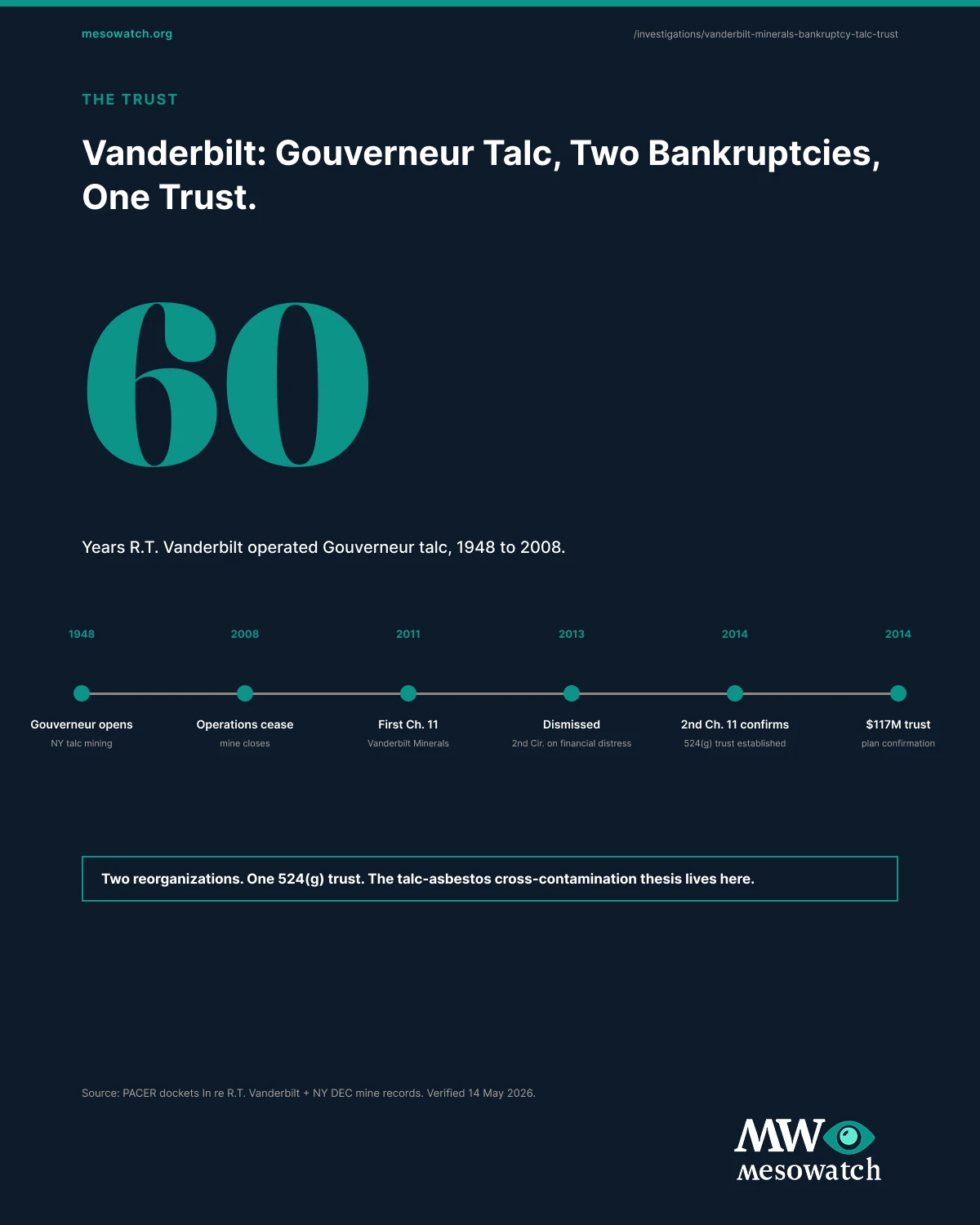
The full vanderbilt minerals report, in one image.
Every claim sources to a primary government regulator or named investigative outlet. The composite is free to embed with credit. No modification of the image.
Press inquiries: editorial@mesowatch.org (MesoWatch Editorial Team)
Want to reach the desk, request the dataset, or subscribe to data drops? Jump to the newsroom