The Owens Corning Trust Was Funded With Approximately $5 Billion at 2006 Formation. The Subfund Payment Percentages Are Now 4.7% and 3.7%.
Owens Corning filed Chapter 11 in 2000. The 524(g) trust formed October 2006 with two subfunds. Payment percentages now 4.7% (OC) and 3.7% (Fibreboard).


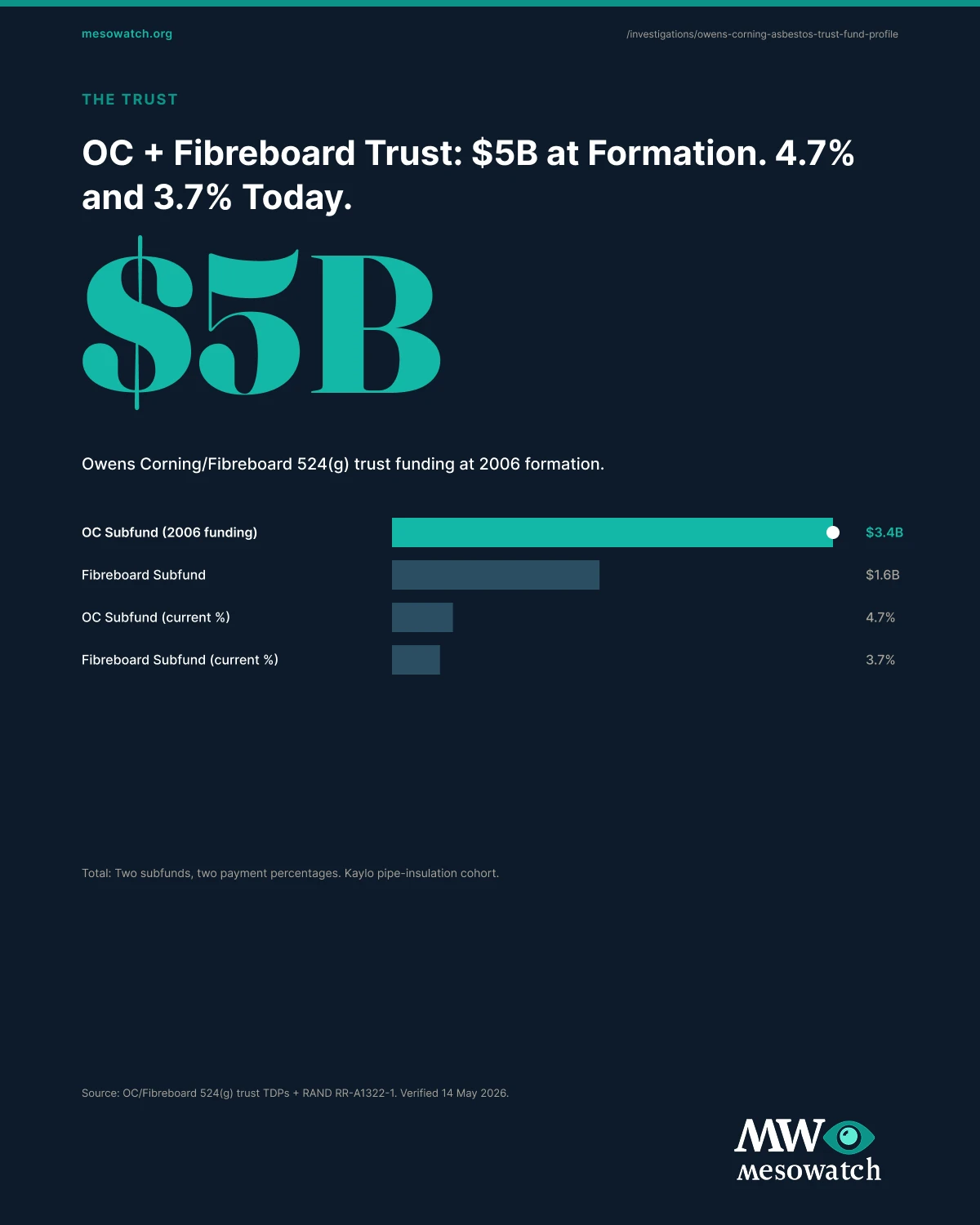
The Owens Corning/Fibreboard Asbestos Personal Injury Trust opened October 31, 2006 with approximately $5 billion in funding.
It resolves personal injury claims tied to Owens Corning Corporation and its subsidiary Fibreboard Corporation, including the Kaylo pipe insulation product line that Owens Corning acquired from Owens-Illinois in 1958.
The trust operates two accounting subfunds. The Owens Corning subfund processes claims tied to Owens Corning’s own products. The Fibreboard subfund processes claims tied to Fibreboard’s pre-acquisition liabilities.
This profile companions the Celotex Asbestos Trust profile and the Vanderbilt Minerals talc-trust case in the trust-funds cluster.
All three sit in the post-bankruptcy compensation system established under 11 U.S.C. § 524(g). The Johnson and Johnson talc bankruptcy proceedings represent the live frontier of the same statutory mechanism.
The current Owens Corning subfund payment percentage is 4.7% of scheduled value. The Fibreboard subfund payment percentage is 3.7%.
Mesothelioma sits at Level VIII in the Trust Distribution Procedures with an Owens Corning scheduled value of $215,000 and a Fibreboard scheduled value of $135,000.
The arithmetic of a mesothelioma payout against the Owens Corning subfund is direct: $215,000 multiplied by 0.047 equals approximately $10,105.
How the Owens Corning Trust Was Formed
Owens Corning filed Chapter 11 on October 5, 2000 in the District of Delaware. The case was docketed as In re Owens Corning, Case No. 00-3837. The Toledo, Ohio company manufactured fiberglass insulation, building materials, roofing products, and industrial composites.
The asbestos liability that drove the filing traced primarily to Kaylo pipe insulation.
By 2000, Owens Corning had been named as a defendant in tens of thousands of asbestos personal injury cases nationally.
The Chapter 11 filing was a coordinated reorganization to address the liability through a § 524(g) trust mechanism while continuing operations as a building-materials business.
The Plan of Reorganization, confirmed in 2006, established the Owens Corning/Fibreboard Asbestos Personal Injury Trust under 11 U.S.C. § 524(g) authorization. The provision was added to the U.S. Bankruptcy Code by the 1994 Bankruptcy Reform Act.
The statute provides a structured mechanism for resolving present and future asbestos personal injury claims through a court-supervised trust.
The trust assumed liability for all qualifying asbestos personal injury claims against Owens Corning and Fibreboard, releasing the reorganized company from ongoing litigation for those claims.
Owens Corning emerged from Chapter 11 on October 31, 2006, the same date the trust was established.
The trust is to assume the liabilities of a debtor which at the time of entry of the order for relief has been named as a defendant in personal injury, wrongful death, or property-damage actions seeking recovery for damages allegedly caused by the presence of, or exposure to, asbestos or asbestos-containing products.
The Fibreboard subfund operates as a separate accounting subdivision to address claims arising specifically from Fibreboard Corporation’s pre-acquisition asbestos products.
Fibreboard manufactured asbestos-containing insulation, acoustic ceiling tiles, and pipe coverings before Owens Corning acquired the company in 1997.
The Fibreboard subfund began processing claims on August 27, 2007 with approximately $1.56 billion in initial funding. The Owens Corning subfund began processing claims at trust formation in October 2006.
The Kaylo Product History
Kaylo asbestos pipe insulation was the principal product driving Owens Corning’s asbestos liability.
Owens-Illinois introduced Kaylo in the 1940s as a high-temperature thermal pipe insulation.
Owens Corning purchased the Kaylo product line from Owens-Illinois in 1958 and continued manufacturing through the 1960s. Production ceased in the early 1970s.
The product was widely specified for thermal insulation on hot piping across:
- Shipyards (naval and commercial)
- Refineries and petrochemical plants
- Power plants (steam-line and boiler-room piping)
- Chemical plants and paper mills
- Industrial-scale construction projects
Naval shipbuilders specified Kaylo for shipboard pipe insulation in the postwar era. Refinery and petrochemical operators specified it for process piping. Power plant operators specified it for steam-line and boiler-room runs.
The product’s wide adoption made Kaylo one of the most-cited asbestos pipe insulation products in shipyard and refinery mesothelioma cases.
The Houston Ship Channel exposure sites, the Beaumont-Port Arthur refinery corridor, and the Galveston-Texas City shipyard belt investigations document the broader Gulf Coast occupational exposure pattern.
Kaylo recurs across the exposure histories in all three corridors.
Owens Corning ceased Kaylo production in the early 1970s following emerging knowledge about asbestos health hazards. The OSHA general industry asbestos standard (29 CFR 1910.1001) took effect in 1972.
By that time, decades of Kaylo had already been installed in industrial facilities. The legacy product remained in service for decades after manufacture stopped.
Workers who installed, removed, or worked near Kaylo had significant occupational asbestos exposure. The trades affected included insulators, pipefitters, boilermakers, electricians, and laborers.
Removal during turnaround maintenance or facility demolition produced the highest airborne fiber concentrations.
The 8-Tier Disease Level Structure
The Owens Corning/Fibreboard Trust Distribution Procedures (Amended TDP, December 2, 2015) establish 8 disease levels with progressively higher scheduled values.
The structure follows the standard 524(g) trust pattern, separating asbestos-related diseases into tiers based on severity, medical documentation, and exposure history.
Each tier has specific medical criteria and exposure criteria a claimant must satisfy.
Level I: Other Asbestos Disease
Level I pays an Owens Corning scheduled value of $400 against the lowest-tier asbestos disease claim. It requires radiographic or pathological evidence of an asbestos-related condition plus documented asbestos exposure to Owens Corning or Fibreboard products.
Level II: Asbestosis or Pleural Disease
Level II pays an Owens Corning scheduled value of $8,000 for asbestosis or pleural disease. The tier covers asbestosis or bilateral pleural plaques or thickening, with pulmonary function test results meeting the threshold criteria specified in the TDP.
Level III: Asbestosis with Greater Impairment
Level III pays an Owens Corning scheduled value of $19,000 for asbestosis with greater impairment. The tier requires evidence of more advanced impairment plus significant Owens Corning or Fibreboard product exposure.
Level IV: Severe Asbestosis
Level IV pays an Owens Corning scheduled value of $42,000 for severe asbestosis. The tier covers the most advanced non-malignant asbestos disease, with PFT and radiographic criteria specified in the TDP.
The Cancer Levels
The higher levels cover asbestos-related cancers, with progressively higher scheduled values per the TDP matrix. These tiers cover asbestos-related lung cancer and other asbestos-related cancers (larynx, esophagus, colon, stomach, and kidney), each with the specific medical and exposure documentation the TDP requires.
Level VIII: Mesothelioma
Level VIII pays an Owens Corning scheduled value of $215,000 and a Fibreboard scheduled value of $135,000, the highest tier in the trust matrix. Mesothelioma claims require diagnosis by biopsy, imaging, or physician panel, plus sufficient Owens Corning or Fibreboard product exposure.
No minimum years are specified, reflecting the substantial-exposure standard appropriate for mesothelioma given its short-fiber pathway.
The Payout Arithmetic
Actual payment equals scheduled value multiplied by the current subfund payment percentage.
For an approved Level VIII mesothelioma claim against the Owens Corning subfund at 4.7%, the calculation is $215,000 times 0.047, which is approximately $10,105. Against the Fibreboard subfund at 3.7%, the calculation is $135,000 times 0.037, which is approximately $5,000.
The published scheduled value is therefore a ceiling tied to the trust’s matrix. The dollar that lands in a claimant’s hand is the matrix value times the current payment percentage. The payment percentage is set by the trust to preserve solvency over the trust’s actuarial life.
What Payment Percentage Means
The 4.7% (Owens Corning) and 3.7% (Fibreboard) payment percentages reflect the trust’s actuarial position, not a discount applied to any individual claim. Trusts are funded with finite assets at formation and must pay current and future claims over decades.
To preserve solvency for future claimants, including the latent mesothelioma cohort that has not yet been diagnosed, trusts pay a fraction of the published scheduled value.
The Agency for Toxic Substances and Disease Registry reports a 20-to-50-year latency from initial asbestos fiber inhalation to clinical diagnosis. The trust must remain solvent across that entire window.
The trust advisory committee, future claimants representative, and trust administrator together review the payment percentage periodically. The review accounts for the actual claim flow, the projected future claim volume, the trust’s investment returns, and the actuarial life of the trust.
Payment percentages can be adjusted up or down. The Owens Corning/Fibreboard subfund percentages have been adjusted multiple times since the trust was established in 2006. Each adjustment is published by the trust administrator.
Trusts use a payment percentage to ensure that they have sufficient funds to pay current and future claims. The payment percentage is the proportion of a claim’s liquidated value that the trust pays to the claimant.
Across the 524(g) asbestos trust system, payment percentages typically range from 1% to 25%, depending on each trust’s funding position. Some smaller trusts pay closer to face value because their claim volumes are limited.
Larger trusts with high claim volumes pay lower percentages to maintain solvency over decades.
KCIC and trust administrator publications track payment percentage changes across the major trusts.
The asbestos trust fund payouts overview covers the broader trust system. The asbestos trust fund compensation guide covers eligibility and filing mechanics.
Who Can File and How
People diagnosed with mesothelioma, asbestos-related lung cancer, asbestosis, pleural disease, or other asbestos-related conditions can file with the Owens Corning/Fibreboard Trust if they have documented exposure to Owens Corning, Owens-Illinois (post-1958), or Fibreboard products.
Common Exposure Pathways
- Direct work with Kaylo pipe insulation as an insulator (lagger), pipefitter, boilermaker, or electrician
- Bystander exposure at shipyards, refineries, power plants, chemical plants, paper mills, and industrial facilities where Kaylo was installed
- Demolition or renovation work that disturbed legacy Kaylo installations
- Family member take-home exposure through asbestos dust on a worker’s clothing, under the household-contact exposure category
- Naval service on vessels with shipboard Kaylo installations
Documentation the TDP Requires
The TDP specifies the medical and exposure documentation required for each disease level. Medical documentation typically includes the diagnostic biopsy report (for mesothelioma and lung cancer), pulmonary function test results (for asbestosis), and physician statements.
Exposure documentation typically includes employment records, work-site documentation, and exposure history declarations. The attorney coordinating the claim builds the unified exposure-history file that supports all concurrent trust filings.
Concurrent Filings Across the Trust System
Filing is typically coordinated through an attorney who handles mesothelioma cases. The attorney develops the occupational-history document and identifies all eligible 524(g) trusts based on the worker’s exposure profile.
People with significant Gulf Coast shipyard, refinery, or industrial exposure may be eligible to file with multiple trusts concurrently.
The major trusts a Gulf Coast worker’s exposure profile may qualify for include:
- Owens Corning/Fibreboard (Kaylo, Fibreboard products)
- Celotex/Carey Canada (roofing, insulation, fire protection, acoustic materials)
- Combustion Engineering (industrial boilers)
- Babcock and Wilcox (industrial boilers)
- Eagle-Picher (insulation and refractory)
- Armstrong World Industries (acoustic ceiling, flooring)
- Vanderbilt Minerals (industrial talc, trust forming)
The full filing process can take months to years depending on the volume and the specific trust requirements. Each subfund publishes its own deficiency-notice timeline and review cadence.
Statute of Limitations Considerations
Most asbestos trust claim deadlines follow the statute of limitations of the state where the claimant lives or where exposure occurred. For mesothelioma, most state statutes run from the date of diagnosis under the discovery rule, not the date of exposure.
The Owens Corning/Fibreboard TDP also includes specific internal filing deadlines for different claim types. The state SOL and the TDP deadlines run in parallel.
State Deadlines for New Mesothelioma Diagnoses
People with new mesothelioma diagnoses generally have one to three years from diagnosis to file under most state statutes. The exact deadline depends on the state where the claimant resides or where the qualifying exposure occurred:
- Texas: 2 years from diagnosis (Tex. Civ. Prac. & Rem. Code § 16.003)
- Illinois: 2 years from diagnosis (735 ILCS 5/13-202)
- New York: 3 years from diagnosis (CPLR 214-c)
- Pennsylvania: 2 years from diagnosis (42 Pa. C.S. § 5524)
- California: 1 year from diagnosis (Cal. Civ. Proc. Code § 340.2)
Filing earlier than the deadline is strongly preferred. Trust claim review takes time, and the periodic actuarial reviews can reduce payment percentages between submission and payout.
A Closing Thesis
The Owens Corning/Fibreboard Trust is one node in a 524(g) network that quietly underwrites the compensation system for workers exposed to asbestos through the 1970s. The Kaylo pipe insulation product line drove the underlying liability.
The trust now resolves claims from the workers and family members affected by that product’s broad industrial penetration.
The mechanics are public. The 8-tier disease level structure is published in the 2015 Amended TDP.
The 4.7% (Owens Corning) and 3.7% (Fibreboard) payment percentages are published by the trust administrator.
The arithmetic is simple. Matrix value times payment percentage equals the dollar that lands in the claimant’s hand.
What the mechanics do not tell you is the human framing. A person whose father worked at the Beaumont refinery in 1962 and now carries mesothelioma at age 71 is staring at a roughly $10,000 Owens Corning subfund payout that is one piece of a multi-trust compensation matrix.
The full filing runs across the parallel construction-trades trusts that workers in shipyards, refineries, and power plants qualify for concurrently.
For a person with documented Kaylo exposure now diagnosed with mesothelioma, the practical question is not “what does the Owens Corning trust pay?” The practical question is: which trusts does this exposure history qualify me for, and how do the filings coordinate?
An attorney who handles mesothelioma cases identifies all eligible trusts and develops the unified exposure-history file that supports the concurrent filings.
The post-bankruptcy compensation system is decades old. The pipeline of cases is not. The J&J talc bankruptcy proceedings are the live frontier of the same statutory mechanism, three failed attempts in.
The 524(g) framework is how American industrial liability for the asbestos century gets resolved, one trust at a time, one claimant at a time.
Reader Q&A
Frequently Asked Questions
When was the Owens Corning/Fibreboard Asbestos Trust established?
The Owens Corning/Fibreboard Asbestos Personal Injury Trust was established on October 31, 2006 following Owens Corning's October 5, 2000 Chapter 11 bankruptcy filing in the District of Delaware. The trust operates two subfunds: the Owens Corning subfund (which began processing claims at trust formation) and the Fibreboard subfund (which began processing claims on August 27, 2007 with approximately $1.56 billion in initial funding). Total initial trust funding was approximately $5 billion, including stock contributions from Owens Corning post-emergence. The trust resolves asbestos personal injury claims arising from products manufactured by Owens Corning Corporation and its subsidiary Fibreboard Corporation.
What is Kaylo asbestos pipe insulation?
Kaylo was an asbestos-containing thermal pipe insulation product widely used in shipyards, refineries, power plants, and industrial facilities for thermal insulation on hot piping and equipment. Owens-Illinois originally manufactured Kaylo and Owens Corning purchased the product line from Owens-Illinois in 1958. Owens Corning continued manufacturing Kaylo until production ceased in the early 1970s following emerging knowledge about asbestos health hazards. Workers who installed, removed, or worked near Kaylo (including insulators, pipefitters, boilermakers, electricians, and laborers) had significant occupational asbestos exposure. Kaylo's broad industrial penetration through the 1950s and 1960s makes the product one of the most-cited insulation products in shipyard and refinery mesothelioma cases.
What is the Owens Corning Trust payment percentage?
The current Owens Corning subfund payment percentage is 4.7% of scheduled value, and the Fibreboard subfund payment percentage is 3.7% of scheduled value. Payment percentages represent the share of the published scheduled value that the trust actually pays for an approved claim. Trusts are funded with finite assets and must pay claims over decades to preserve solvency for future claimants. The Owens Corning/Fibreboard trust is one of more than 60 active asbestos 524(g) trusts. Across the system, payment percentages typically range from 1% to 25%, depending on each trust's actuarial position. The percentage is reviewed periodically by trust administrators and trust advisory committees, and can be adjusted up or down.
What disease tiers does the Owens Corning Trust use?
The Owens Corning/Fibreboard Trust Distribution Procedures (Amended TDP dated December 2, 2015) establish 8 disease levels with progressively higher scheduled values. On the Owens Corning subfund, Level I is other asbestos disease ($400 scheduled value), Level II is asbestosis or pleural disease ($8,000), Level III is asbestosis with greater impairment ($19,000), and Level IV is severe asbestosis ($42,000). The higher levels cover asbestos-related cancers, with mesothelioma at Level VIII carrying the highest scheduled value at $215,000 on the Owens Corning subfund and $135,000 on the Fibreboard subfund. Each tier requires specific medical and exposure documentation per the TDP. Actual paid amount equals scheduled value times current payment percentage.
Who can file a claim with the Owens Corning Trust?
People diagnosed with mesothelioma, asbestos-related lung cancer, asbestosis, pleural disease, or other asbestos-related conditions can file with the Owens Corning/Fibreboard Trust if they have documented exposure to Owens Corning, Owens-Illinois (post-1958), or Fibreboard products. Common exposure pathways include direct work with Kaylo pipe insulation, Fibreboard insulation and acoustic ceiling products, and bystander exposure at shipyards, refineries, power plants, and construction sites where these products were installed. Family members exposed through contact with workers' clothing have also brought successful trust claims under the household contact exposure category. The TDP specifies the medical and exposure documentation required for each disease level. Filing is typically coordinated through an attorney who handles mesothelioma cases.
How does the Owens Corning Trust compare to the Celotex Trust?
The Owens Corning/Fibreboard Trust and the Celotex Asbestos Settlement Trust are both major construction trades 524(g) trusts. Both use 8-tier disease level structures (Levels I through VIII). Both pay a fraction of scheduled value based on current payment percentage. Both cover overlapping shipyard, refinery, power plant, and construction trades exposure cohorts. The product mix differs: Celotex/Carey Canada products covered roofing, insulation, fire protection, and acoustical materials; Owens Corning Kaylo and Fibreboard products covered pipe insulation and acoustic ceiling materials. People with documented exposure may be eligible to file with multiple trusts concurrently. Across more than 60 active asbestos trusts, total remaining assets are estimated at approximately $30 billion per industry sources.

The full the owens corning/fibreboard asbestos trust report, in one image.
Every claim sources to a primary government regulator or named investigative outlet. The composite is free to embed with credit. No modification of the image.
Press inquiries: editorial@mesowatch.org (MesoWatch Editorial Team)
Want to reach the desk, request the dataset, or subscribe to data drops? Jump to the newsroom