The Beaumont-Port Arthur Refinery Corridor's Asbestos Exposure Map.
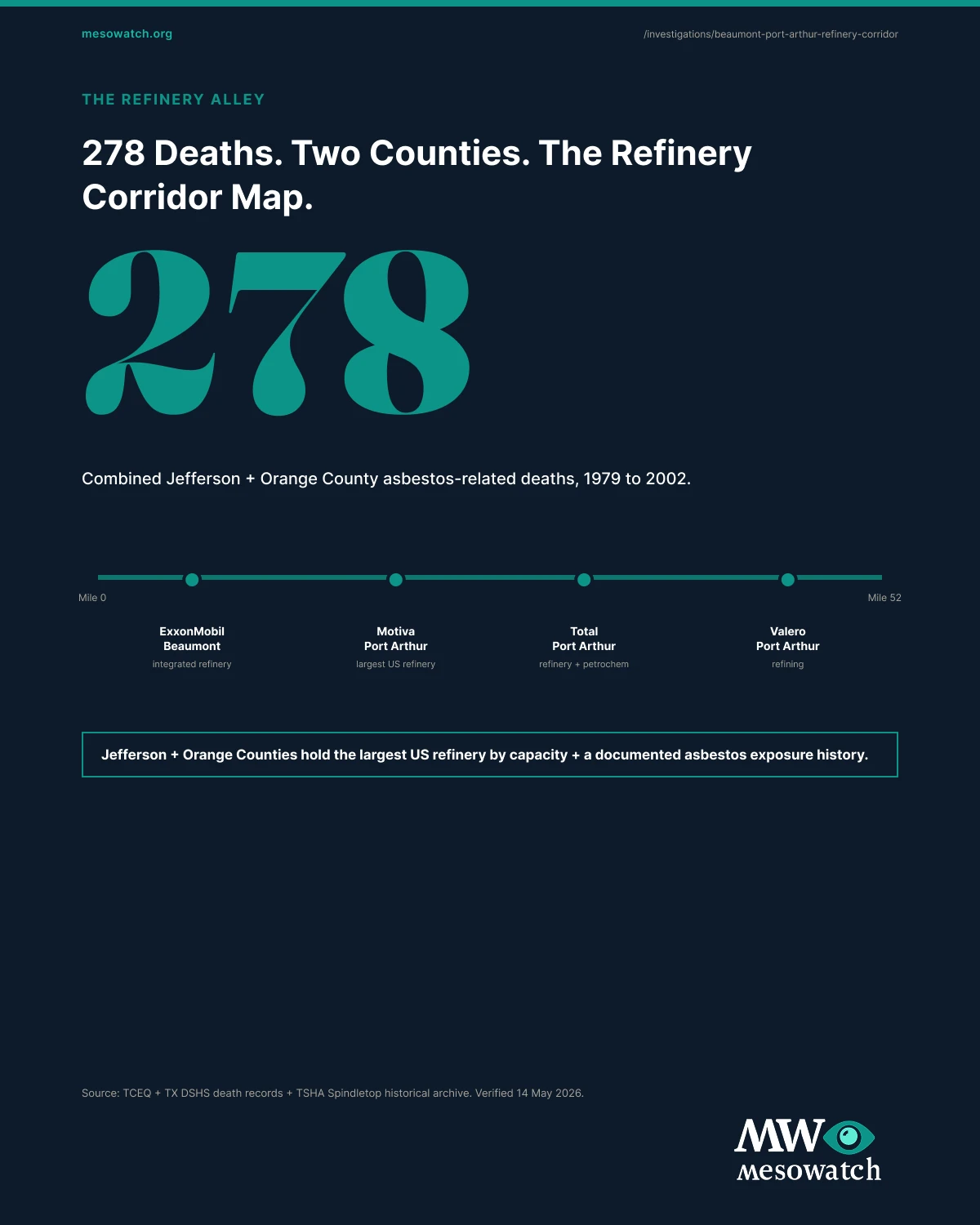
Jefferson and Orange Counties in southeast Texas hold the largest US refinery by capacity and a documented asbestos exposure history. The corridor map.

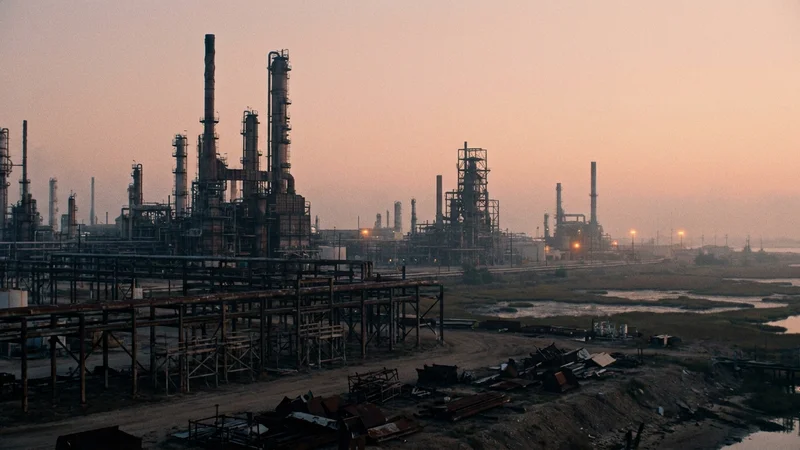
The Beaumont-Port Arthur corridor anchors the densest petrochemical concentration on the Texas coast, and the underlying asbestos exposure footprint from the pre-OSHA construction era is still on the ground.
Peer-reviewed exposure data place documented insulator fiber concentrations at approximately 9 fibers per cubic centimeter in the 1940s and 1950s at the Beaumont refinery complex, among the highest reconstructed occupational exposures on record for the Gulf Coast. The Texas DSHS Cancer Registry continues to record new mesothelioma diagnoses in the region.
The corridor’s exposure history traces from the 1901 Spindletop discovery through the OSHA standards era of the 1970s and beyond, anchored by a refining and petrochemical concentration unmatched elsewhere on the Texas coast.
The corridor’s industrial scale is the story. The ExxonMobil Beaumont Refinery, originally constructed in 1903 to serve the Spindletop oil field, is the 11th-largest refinery in the world by capacity.
The Motiva Port Arthur Refinery (formerly Shell Port Arthur, now a Saudi Aramco subsidiary) is the largest single refinery in the United States.
TotalEnergies and Valero operate additional major facilities in Port Arthur. Few square-mile blocks in North America carry a denser petrochemical concentration.
The occupational asbestos exposure pattern at these refineries is the standard Gulf Coast refinery story. Thermal system insulation ran on miles of process piping. Asbestos lagging surrounded refinery boilers. Fireproofing was sprayed on structural steel.
Gaskets sealed every flanged joint. Equipment insulation surrounded pumps, tanks, dryers, ovens, furnaces, reactors, and heat exchangers.
The pre-1977 construction era left a legacy that persisted decades after the OSHA and EPA standards took effect in 1972 and 1973.
Methodology, and What the Data Captures
The exposure record for this corridor rests on peer-reviewed industrial hygiene data, the Texas DSHS Cancer Registry, and regulatory history, not advocacy mortality tallies.
The Texas Department of State Health Services Cancer Registry continues to record new mesothelioma diagnoses in the corridor, and the latency window for fibers inhaled in the 1960s and 1970s remains active today.
The pre-1980 refinery and petrochemical workforce is now in its 70s and 80s, and diagnoses keep arriving.
The Refinery Map
Four refining majors anchor a 50-mile industrial corridor along the Sabine-Neches waterway, and each carries its own pre-OSHA construction history.
The Beaumont-Port Arthur metropolitan statistical area covers Jefferson County and Orange County. Beaumont, Port Arthur, Nederland, Groves, and Orange sit along the Sabine-Neches navigation channel that runs from Beaumont south to the Gulf of Mexico.
The waterway provides shipping access for crude oil imports and refined product exports, anchoring the oil refinery and petrochemical concentration. Crude moves in by barge and pipeline; refined product moves out by tanker, barge, and pipeline back across the Gulf and inland.
ExxonMobil Beaumont: Spindletop-Era Origins
The Beaumont facility traces directly to the 1901 Spindletop discovery and the 1903 construction of Burt Refining Company.
ExxonMobil Beaumont opened in 1903 to serve the Spindletop oil field that launched the modern Texas oil industry, per the Texas State Historical Association.
Magnolia Petroleum Co. acquired the facility in 1909. The refinery passed through the Standard Oil corporate family and has operated continuously since. After a major 2023 expansion it is the 11th-largest refinery in the world by capacity. Adjacent ExxonMobil facilities include the Beaumont Polymers Plant and the Beaumont Olefins Plant.
Motiva Port Arthur: Largest Single US Refinery
Motiva Enterprises operates the Port Arthur Refinery, the largest single refinery in the United States by crude distillation capacity.
The facility began as a Shell operation in 1903 and grew through 20th-century petrochemical expansion. Motiva became a Saudi Aramco / Shell joint venture in 1998, and Saudi Aramco bought out Shell’s remaining stake in 2017.
The refinery is now wholly owned by Saudi Aramco. The site footprint spans hundreds of acres.
TotalEnergies Port Arthur: Heavy and Sour Crude
TotalEnergies operates a separate Port Arthur refinery focused on heavy and sour crude processing.
The facility, originally a Texaco operation, passed to Premcor and then to TotalEnergies through the Total / Atofina petrochemical consolidation of the early 2000s. The site sits inside the same Port Arthur industrial complex as Motiva and Valero.
Valero Port Arthur: Coker-Heavy Configuration
Valero operates the Port Arthur Refinery (a separate facility from Motiva and TotalEnergies) and adjacent petrochemical units.
The facility was originally a Premcor operation acquired in the 2005 Valero-Premcor merger. Valero added significant coker capacity in the 2010s to process heavy Canadian and Venezuelan crude. The Port Arthur Refinery is one of Valero’s largest by capacity.
Across the four refining majors, the construction era is the underlying signal. Facilities established between 1903 and 1942 carry the densest pre-OSHA asbestos footprint. Expansions from the 1950s and 1960s added equipment that used asbestos-containing insulation and gaskets through the 1970s.
What the Disease Record Shows
The corridor’s mesothelioma burden is occupationally driven, tied to the pre-OSHA refinery and petrochemical workforce, and the latency clock for fibers inhaled in the 1960s and 1970s is still running.
Mesothelioma latency from initial fiber inhalation typically runs 20 to 50 years per ATSDR. Workers exposed in the 1940s through 1970s at Beaumont and Port Arthur refineries fall squarely inside that latency window, and the Texas DSHS Cancer Registry continues to record new mesothelioma diagnoses in the region.
The pre-1980 refinery and petrochemical workforce is now in its 70s and 80s. Diagnoses keep arriving.
The disease pattern is concentrated among men who held high-exposure trades — insulators, pipefitters, boilermakers — in the era before OSHA standards took effect in 1972.
The Galveston and Texas City shipyard belt carries a comparable occupational signal anchored in shipyard rather than refinery employment, while the ASARCO El Paso smelter cohort shows the West Texas counterpoint on a non-petrochemical pathway.
The Occupational Exposure Map
Insulators carried the highest documented refinery exposure. Pipefitters and boilermakers followed close behind. Electricians, laborers, and family members through take-home dust round out the cohort.
Insulators: 9 Fibers per Cubic Centimeter, 1940 to 1950
Insulators had the highest documented occupational asbestos exposure at Gulf Coast refineries.
Williams, Paustenbach et al. (2007, Journal of Toxicology and Environmental Health, Part A, PMID 17558804) reconstructed insulator exposures at the Beaumont, Texas petroleum refinery and petrochemical complex.
The reconstructed 50th-percentile 8-hour time-weighted-average exposures:
- 1940 to 1950: approximately 9 fibers per cubic centimeter
- 1951 to 1965: approximately 8 fibers per cubic centimeter
- 1966 to 1971: approximately 2 fibers per cubic centimeter
- 1972 to 1975: approximately 0.3 fibers per cubic centimeter
- 1976 to 1985: approximately 0.005 fibers per cubic centimeter
Exposure dropped sharply after the OSHA standard took effect in 1972, and again after the 1976 NESHAP revisions. The pre-1972 era is where the cohort’s documented disease burden originates.
Insulators at the petroleum refinery and petrochemical complex had the highest reconstructed exposures of any occupation studied, with 50th-percentile 8-hour TWA values of approximately 9 fibers per cubic centimeter during the 1940-to-1950 period.
Pipefitters, Boilermakers, and Refinery Turnarounds
Pipefitters and boilermakers had the next-highest exposure during installation, repair, and removal of insulated systems.
Refinery turnarounds, the periodic maintenance shutdowns when units are taken offline for major work, were particularly high-exposure events. Insulation was cut and removed, replaced, and discarded in concentrated activity that filled work areas with airborne fibers.
The same crews moved across multiple refineries during turnaround season. A pipefitter who started at the Beaumont facility in 1955 could plausibly accumulate exposure at Port Arthur, Texas City, Baytown, and the Houston Ship Channel inside a single decade.
Electricians, Laborers, and Take-Home Dust
Electricians encountered asbestos in electrical panels, arc chutes, cable insulation, and motor housings. Laborers had bystander exposure during cleanup operations, estimated at one-fifth to one-tenth of insulator exposure.
Family members of refinery workers were exposed through take-home asbestos dust on work clothing brought home and washed at home, before on-site changing and laundering became standard practice.
The take-home pathway is the basis for successful spouse and child mesothelioma claims across Texas refinery cohorts.
The Asbestos Materials at the Refineries
Documented asbestos applications at Gulf Coast refineries spanned eight major categories, all installed before the 1977 EPA NESHAP rule banned new asbestos thermal-system insulation. The categories on the ground at Beaumont and Port Arthur:
- Asbestos thermal system insulation (ATSI) on miles of process piping
- Boiler lagging surrounding refinery steam generation systems
- Fireproofing sprayed on structural support members
- Gaskets between flanges and at valve seats
- Cement building panels as exterior cladding and interior partitions
- Equipment insulation on pumps, tanks, dryers, ovens, furnaces, reactors, and heat exchangers
- Refractory products in process heaters and furnaces
- Brake and clutch linings on refinery vehicles and process pumps
Most US refineries were constructed before 1977, when the EPA NESHAP rule banned new installation of asbestos thermal system insulation. The pre-1977 construction era means legacy asbestos-containing materials remain in operating areas of facilities constructed before 1980.
Even where asbestos was not added after the NESHAP rule, decades of in-place insulation continued to expose workers during maintenance, repair, and demolition activities.
The legacy asbestos footprint is national in scope and concentrated in the Gulf Coast, where the bulk of the country’s refining capacity sits.
The new EPA chrysotile rule under TSCA (effective May 28, 2024) phases out remaining chrysotile asbestos uses in the chlor-alkali industry on a 5-to-12-year timeline.
The Gulf Coast petrochemical concentration intersects directly with the chlor-alkali phase-out under the EPA chrysotile rule, since several remaining chlor-alkali facilities operate in the same Texas-Louisiana petrochemical corridor.
Texas Legal Framework for Refinery Worker Mesothelioma Claims
Texas applies a 2-year statute of limitations, and for asbestos claims Section 16.0031 fixes when that clock starts while Chapter 90 sets a medical-certification requirement.
Texas Civil Practice and Remedies Code Section 16.003 applies a 2-year statute of limitations to personal injury claims, including mesothelioma.
For asbestos-related and silica-related injuries, Section 16.0031 governs accrual. The cause of action accrues on the earlier of two dates: the exposed person’s death, or the date the claimant serves a defendant with a report that complies with the Chapter 90 medical-certification requirements.
Texas Civil Practice and Remedies Code Chapter 90 (Asbestos and Silica Claims), enacted in 2005, sets that certification standard along with exposure thresholds for asbestos claims.
Plaintiffs must submit a report from a qualified physician demonstrating an asbestos-related condition meeting statutory criteria.
For workers in the Beaumont-Port Arthur corridor, the practical implications are clear. Mesothelioma diagnoses today often trace exposure to refinery employment in the 1960s and 1970s.
Because the accrual rule and the certification step are technical, anyone diagnosed with mesothelioma traceable to refinery employment should consult a Texas-licensed attorney promptly to protect access to the legal system, regardless of how long ago the underlying exposure occurred.
In an action for personal injury or death resulting from an asbestos-related injury, the cause of action accrues for purposes of Section 16.003 on the earlier of the date of the exposed person’s death or the date the claimant serves on a defendant a report complying with the Chapter 90 medical-certification requirements.
Asbestos trust fund claims under Section 524(g) trusts and federal court tort claims may both apply, depending on the specific defendant mix and exposure documentation.
The trust framework matters in the refinery cohort because many of the original equipment-and-insulation manufacturers (Owens Corning, Johns Manville, Babcock and Wilcox, and others) are in 524(g) trusts rather than active in tort.
Family members exposed through take-home dust on work clothing have also brought successful mesothelioma claims. The exposure pathway is well-documented in case literature and recognized by Texas courts. The same 2-year limitations period and Section 16.0031 accrual rule apply.
Cross-Cluster Context: The Texas Gulf Coast Triangle
The Beaumont-Port Arthur refinery corridor, the Houston Ship Channel, and the Galveston-Texas City shipyard belt form a connected Texas Gulf Coast asbestos cohort.
The three jurisdictions share a labor pool. A pipefitter, boilermaker, or insulator who started in any one of the three could plausibly work across all three during a single career.
- The Houston Ship Channel exposure sites cohort sits in the Houston metro, anchored in Harris County’s refining, petrochemical, and shipyard industry base.
- The Galveston and Texas City shipyard belt cohort traces to BP Texas City, Marathon Galveston Bay, and the Todd Shipyards complex.
- The Texas military base asbestos footprint covers veterans who worked Lackland, Fort Sam Houston, Fort Cavazos, Fort Bliss, and NAS Corpus Christi.
- The ASARCO El Paso smelter cohort covers the West Texas smelter workforce on a separate exposure pathway.
The shared labor pool means defendant identification in a Beaumont-Port Arthur case often expands to defendants tied to Houston, Galveston, or Texas City facilities.
Documentation work that captures the full career arc, rather than a single facility, is the path that supports trust fund and tort claims.
The Beaumont-Port Arthur refinery corridor, the Houston Ship Channel, and the Galveston-Texas City shipyard belt share a continuous southeast-Texas industrial workforce. A pipefitter, boilermaker, or insulator who started in any one of the three could plausibly work across all three during a single career — one exposure story, not three separate ones.
What Comes Next
The corridor’s documented exposure history continues to produce mesothelioma diagnoses today, and the latency clock for fibers inhaled in the 1960s and 1970s is still running.
The pre-1980 refinery and petrochemical workforce is now in its 70s and 80s. The Texas Department of State Health Services Cancer Registry continues to record new mesothelioma cases in the region.
For people diagnosed with mesothelioma whose work history connects to the Beaumont-Port Arthur refinery and petrochemical industry, the documentation work matters.
Employer records, pay stubs, union records, and co-worker statements help establish the exposure history that supports both asbestos trust claims and tort litigation.
An attorney who handles mesothelioma cases can review the work history and identify the specific defendants most likely to be tied to the documented exposure. With Texas’s 2-year limitations period and the Section 16.0031 accrual rule, there is no time advantage to delay.
Reader Q&A
Frequently Asked Questions
What refineries operate in the Beaumont-Port Arthur corridor?
The corridor's principal operators include ExxonMobil at Beaumont, Motiva (a wholly-owned subsidiary of Saudi Aramco) at Port Arthur, TotalEnergies at Port Arthur, and Valero at Port Arthur. The ExxonMobil Beaumont Refinery, originally constructed in 1903 to serve the Spindletop oil field, is the 11th-largest refinery in the world by capacity. The Motiva Port Arthur Refinery is the largest single refinery in the United States by crude distillation capacity. The corridor also includes major petrochemical facilities operated by these companies and others. Together they form one of the densest petrochemical concentrations in North America.
What asbestos-containing materials were used at these refineries?
Documented asbestos applications at Gulf Coast refineries included thermal system insulation (ATSI) on pipes and boilers, fireproofing applied to structural support members, gaskets between flanges and at valve seats, cement building panels, and equipment insulation on pumps, tanks, dryers, ovens, furnaces, reactors, and heat exchangers. Most US refineries were constructed before 1977 when the EPA NESHAP rule banned new installation of asbestos thermal system insulation. Legacy asbestos-containing materials remain in operating areas of facilities constructed before 1980.
Which jobs had the highest asbestos exposure at refineries?
Insulators had the highest documented occupational asbestos exposure, with approximately 9 fibers per cubic centimeter 8-hour time-weighted average exposure in the 1940s and 1950s at Gulf Coast refinery and petrochemical complexes per Williams, Paustenbach et al. (2007). Pipefitters and boilermakers had the next highest exposure during installation, repair, and removal of insulated systems. Electricians encountered asbestos in electrical panels, arc chutes, and cable insulation. Laborers had bystander exposure during cleanup operations, estimated at one-fifth to one-tenth of insulator exposure. Family members of these workers were exposed to take-home asbestos dust on work clothing before on-site changing became standard.
How does the Beaumont-Port Arthur occupational asbestos exposure compare to other Texas corridors?
The Beaumont-Port Arthur corridor is distinctive because its exposure was concentrated in a small MSA with an unusually dense petrochemical and refinery workforce. Peer-reviewed data place insulator fiber concentrations at approximately 9 fibers per cubic centimeter in the 1940s and 1950s at the Beaumont refinery complex, among the highest reconstructed occupational exposures on record for the Gulf Coast. The Texas DSHS Cancer Registry continues to record mesothelioma diagnoses in the region, reflecting the long latency of fiber-inhaled disease from that pre-OSHA era. The Houston Ship Channel exposure sites investigation documents the parallel pattern in Harris County across a larger population.
What is the Texas statute of limitations for asbestos and mesothelioma claims?
Texas Civil Practice and Remedies Code Section 16.003 applies a 2-year statute of limitations to personal injury claims, including mesothelioma. For asbestos-related injuries, Section 16.0031 sets when that 2-year clock starts: the cause of action accrues on the earlier of the exposed person's death or the date the claimant serves a defendant with a report meeting the Chapter 90 medical-certification requirements. Texas Civil Practice and Remedies Code Chapter 90 (Asbestos and Silica Claims), enacted in 2005, sets that medical-certification and exposure-threshold standard. Because the rules around accrual and certification are technical, people diagnosed with mesothelioma should consult a Texas-licensed attorney promptly.
Can family members exposed to take-home asbestos dust file claims?
Yes, family members who developed mesothelioma from secondary exposure to take-home dust on a worker's clothing have brought successful claims in Texas and elsewhere. The exposure pattern (washing work clothing contaminated with asbestos fibers) is well-documented in mesothelioma case literature and has produced verdicts in cases involving spouses, children, and other household members of refinery, shipyard, and industrial workers. The same 2-year statute of limitations applies. An attorney who handles mesothelioma cases can review the family member's exposure history and identify potential trust fund and litigation options.
Will 30 minutes of asbestos exposure hurt you?
No level of asbestos exposure is considered safe, but a single 30-minute exposure carries a relatively low risk of causing mesothelioma or other asbestos-related disease, because risk follows a dose-response relationship tied to long-term occupational exposure. OSHA notes that short exposures of even a few days can in rare cases lead to mesothelioma decades later, but evidence shows isolated brief incidents are unlikely to cause harm unless they involve high fiber concentrations, poor ventilation, or amphibole asbestos types. Visible dust and enclosed spaces raise the risk; intact materials outdoors pose minimal threat. Anyone with a known exposure history should share that history with their physician, since asbestos-related disease may appear 20 to 50 years after exposure.

The full the beaumont and port arthur refinery corridor report, in one image.
Every claim sources to a primary government regulator or named investigative outlet. The composite is free to embed with credit. No modification of the image.
Press inquiries: editorial@mesowatch.org (MesoWatch Editorial Team)
Want to reach the desk, request the dataset, or subscribe to data drops? Jump to the newsroom