Five Asbestos-Intensive Operators Anchor a 52-Mile Industrial Corridor
Exxon Baytown, Shell Deer Park, Lyondell Channelview, Todd Shipyards, and Brown Shipbuilding ran on asbestos for decades. A sourced map of the cohort.

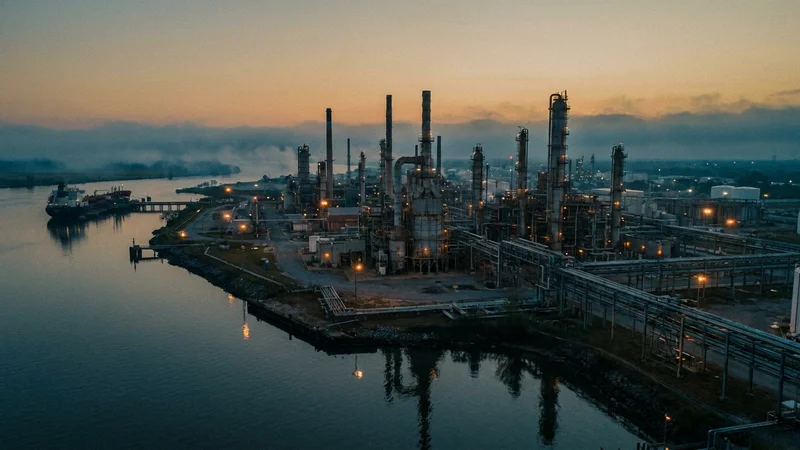
The Houston Ship Channel is a 52-mile industrial waterway lined with refineries, chemical plants, and shipyards, and it produced one of the largest asbestos-exposed worker cohorts in Texas. Texas DSHS Cancer Registry data ranks the Houston metro region first in the state for mesothelioma incidence by region.
More than 200 privately-owned industrial facilities line the Houston Ship Channel today per Port Houston Authority. The corridor has hosted asbestos-intensive operations since the 1940s, with Exxon’s Baytown refinery dating to 1919.
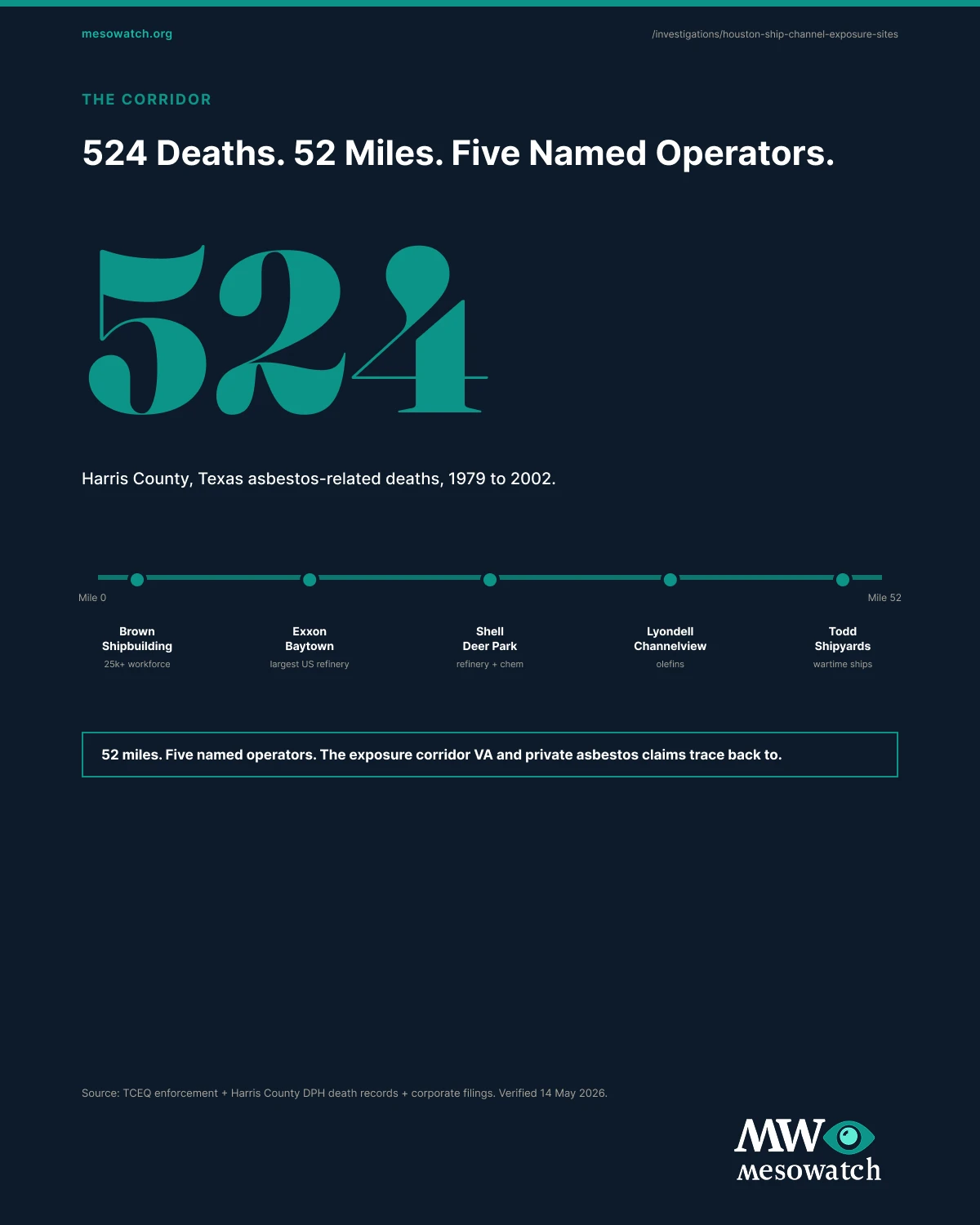
Five named operators carry the cohort. Each is corroborated against a federal, state, or court record later in this investigation:
- Exxon Baytown (one of the largest integrated refining and petrochemical complexes in the US)
- Shell Deer Park (Channel-side refining and petrochemicals)
- Lyondell Channelview (built 1955 to 1957 by Texas Butadiene and Chemical, later ARCO, now LyondellBasell)
- Todd Shipyards (commercial tanker repair on the Channel)
- Brown Shipbuilding (359 wartime vessels on Greens Bayou, 1942 to 1946)
Refineries. Chemical plants. Shipyards. Power generating stations. Each used asbestos insulation as standard practice for high-temperature pipe systems, boilers, heat exchangers, and pressure vessels.
The workers who built, maintained, and repaired those systems inhaled asbestos fibers over careers that sometimes spanned three decades.
The exposed trades include pipefitters, boilermakers, insulators, electricians, and laborers.
Mesothelioma latency runs 20 to 50 years per ATSDR. The workers exposed on the Ship Channel in the 1960s and 1970s are being diagnosed today.
Methodology, and What We Could Not Count
The incidence spine of this investigation is the Texas DSHS Cancer Registry, which ranks the Houston metro region first in Texas for mesothelioma incidence by region. The corporate spine is operator-by-operator primary retrieval.
A note on sourcing matters here. Mesothelioma did not receive a discrete ICD code until ICD-10 took effect for US mortality in 1999, so no mesothelioma-specific death count runs back to 1979, and this report does not assert one. DSHS publishes incidence at the county and SES region level rather than the ZIP level, and by county of residence, so a retired worker who moved before diagnosis is logged wherever they lived at death. The registry ranking is a floor for the corridor cohort, not a ceiling.
Operator-by-operator primary retrieval drives the corporate ledger. Each named site below is corroborated against a federal, state, or court record. Asbestos products of the kinds used at these facilities appear broadly in Southern District of Texas product-identification litigation. This investigation does not pull or cite a specific docket against any individual operator.
Texas DSHS publishes mesothelioma incidence at the county and SES region level. ZIP-code-level breakdowns are not publicly released, so the elevated incidence around the industrial communities adjacent to the corridor is documented at the regional scale rather than the ZIP scale.
Worker-cohort and trade categories are drawn from the OSHA 29 CFR 1910.1001 rulemaking record and from asbestos product-identification filings in Texas multidistrict litigation.
The pipefitter, insulator, boilermaker, electrician, and millwright categories cited here are the cohort the dockets carry.
Documented Operators Along the Channel
Five operators anchor the corridor’s asbestos exposure history. Each is corroborated against a primary record.
The Channel runs west to east from the Turning Basin near downtown Houston to Morgan’s Point at Galveston Bay.
The operators that follow are the sites with the largest workforce, the longest operating history, and the most extensive documentation in federal records or asbestos personal-injury filings.
Exxon Baytown: One of the Largest US Refining Complexes
The Baytown complex has operated continuously since 1919 and is one of the largest integrated refining and petrochemical complexes in the United States per ExxonMobil’s own fact sheet.
Originally built by Humble Oil and Refining, it sat directly on the north shore of the Ship Channel near the mouth of the San Jacinto River.
Baytown ran continuous refinery operations through the period of heaviest asbestos use. Refinery turnarounds, the scheduled shutdowns when entire units are taken offline for maintenance, concentrated insulation work.
Workers cut old asbestos insulation away from pipes and valves, generating high airborne fiber counts in enclosed spaces.
United Association Local 211 in Houston supplied the union pipefitter workforce under signatory contracts with Baytown and other Channel refineries. The local’s jurisdiction history places its members on Baytown turnarounds throughout the 1960s and 1970s.
Shell Deer Park: Channel-Side Refining and Petrochemicals
Shell’s Deer Park complex sits directly on the Channel and traces to 1929 per Shell’s published site history. The refinery and adjacent petrochemical plant ran on the same asbestos pipe insulation, boiler lagging, and gasket systems used industry-wide.
The pipefitter and boilermaker trades at refineries like Deer Park are the cohort that recurs in Southern District of Texas asbestos product-identification litigation. Gasket manufacturers named broadly in Texas refinery cases include Garlock, John Crane, and Flexitallic.
Lyondell Channelview: Petrochemicals on High-Temperature Systems
The Channelview facility was built between 1955 and 1957 by Texas Butadiene and Chemical Corporation, passed to Sinclair in 1962, then to ARCO, and is now part of LyondellBasell. It processes petrochemicals using high-temperature systems extensively insulated with asbestos pipe lagging. It anchors LyondellBasell’s North American manufacturing footprint per the company’s site profile.
Channelview’s exposure profile mirrors the refinery pattern: pipefitters and insulators handling lagging on hot-service piping, mechanics changing gaskets at flanged connections, electricians working around asbestos-insulated equipment.
Todd Shipyards: Ship Repair on the Channel
Todd Shipyards operated on the Houston Ship Channel performing maintenance and repair on the petroleum tankers and chemical carriers that serviced the refineries. Shipboard work concentrated asbestos exposure in the confined spaces of engine rooms, pipe chases, and boiler rooms.
Workers in the ship repair trades, including machinists, electricians, and insulators, worked alongside asbestos lagging on boilers and pipes in spaces without forced ventilation.
Fiber counts in engine rooms during active insulation removal exceeded OSHA’s current permissible exposure limit by orders of magnitude under conditions that prevailed before respirator requirements were enforced.
The commercial Ship Channel maintenance work produced exposure conditions comparable to the published Navy shipyard cohorts but ran on commercial vessel hulls.
Brown Shipbuilding: 359 Wartime Vessels on Greens Bayou
Brown Shipbuilding Company operated on Greens Bayou, a Ship Channel tributary, from 1942 to 1946 and delivered 359 vessels for the US Navy per the Texas State Historical Association’s Handbook of Texas.
At peak production it employed more than 25,000 workers, the second-largest wartime shipyard workforce in Texas.
The build list includes destroyer escorts, landing craft, and patrol vessels. Each was constructed and outfitted with asbestos insulation, gaskets, and fireproofing standard to wartime Navy construction. Naval History and Heritage Command preserves the ship-by-ship build record.
Brown closed at the end of the war. The cohort that built and outfitted those 359 hulls is now well into the diagnosis window for mesothelioma, and wartime shipyard cohorts of this kind are well-represented in asbestos personal-injury litigation.
Exposure of employees to airborne concentrations of asbestos fibers shall be limited as provided in this section.
Even after the standard took effect, asbestos already installed across the Channel’s refineries and chemical plants continued to expose maintenance workers during removal and repair through the late 1970s.
The Refinery Belt
The Ship Channel refineries are the dominant exposure source by sheer scale. Baytown alone has run more than a century of refining on the corridor.
Each Channel refinery employed union pipefitters under contracts with United Association locals. Pipefitters who installed and removed insulation during turnarounds had the highest direct exposure.
Turnarounds concentrated insulation work. Workers cut old asbestos insulation away from pipes and valves, generating high airborne fiber counts in enclosed spaces.
Gaskets are a separate exposure pathway. Refineries use thousands of flanged connections where two pipe sections join. The gaskets that seal those connections were, for decades, made from compressed asbestos sheet.
Pipefitters and mechanics who changed out gaskets, cutting old material and fitting new, created dust with every cut. Gasket manufacturers named in Texas refinery cases include Garlock, John Crane, and Flexitallic.
The Shipyards and Marine Trades
Commercial ship repair on the Channel produced the same confined-space exposure profile as Navy yard work, on commercial hulls.
Todd Shipyards on the Channel and Brown Shipbuilding on Greens Bayou anchor the marine-trades exposure history. Todd handled in-service tanker and chemical-carrier repair through the post-war decades. Brown built and outfitted 359 wartime hulls before closing in 1946.
The trades exposed during shipboard work share a profile across both yards:
- Machinists working alongside asbestos-lagged steam piping in engine rooms
- Insulators installing and stripping pipe and boiler lagging in pipe chases and machinery spaces
- Electricians in switch gear rooms with asbestos arc chutes and panel-board millboard
- Boilermakers working on Scotch and water-tube boilers wrapped in asbestos cloth and block
- Pipefitters changing gaskets at thousands of flanged connections in fuel, lubrication, and steam lines
Confined-space ventilation on shipboard work was minimal. The fiber counts in engine rooms during active insulation removal exceeded OSHA’s current permissible exposure limit by orders of magnitude under conditions that prevailed before respirator requirements were enforced.
The Chemical Plants and Power Stations
Lyondell Channelview, Celanese, and the smaller chemical producers on the corridor ran on the same asbestos insulation systems as the refineries.
Electric generating stations on the Channel, supplying power to refinery operations, ran turbines and boilers insulated with asbestos throughout the 1970s. The chemical-plant pipefitter, boilermaker, and insulator cohort overlaps substantially with the refinery cohort across the Channel.
Electricians at these facilities encountered asbestos in a less visible set of components:
- Electrical switch gear with asbestos millboard backing on panel boards
- Arc chutes designed to smother electrical arcs, manufactured with asbestos cement
- Cable insulation in older feeder runs
- Fireproofing and lagging in transformer vaults and switch rooms
The electrical pathway is less well-known than pipe insulation but has been documented in Texas asbestos litigation against arc-chute and switch-gear manufacturers.
Secondary Exposure in Harris County
Family exposure is documented in Harris County mesothelioma cases. The mechanism is straightforward.
Workers carried asbestos fibers home on their work clothing, in their hair, on their skin, and in their vehicles. Family members who laundered those clothes, who rode in the work truck, who greeted workers at the door before they could change, inhaled fibers.
Where the Cohort Lived
The worker-cohort residence pattern concentrates in the industrial communities adjacent to the corridor. Texas DSHS publishes incidence at the county and SES region level, so the ZIP-level pattern below is inferred from the cohort residence rather than registry tabulation.
- Galena Park (77547), immediately south of the Turning Basin
- Jacinto City (77029), adjacent to the upper Channel
- Deer Park (77536), home to the Shell workforce
- Pasadena (77502, 77503, 77504, 77506), the largest Channel-adjacent residential city
- Baytown (77520, 77521, 77522), home to the Exxon workforce
- East Houston ZIPs including 77012, 77013, and 77015
The pattern is consistent with occupational and secondary exposure rather than ambient environmental contamination. Mesothelioma requires sustained asbestos fiber inhalation. The worker cohort, and the household members who lived with them, is the population at risk.
Family members of workers occupationally exposed to asbestos have developed asbestos-related diseases as a result of secondary exposure to asbestos fibers brought home on work clothing. Take-home exposure has been documented in mesothelioma cases in spouses, children, and other household members of asbestos-exposed workers.
Documented Exposure Sites by Industry
The Houston Ship Channel hosted multiple asbestos-using industries during the heavy-exposure era. The mix below summarizes the major facility categories along the corridor.
The category counts draw on the Port Houston Authority’s published facility tally cross-referenced against Harris County Appraisal District industrial-parcel records. Specific operator naming is limited to the sites with primary-record corroboration in this investigation.
Trust Funds and Texas Statute of Limitations
Workers with documented Ship Channel exposure can potentially access multiple asbestos bankruptcy trusts depending on which products were present at their specific facility.
Gasket manufacturer trusts include the Garlock Sealing Technologies Asbestos Settlement Trust and the John Crane Trust. Garlock, John Crane, and Flexitallic are among the gasket makers named broadly as defendants in asbestos product-identification litigation.
Family members who developed mesothelioma from secondary exposure have brought successful claims in Texas and elsewhere. The take-home pathway is well-documented in the Harris County mesothelioma case literature.
An attorney who handles mesothelioma cases can review the exposure history and identify applicable trust fund and litigation options.
See Texas asbestos verdicts and settlements and the Texas trust funds guide for workers for the broader context.
A Closing Thesis
The 52-mile industrial corridor that built Houston also built one of the largest asbestos-disease cohorts in Texas. Houston metro leads Texas in mesothelioma incidence by region per the DSHS Cancer Registry, and the exposed corridor workforce is the population behind that ranking.
Exxon Baytown has run more than a century of refining on the Channel. Shell Deer Park, Lyondell Channelview, and Todd Shipyards carried the post-war decades. Brown Shipbuilding produced the wartime cohort in four years on Greens Bayou.
Each of these facilities used asbestos pipe insulation, boiler lagging, gaskets, and fireproofing through the 1970s. The workers who installed, maintained, and removed those materials are now in the diagnosis window. So are the family members who laundered the clothes.
Asbestos exposure on the Houston Ship Channel was documented in real time by federal regulators, by state cancer-registry epidemiologists, and by the courts. The latency period means the diagnoses are still arriving.
Reader Q&A
Frequently Asked Questions
Which companies operated asbestos-intensive facilities on the Houston Ship Channel?
Named operators include Exxon Baytown (one of the largest integrated refining and petrochemical complexes in the United States, operated by Exxon and predecessor Humble Oil since 1919), Shell Oil at Deer Park, Lyondell Chemical at Channelview (a complex built in 1955 to 1957 by Texas Butadiene and Chemical Corporation, later held by Sinclair, then ARCO, and now LyondellBasell), Todd Shipyards on the Channel (commercial tanker and chemical-carrier maintenance), and Brown Shipbuilding on Greens Bayou (which delivered 359 wartime vessels for the US Navy between 1942 and 1946). Smaller refineries operated by predecessors to Marathon, Valero, and Total also lined the corridor. Each facility used asbestos pipe insulation, boiler lagging, and gaskets. Asbestos products of these types have been identified in Southern District of Texas multidistrict litigation generally.
What jobs had the highest asbestos exposure at Ship Channel facilities?
Pipefitters and insulators had the highest direct exposure, cutting and removing asbestos insulation from pipes, valves, and heat exchangers during scheduled refinery turnarounds. Boilermakers worked around asbestos-insulated boilers in power plant operations. Electricians encountered asbestos in electrical panels, arc chutes, and cable insulation. Millwrights and maintenance workers performed general facility work and were exposed during turnarounds when insulation was removed and replaced. Laborers who cleaned up after insulation removal had significant bystander exposure. Family members of workers in these trades were exposed to asbestos fibers brought home on work clothing before on-site changing was standard.
Is mesothelioma incidence higher in the Houston metro area?
Texas Department of State Health Services cancer registry data shows the Houston metro area ranks first in Texas for mesothelioma incidence by region. DSHS publishes incidence at the county and SES region level, not the ZIP code level. The elevated regional incidence is consistent with occupational exposure patterns from the Ship Channel industrial corridor, including the worker cohort living in Galena Park, Jacinto City, Deer Park, Pasadena, and Baytown.
What trust funds cover Ship Channel exposure?
Workers with documented exposure at Ship Channel facilities may be eligible to file claims with multiple asbestos bankruptcy trusts depending on which products were present at their specific worksite. Trusts with broad coverage for petrochemical and industrial workers include the Combustion Engineering 524(g) Trust, the Eagle-Picher Industries Personal Injury Settlement Trust, the Babcock and Wilcox Asbestos Personal Injury Settlement Trust (for boiler work), and the Armstrong World Industries Asbestos Personal Injury Settlement Trust. Gasket-manufacturer trusts include the Garlock Sealing Technologies Asbestos Settlement Trust. An exposure history document is required for trust claims and should be developed with an attorney who handles mesothelioma cases.
Can someone who worked at a Ship Channel refinery or chemical plant still file a claim?
Yes, if they have been diagnosed with mesothelioma or an asbestos-related disease. Texas has a two-year statute of limitations for personal-injury claims that runs from the date of diagnosis under the discovery rule, not from the date of exposure. The statutory authority is Texas Civil Practice and Remedies Code Section 16.003. Family members who developed mesothelioma from secondary exposure, including washing work clothes or contact with contaminated vehicles, have also brought successful claims in Texas. An attorney who handles mesothelioma cases can review the exposure history.
What was Brown Shipbuilding and why does it matter?
Brown Shipbuilding Company operated on Greens Bayou, a tributary of the Houston Ship Channel, from 1942 to 1946. Under US Navy contract it delivered 359 vessels including destroyer escorts and landing craft, employing more than 25,000 workers at peak production. The shipyard built and outfitted vessels using asbestos insulation, gaskets, and fireproofing standard to wartime Navy construction. The Naval Institute and US Navy historical records preserve the build list. Wartime shipyard cohorts of this kind are well-represented in asbestos personal-injury litigation.

The full houston ship channel asbestos report, in one image.
Every claim sources to a primary government regulator or named investigative outlet. The composite is free to embed with credit. No modification of the image.
Press inquiries: editorial@mesowatch.org (MesoWatch Editorial Team)
Want to reach the desk, request the dataset, or subscribe to data drops? Jump to the newsroom