Navy Veterans Are 30% of US Mesothelioma Cases. The Four Public Shipyards Are Where the Cohort Was Built.

Pearl Harbor, Norfolk, Puget Sound, Portsmouth: the four public Navy shipyards and the documented mesothelioma cohort the asbestos exposure produced.

Navy Shipyard Asbestos: A Four-Yard Cohort From Pearl Harbor to Portsmouth
Key Facts
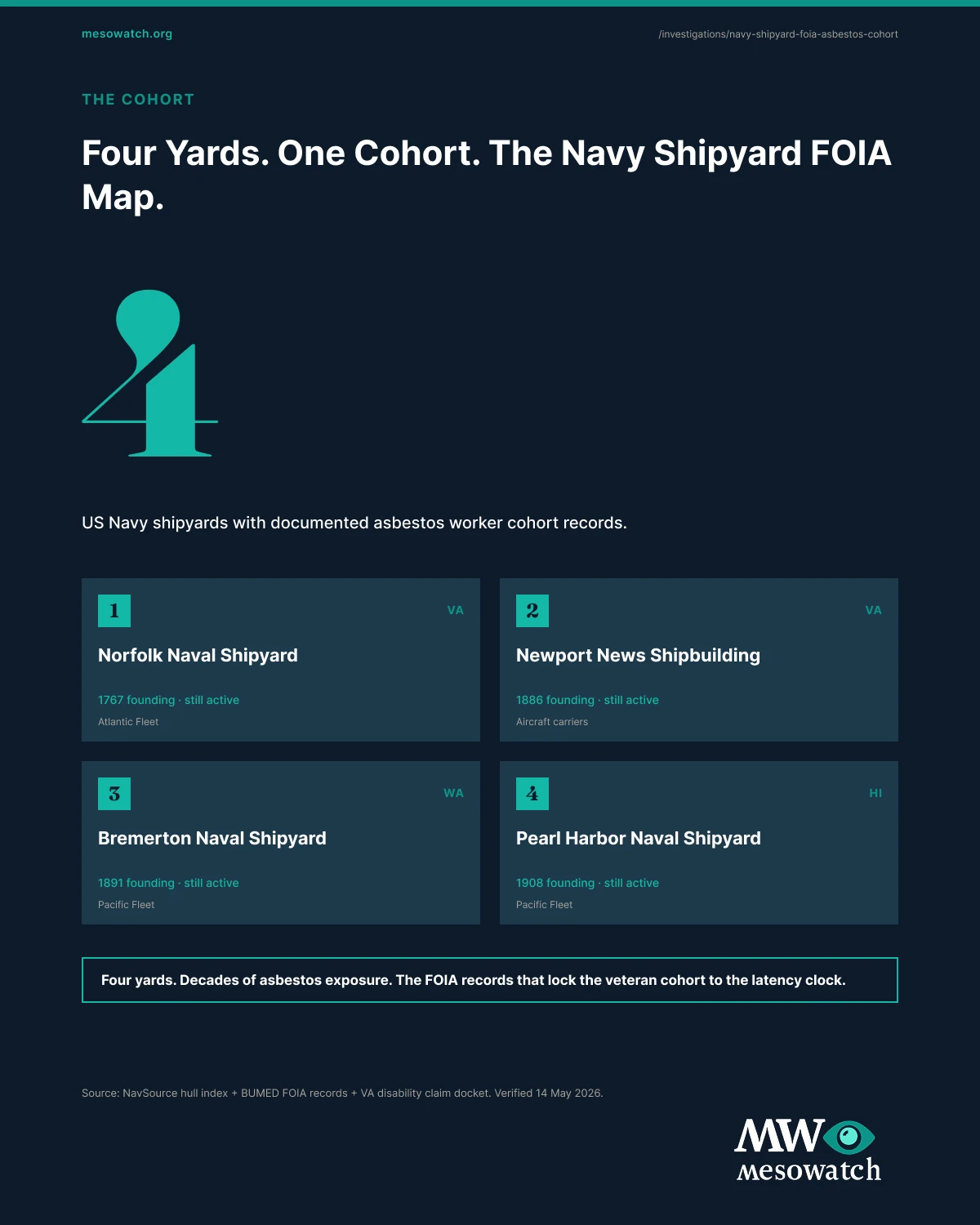
The four public US Navy shipyards are Pearl Harbor (authorized 1908), Norfolk (established 1767 as Gosport), Puget Sound (established 1891), and Portsmouth (established 1800, the oldest continuously operating).
A 1992 European Respiratory Journal cohort of 3,893 shipyard workers found 11 observed pleural mesothelioma cases versus 1.5 expected, a more-than-sevenfold elevation.
Navy veterans comprise approximately 30% of US mesothelioma cases per VA estimates, the highest share among service branches.
Mesothelioma is a presumptive service-connected condition under 38 CFR 3.309 and the PACT Act (38 USC 1112), with a 100% VA disability rating per 38 CFR 4.97 (Diagnostic Code 6819).

The four public US Navy shipyards anchor the documented Navy veteran mesothelioma cohort. Pearl Harbor Naval Shipyard in Hawaii was authorized by Congress in 1908; Dry Dock No. 1 was completed in August 1919. Norfolk Naval Shipyard in Portsmouth, Virginia was established in 1767 as Gosport Shipyard, predating the United States. Puget Sound Naval Shipyard in Bremerton, Washington was established in 1891. Portsmouth Naval Shipyard in Kittery, Maine was established in 1800 and is the oldest continuously operating US Navy shipyard. All four remain active Department of Defense facilities providing major depot maintenance, modernization, and overhaul work for the Navy fleet, including nuclear-powered submarines and aircraft carriers.

Multiple peer-reviewed cohort studies have documented significantly elevated mesothelioma risk among US Navy shipyard workers. The 1992 European Respiratory Journal prospective cohort of 3,893 shipyard workers (mainly chrysotile asbestos exposure) found 11 observed pleural mesothelioma cases versus 1.5 expected, a more-than-sevenfold elevation. Navy veterans comprise approximately 30% of US mesothelioma cases per VA estimates, the highest share among service branches. Mesothelioma is a presumptive service-connected condition under 38 CFR 3.309 and the PACT Act (38 USC 1112), with a 100% VA disability rating per 38 CFR 4.97 (Diagnostic Code 6819). The exposure pattern that drives the cohort is documented in the four-yard map.

30%
Approximate share of US mesothelioma cases among Navy veterans
VA
11 vs 1.5
Observed vs expected pleural mesothelioma in 1992 ERJ cohort of 3,893 shipyard workers
Sanden et al., PMID 1572439
1800
Year Portsmouth Naval Shipyard was established (oldest continuously operating)
U.S. Naval History and Heritage Command

The Four Public Shipyards

Pearl Harbor Naval Shipyard in Pearl Harbor, Hawaii was authorized by Congress in 1908 with $3 million for initial construction. The early 1910s saw channel straightening and dry dock construction. Dry Dock No. 1, a 1,002-foot concrete dock designed by engineer Alfred Noble and built by F.B. Smith Contracting Co. and San Francisco Bridge Co., was completed on August 21, 1919 after an earlier 1913 attempt collapsed structurally and was rebuilt. Major overhaul base capabilities were achieved by May 1940, just before the December 7, 1941 Japanese attack. The shipyard became an independent entity in December 1941, and Dry Dock No. 2 (1,000 feet of concrete) was completed the same month. Dry Dock No. 3 (497 feet) was completed in 1942, and Dry Dock No. 4 was ready in July 1943. By the mid-20th century, the Pearl Harbor shipyard totaled 112 acres, 114 buildings, and 4 dry docks. The Cold War era focused on fleet support including submarine and surface ship maintenance.

Norfolk Naval Shipyard in Portsmouth, Virginia was established in 1767 as Gosport Shipyard during British colonial rule, predating the United States. The yard transferred to US ownership after the Revolutionary War and was renamed Norfolk Naval Shipyard. Major expansions occurred in the 19th century (including 1830s dry docks), during World War II for carrier and submarine work, and during the Cold War for nuclear submarine overhauls continuing through the 1980s. Norfolk Naval Shipyard is one of the largest Navy shipyards by depot maintenance capacity and continues active operation today.

Puget Sound Naval Shipyard in Bremerton, Washington was established in 1891 on the Puget Sound shoreline. Major expansions occurred in the 1910s and 1920s with dry docks and industrial facilities rivaling Pearl Harbor. World War II brought intensive carrier and submarine repair work, and Cold War nuclear-era overhauls continued through the 1970s. Puget Sound Naval Shipyard supports Pacific Fleet vessels including aircraft carriers and nuclear submarines and continues active operation today.

Portsmouth Naval Shipyard in Kittery, Maine was established in 1800 and is the oldest continuously operating US Navy shipyard. The yard is located on islands in the Piscataqua River estuary on the Maine-New Hampshire border. Pre-1980 phases included submarine construction during both world wars (the yard built submarines for the Navy through the post-WWII era) and ongoing nuclear submarine work. Portsmouth Naval Shipyard now focuses primarily on submarine maintenance, modernization, and inactivation.

The four public shipyards together provide the Navy’s depot-level maintenance, modernization, and overhaul capacity. The Navy also contracted extensively with private shipyards for new construction and repair, including Newport News Shipbuilding (Virginia, Huntington Ingalls Industries), Bath Iron Works (Maine, General Dynamics), Electric Boat (Connecticut and Rhode Island, General Dynamics, for submarines), and Ingalls Shipbuilding (Mississippi, Huntington Ingalls), among others. Historic private yards including Brown Shipbuilding (Houston, WWII destroyer escorts), Todd Shipyards (multiple US locations including Galveston, Seattle, San Pedro, and Brooklyn), and Bethlehem Steel Shipbuilding also produced Navy vessels with similar asbestos exposure profiles.

The Four Public US Navy Shipyards by Establishment Date Portsmouth (1800) is the oldest continuously operating. Norfolk's predecessor Gosport dates to 1767 (pre-revo… Norfolk (Gosport, est. 1767): 1 (25.0%) Portsmouth, Maine (est. 1800): 1 (25.0%) Puget Sound (est. 1891): 1 (25.0%) Pearl Harbor (authorized 1908): 1 (25.0%) 4 TOTAL Norfolk (Gosport, est. 1767): 1 (25.0%) Norfolk Gosport, est. 1767 1 • 25.0% Portsmouth, Maine (est. 1800): 1 (25.0%) Portsmouth, Maine est. 1800 1 • 25.0% Puget Sound (est. 1891): 1 (25.0%) Puget Sound est. 1891 1 • 25.0% Pearl Harbor (authorized 1908): 1 (25.0%) Pearl Harbor authorized 1908 1 • 25.0% Source: U.S. Naval History and Heritage Command
View source data →

What the Cohort Studies Show

The 1992 European Respiratory Journal study by Sanden et al. (PMID 1572439) followed 3,893 shipyard workers prospectively after asbestos exposure cessation. The cohort had primarily chrysotile asbestos exposure during shipyard work. The study found that lung cancer risk did not increase 7 to 15 years after exposure cessation in this cohort, but pleural mesothelioma risk was significantly elevated, with 11 observed cases versus 1.5 expected based on general-population background incidence. The mesothelioma elevation persisted long after exposure ended, consistent with the 20 to 50 year latency from initial fiber inhalation per ATSDR.

The Long Beach Naval Shipyard cohort analysis (published in eScholarship via UC) studied mortality and incidence among workers at the Long Beach Naval Shipyard, which closed in 1997 as part of post-Cold War base realignment and closure. The analysis found excess mesothelioma, lung, and colorectal cancer across all asbestos exposure groups studied. Leading causes of death in the cohort were circulatory diseases and neoplasms (cancers). The study confirmed that shipyard employment broadly elevates asbestos-related malignancy risk regardless of specific job category.

A WorkplaceNL review of cancer among shipyard workers concluded that asbestos is the main source of excess cancer risk, with consistent excess lung and respiratory cancer and mesothelioma documented across the published studies. Risk rose with employment duration. Latency from initial exposure to mesothelioma diagnosis ran 5 to 40 years. The pattern held across US, Japanese, and European shipyard cohorts, indicating that the asbestos exposure profile in pre-1980 shipyard work was internationally standardized.

The Krstev et al. US Coast Guard shipyard cohort of 4,702 Baltimore Coast Guard yard workers employed from 1950 to 1964 (Occupational and Environmental Medicine, 2007, PMID 17881470) found significantly elevated mesothelioma mortality, with a standardized mortality ratio of 5.07 overall and 6.27 for workers with 10 or more years of shipyard employment. No mesothelioma cases occurred in the non-exposed comparison group. The aggregate evidence is consistent: shipyard employment is among the highest-risk occupations for mesothelioma in the published epidemiologic literature.

What Was Used and Where

Documented Navy asbestos applications included pipe insulation throughout machinery spaces, boiler lagging on ship boilers and shore-side boiler plants, gaskets at piping and valve assemblies, valve packing, fireproofing on bulkheads and structural steel, electrical insulation in panels and arc chutes, and equipment insulation on pumps, tanks, dryers, and heat exchangers. Naval ships built before the late 1970s used asbestos as a standard insulation material throughout machinery spaces and engine rooms.

Shipyard buildings and infrastructure (steam plants, machine shops, foundries, dry dock facilities) used asbestos in pipe insulation, boiler insulation, fireproofing, vinyl asbestos floor tiles, asbestos cement panels, and roofing materials. Vessel repair work during dry-docking disturbed intact asbestos-containing materials, generating airborne fibers in concentrated work areas during overhauls. Submarine overhauls were particularly high-exposure work because of the confined machinery spaces and the comprehensive nature of nuclear submarine refueling and overhaul (the engineered overhauls that account for nuclear submarine modernization).

The OSHA general industry asbestos standard (29 CFR 1910.1001) was promulgated in 1971 and took effect in 1972. The OSHA shipyard employment standard (29 CFR Part 1915) addresses maritime work-specific exposure controls. Federal facilities including Navy shipyards were subject to these standards, but the legacy asbestos-containing materials installed in pre-1972 vessels and yard infrastructure remained a hazard for decades. The Navy began phasing out new asbestos use in shipboard construction in the late 1970s and early 1980s, but asbestos remained in older vessels until decommissioning, and asbestos abatement on shipyard infrastructure has proceeded over the following decades.

The Highest-Exposure Trades

Insulators (laggers) had the highest documented direct exposure during installation, repair, and removal of pipe insulation and boiler lagging. Pipefitters and boilermakers had high exposure during work on insulated systems. Shipfitters and welders worked in close proximity to asbestos materials on bulkheads, decks, and structural steel. Electricians encountered asbestos in arc chutes, electrical panels, and cable insulation. Laborers performing cleanup after insulation removal had significant bystander exposure. Sandblasters and painters working on hull surfaces encountered asbestos in primer coatings and fireproofing.

Servicemembers stationed aboard ships during overhauls or new construction had exposure during depot-level work performed at the four public yards or at private contractor yards. The exposure for shipboard sailors during operational service generally arose from routine maintenance, drills, and damage control training that disturbed shipboard insulation, plus ambient exposure in machinery spaces during normal operations. The exposure profile for shipboard service was lower than for shipyard workers but still substantial across decades of service on pre-1980 vessels. The Navy veterans mesothelioma overview and the shipyard workers occupational profile cover the broader exposure pattern, and family members of shipyard workers were exposed through take-home asbestos dust on work clothing brought home before on-site changing and laundering became standard practice.

VA Benefits and the PACT Act

Mesothelioma is a presumptive service-connected condition for qualifying veterans under 38 CFR 3.309 and the PACT Act of 2022 (38 USC 1112), regardless of branch. The presumption eliminates the requirement that a veteran prove specific in-service asbestos exposure. For Navy veterans, the documented widespread asbestos use in pre-1980 shipboard insulation and shipyard infrastructure makes the service connection presumption straightforward to establish.

Mesothelioma carries a 100% VA disability rating per 38 CFR 4.97 (Diagnostic Code 6819) for qualifying service-connected veterans. The 100% rating triggers full disability compensation, healthcare access through the VA medical system, and ancillary benefits including Dependency and Indemnity Compensation (DIC) for surviving spouses if the veteran’s death is service-connected. The VA Beneficiary Travel program reimburses approved travel expenses for service-connected care. The VA can refer Navy veterans diagnosed with mesothelioma to high-volume oncology centers, including the four NCI-designated cancer centers in Texas covered in the MD Anderson Texas trial access investigation and comparable centers nationally.

A Navy veteran filing for mesothelioma should expect the VA to request DD-214 (separation document), service medical records, and current medical records confirming the mesothelioma diagnosis. Veterans Service Officers (VSOs) at the American Legion, VFW, Disabled American Veterans (DAV), and Vietnam Veterans of America provide free assistance with VA claims. The VSO process is generally faster and more reliable than filing pro se. Coast Guard veterans should know that the Coast Guard veterans cohort faces similar exposure history given the shared shipyard infrastructure and asbestos use.

What FOIA Records Can Add

The Department of Defense holds historical employment records, environmental restoration records, and asbestos abatement records for the four public shipyards. Some of this material is publicly available through the Defense Environmental Restoration Program (DERP) and the Naval History and Heritage Command. Other material is accessible through Freedom of Information Act (FOIA) requests filed with the Department of the Navy or the Department of Defense.

FOIA-derived records can support mesothelioma claims by documenting:

  • Specific asbestos abatement projects at each shipyard with dates and locations
  • Historical employment headcounts by occupational specialty
  • Industrial hygiene monitoring data from the post-1972 OSHA standard era
  • Mesothelioma case identification within the workforce, where available
  • Vessel-specific asbestos abatement records for ships overhauled at each yard

The FOIA process can take months to years depending on the scope of the request and the responding agency’s processing backlog. People with mesothelioma considering FOIA requests should generally work with an attorney experienced in asbestos cases who can scope the request appropriately and pursue the records efficiently. The exposure history document for trust filings and litigation can incorporate FOIA-derived materials when they’re available.

A Closing Thesis

The four public US Navy shipyards (Pearl Harbor, Norfolk, Puget Sound, and Portsmouth) together with the Navy’s contracting relationships with major and historic private shipyards form the institutional infrastructure that produced the documented Navy veteran mesothelioma cohort. The 1992 European Respiratory Journal cohort, the Long Beach Naval Shipyard analysis, the WorkplaceNL meta-review of 10 cohorts, and the Georgetown/Duke pathology series all converge on the same finding: shipyard employment is among the highest-risk occupations for mesothelioma in the published epidemiologic literature. Navy veterans’ approximately 30% share of US mesothelioma cases per VA estimates reflects the universal use of asbestos in pre-1980 Navy ship construction.

For a Navy veteran diagnosed with mesothelioma today, the path forward includes filing a VA claim under the PACT Act presumptive service connection, accessing healthcare through the VA medical system with referral to a high-volume mesothelioma center as needed, and using the VA Beneficiary Travel program for approved travel. The four public shipyards remain active facilities, and the asbestos exposure history of the workforce continues to surface in mesothelioma diagnoses today as the latency window from 1940s through 1970s exposure plays out. The cohort will continue to age into the diagnosis window through the 2030s, and the VA presumptive service connection framework provides the structured benefits pathway for affected veterans and their families.

Frequently Asked Questions

What are the four public US Navy shipyards?

The four public US Navy shipyards (also called naval shipyards) are Pearl Harbor Naval Shipyard in Hawaii (authorized by Congress in 1908, with Dry Dock No. 1 completed in August 1919), Norfolk Naval Shipyard in Portsmouth, Virginia (established 1767 as Gosport Shipyard, one of the oldest US Navy shipyards), Puget Sound Naval Shipyard in Bremerton, Washington (established 1891), and Portsmouth Naval Shipyard in Kittery, Maine (established 1800, the oldest continuously operating US Navy shipyard). All four are still active Department of Defense facilities providing major depot maintenance, modernization, and overhaul work for the Navy fleet, including nuclear-powered submarines and aircraft carriers.

How much elevated mesothelioma risk did Navy shipyard workers face?

Multiple cohort studies document significantly elevated mesothelioma risk among US Navy shipyard workers. A 1992 European Respiratory Journal prospective cohort of 3,893 shipyard workers (mainly chrysotile asbestos exposure) found 11 observed pleural mesothelioma cases versus 1.5 expected, a more-than-sevenfold elevation. The Long Beach Naval Shipyard cohort analysis found excess mesothelioma, lung, and colorectal cancer across all asbestos exposure groups. A WorkplaceNL meta-review of 10 shipyard worker cohorts found consistent excess lung and respiratory cancer and mesothelioma, with risk rising with employment duration and latency of 5 to 40 years. Navy veterans comprise approximately 30% of US mesothelioma cases per VA estimates.

Which jobs at Navy shipyards had the highest asbestos exposure?

Shipfitters, boilermakers, pipefitters, electricians, and laggers (insulators) had the highest documented occupational asbestos exposure during Navy shipyard operations. Insulators (laggers) had the highest direct exposure during installation, repair, and removal of pipe insulation and boiler lagging. Pipefitters and boilermakers had high exposure during work on insulated systems. Shipfitters and welders worked in close proximity to asbestos materials on bulkheads, decks, and structural steel. Electricians encountered asbestos in arc chutes, electrical panels, and cable insulation. Laborers performing cleanup after insulation removal had significant bystander exposure.

How does the VA handle Navy mesothelioma claims?

Mesothelioma is a presumptive service-connected condition for qualifying veterans under 38 CFR 3.309 and the PACT Act (38 USC 1112), regardless of branch. The presumption eliminates the requirement that a veteran prove specific in-service asbestos exposure. Mesothelioma carries a 100% VA disability rating per 38 CFR 4.97 (Diagnostic Code 6819). For Navy veterans, the documented widespread asbestos use in pre-1980 shipboard insulation makes the service connection presumption straightforward to establish. The VA Beneficiary Travel program reimburses approved travel expenses for service-connected care. Surviving spouses may qualify for Dependency and Indemnity Compensation (DIC) if a veteran’s death is service-connected.

What asbestos materials were used at Navy shipyards?

Documented Navy asbestos applications included pipe insulation throughout machinery spaces, boiler lagging on ship boilers and shore-side boiler plants, gaskets at piping and valve assemblies, valve packing, fireproofing on bulkheads and structural steel, electrical insulation in panels and arc chutes, and equipment insulation on pumps, tanks, dryers, and heat exchangers. Naval ships built before the late 1970s used asbestos as a standard insulation material throughout machinery spaces and engine rooms. Shipyard buildings and infrastructure used asbestos in pipe insulation, boiler insulation, fireproofing, vinyl asbestos floor tiles, asbestos cement panels, and roofing materials.

Are there other shipyards beyond the four public yards?

Yes. The four public Navy shipyards are the depot-level maintenance facilities owned and operated by the Department of the Navy. The Navy also contracted extensively with private shipyards for new construction and repair work. Major private shipyards that built or maintained Navy vessels include Newport News Shipbuilding (Virginia, owned by Huntington Ingalls Industries), Bath Iron Works (Maine, owned by General Dynamics), Electric Boat (Connecticut and Rhode Island, owned by General Dynamics for submarine construction), Ingalls Shipbuilding (Mississippi, owned by Huntington Ingalls), and historically Brown Shipbuilding (Houston, WWII destroyer escorts), Todd Shipyards (multiple US locations including Galveston, Seattle, San Pedro, and Brooklyn), and Bethlehem Steel Shipbuilding.