Texas's Documented Asbestos-Exposure Cohorts Outside Houston Have Zero Active Mesothelioma Trials
Texas's documented asbestos-exposure cohorts (ASARCO El Paso, the Beaumont refinery corridor) have zero active mesothelioma trials. The bench is in Houston.


Texas's Mesothelioma Trial-Access Gap: 26 Trials, Almost All in Houston

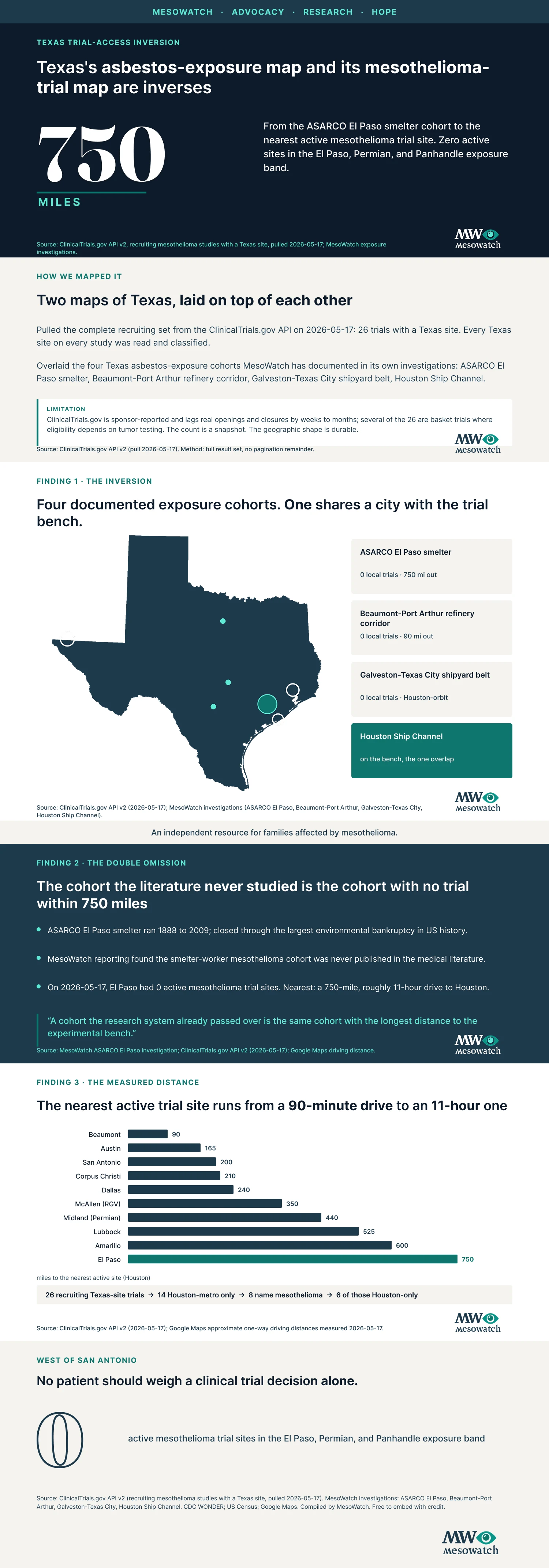
Put two maps of Texas side by side. One marks where the state’s documented asbestos-exposure cohorts lived and worked. The other marks where a person can physically enter a recruiting mesothelioma trial today. The maps are near inverses. They line up in exactly one place: Houston.
The complete recruiting set was pulled from the ClinicalTrials.gov API on 2026-05-17, covering every Texas site on every study. The registry listed 26 recruiting mesothelioma trials with a Texas site. Fourteen of the 26 listed only Houston-metro locations. The distinct cities hosting any active site (Houston, Dallas, Fort Worth, Richardson, Irving, Tyler, Abilene, Austin, San Antonio) all sit inside the Houston-Dallas-San Antonio-Austin quadrilateral.
The count in El Paso, Lubbock, Amarillo, Midland, Odessa, McAllen, Corpus Christi, and Beaumont was zero.
Then lay the exposure cohorts on top. MesoWatch has documented four Texas asbestos-exposure populations in their own investigations: the ASARCO El Paso smelter, the Beaumont-Port Arthur refinery corridor, the Galveston-Texas City shipyard belt, and the Houston Ship Channel. Only the last one shares a city with the trial bench.
The El Paso smelter cohort, a population our own reporting found was never published in the medical literature, sits 750 miles and an 11-hour drive from the nearest active site.
That is the finding: the exposure Texas already failed to study is also the exposure it cannot trial. This investigation maps that inversion and measures the distance across it.
The Trial-Desert Map
The 26 recruiting trials do not spread across Texas. They collapse onto Houston, with a thin secondary band in Dallas-Fort Worth, San Antonio, and Austin, and nothing west of that.
Fourteen of the 26 studies listed only Houston-metro sites: Houston itself plus the MD Anderson satellite footprint in Sugar Land, League City, Conroe, and The Woodlands. The remaining studies that reach beyond Houston still stay inside the eastern triangle.
The sharpest cut is the mesothelioma-primary subset. Eight of the 26 studies name mesothelioma in the title. Six of those 8 are Houston-metro only. The two that are not are a sarcomatoid mesothelioma immunotherapy study at UT Southwestern in Dallas-Fort Worth (NCT05647265, with one of two Dallas sites listed as suspended) and a Phase 1 study at a research site in Austin (NCT06566079).
That is the entire mesothelioma-primary trial geography of Texas: Houston, a Dallas-Fort Worth study, and one Austin site.
The other 18 studies are broad solid-tumor or molecularly-defined basket trials, including MTAP-deletion and mesothelin-targeted studies, for which a person with mesothelioma may qualify based on tumor testing rather than diagnosis alone. Those broaden the map slightly into San Antonio, Tyler, Abilene, and Irving, but they do not change the western picture.
The counts overlap because a single study can list sites in more than one city. The pattern does not change with the counting method. The bench is in Houston. The rest of the state thins to nothing.
Why the Bench Concentrates
Two forces concentrate the mesothelioma trial bench at the highest-volume centers: the rare-disease patient math and the cost of the multidisciplinary infrastructure.
Mesothelioma is rare. The CDC’s United States Cancer Statistics records approximately 3,000 new cases nationally per year. The latency from initial asbestos fibre inhalation runs 20 to 50 years per ATSDR, so today’s case pipeline reflects exposure from decades ago.
Texas records roughly 126 mesothelioma deaths a year, based on CDC WONDER showing 3,034 Texas deaths from 1999 to 2022. The case pipeline concentrates in the Gulf Coast industrial corridor; the Houston Ship Channel exposure sites and Beaumont-Port Arthur refinery corridor investigations document the occupational history.
Trial enrollment requires patient volume to power the statistical analysis that drives study completion. For a rare cancer, the math is unforgiving.
A trial that needs 100 people with mesothelioma to reach significance can do that in about two years at a centre seeing 200 cases a year. The same trial takes roughly a decade at a centre seeing 20 cases a year. That threshold is one reason the deepest portfolios sit at the highest-volume centers.
The infrastructure investment is the other reason. A mesothelioma program needs thoracic surgeons trained in extrapleural pneumonectomy or pleurectomy and decortication, medical oncologists fluent in platinum-pemetrexed and the immunotherapy combinations now standard for unresectable disease, radiation oncologists with intensity-modulated capability, and pathologists who can separate epithelioid, sarcomatoid, and biphasic histology.
Clinical research coordinators, regulatory specialists, and biospecimen processing round out the bench. That depth is expensive to build and harder to maintain at lower volumes.
For mesothelioma specifically, the highest-volume program in Texas operates at MD Anderson under the direction of Dr. Anne Tsao, covering pleural, peritoneal, and rare presentations. A current recruiting example is the Phase 2 peritoneal mesothelioma study NCT05001880, open at MD Anderson and its Houston satellites. The other three Texas NCI cancer centers all have thoracic oncology programs; MD Anderson has the deepest mesothelioma-specific bench.
The concentration is not unique to Texas. Mesothelioma trial work clusters nationally at a small number of high-volume centers, including Memorial Sloan Kettering, Brigham and Women’s, and the University of Pennsylvania, for the same reason.
The Inversion: Where Texas Got Sick vs. Where Texas Can Get a Trial
The bench concentration is rational on its own. It becomes a finding only when you lay it over the exposure map, because the two maps are near mirror images. The places Texas documented its asbestos disease are, with one exception, the places with zero trial access.
MesoWatch has investigated four distinct Texas asbestos-exposure populations. Reading each against the 2026-05-17 trial-site geography produces a consistent pattern.
ASARCO El Paso smelter cohort: studied by no one, trialed by no one
The ASARCO El Paso smelter ran from 1888 to 2009 and closed through the largest environmental bankruptcy in US history. Our investigation into that site found something specific: the smelter-worker mesothelioma cohort was never published in the medical literature.
On the 2026-05-17 pull, El Paso also had zero active mesothelioma trial sites, with the nearest site a 750-mile, roughly 11-hour drive to Houston. This is the sharpest point of the inversion: a cohort the research system already passed over is the same cohort with the longest distance to the experimental bench.
Beaumont-Port Arthur refinery corridor: heavy exposure, day-trip access
The Beaumont-Port Arthur refinery corridor is one of the most exposure-dense documented populations in the state, with decades of petroleum refining and petrochemical manufacturing generating sustained occupational asbestos exposure across Jefferson and Orange Counties.
Beaumont’s own active-trial-site count is still zero, but it sits about 90 miles from MD Anderson on I-10, a drive of roughly 90 minutes. The exposure history is severe; the access penalty is the mildest of the four.
Galveston-Texas City shipyard belt: exposure beside the bench
The Galveston-Texas City shipyard belt documents shipyard and petrochemical asbestos exposure on the upper Texas coast, inside the Houston commuting orbit. This cohort sits closest to the deepest bench in the state without being in Houston proper. Geography works in its favour.
Houston Ship Channel: the one overlap
The Houston Ship Channel exposure sites investigation maps an industrial corridor whose exposed population lives in the same metro as MD Anderson, Baylor’s Dan L. Duncan center, and 14 of the 26 recruiting trials. This is the single place where the exposure map and the trial map coincide. It is also the only one of the four cohorts for which the access question is not the binding constraint.
Four documented exposure cohorts. One sits on top of the trial bench. One is a short drive away. One is in commuting range. One is 11 hours and a never-published literature gap away. The trial system did not set out to mirror the exposure map in reverse. The case-volume math did that on its own. But the result is that the Texan least visible to medical research, the El Paso smelter worker, is also the Texan furthest from the trial that research produces.
The Four Texas NCI Cancer Centers
Texas has four National Cancer Institute-designated cancer centers. Three sit in the Houston-Dallas-San Antonio triangle. None sits in El Paso, Lubbock, Amarillo, the Permian Basin, the Rio Grande Valley, or East Texas outside the Houston metro.
The National Cancer Institute designates cancer centers on criteria for research, clinical care, and outreach.
MD Anderson Cancer Center, Houston
One of the original three NCI Comprehensive Cancer Centers established under the National Cancer Act of 1971, alongside Memorial Sloan Kettering and Roswell Park. It holds the deepest mesothelioma-specific bench in Texas and the largest share of the state’s active trial sites.
Dan L. Duncan Comprehensive Cancer Center at Baylor College of Medicine, Houston
An NCI Comprehensive Cancer Center. Its mesothelioma treatment program covers pleural and peritoneal disease, including surgery, immunotherapy, and HIPEC for peritoneal cases.
Harold C. Simmons Comprehensive Cancer Center at UT Southwestern, Dallas
The only NCI Comprehensive Cancer Center in North Texas, with a thoracic oncology team that treats mesothelioma and hosts the sarcomatoid mesothelioma study (NCT05647265) noted above.
Mays Cancer Center at UT Health San Antonio
The only NCI center in South Texas, holding NCI Clinical Cancer Center designation. It supports thoracic and pleural mesothelioma through its lung cancer program.
The Comprehensive designation requires excellence in basic, clinical, population, and translational research. The Clinical designation requires excellence in clinical research. Both renew through competitive NCI peer review. All four centers cluster in the same eastern triangle as the trial sites.
The Texas Geography Problem
Texas covers 268,597 square miles per the US Census Bureau, the second-largest US state after Alaska. The trial-access gradient runs from a 90-minute drive in Beaumont to an 11-hour drive in El Paso, and the western half has no active site at all.
From Dallas, MD Anderson is about 240 miles via I-45, roughly four hours, though Dallas patients also have UT Southwestern’s Simmons center and the recruiting sarcomatoid study locally. From San Antonio, about 200 miles via I-10, roughly three hours, with Mays Cancer Center as the local NCI option. From Austin, about 165 miles, and Austin now has one Phase 1 mesothelioma-primary site at a research facility.
Beaumont is the closest exposure-heavy population to the Houston bench. MD Anderson sits about 90 miles away on I-10 West, a drive of one hour 30 minutes to one hour 45 minutes.
The Beaumont-Port Arthur refinery corridor investigation documents the occupational exposure history there, covering decades of petroleum refining and petrochemical manufacturing across Jefferson and Orange Counties. A meaningful cohort from that corridor lives within day-trip range of the trial bench, though the Beaumont active-trial-site count itself is still zero.
The West Texas and Panhandle gradient is the steepest, and it ends at zero. From Lubbock, the drive to Houston is about 525 miles, typically eight hours. From Amarillo, about 600 miles, nine to ten hours. From El Paso, about 750 miles via I-10 East, about 11 hours. The Permian Basin around Midland-Odessa sits roughly 440 miles out. The Rio Grande Valley around McAllen is about 350 miles. None of these regions had a single active mesothelioma trial site on the pull date.
For people in West Texas, the Panhandle, the Permian Basin, and far South Texas, reaching an active mesothelioma trial means a multi-day drive or air travel, every time, for the duration of the protocol.
What the Data Does and Does Not Say
This is one registry snapshot, not a permanent census. The honest version of the finding states both the pattern and its limits.
ClinicalTrials.gov reflects sponsor-reported data and lags real site openings and closures by weeks to months. The 26-trial count will change. A Texas site listing can also reflect a coordinating center rather than a physically accessible enrollment location, and several of the 26 are basket trials where mesothelioma eligibility depends on individual tumor testing, not diagnosis alone.
What is durable across those caveats is the geographic shape. Across every reasonable way of counting, the active mesothelioma trial bench in Texas concentrates in Houston, thins through Dallas-Fort Worth, San Antonio, and Austin, and disappears west of that band. A registry lag does not move a trial site 500 miles. The desert is structural, not an artifact of the pull date.
The scope here is access geography, not trial outcomes. This investigation does not compare results between centers. It maps where a person in Texas can physically enroll.
What Veterans Should Know
Mesothelioma is not a VA presumptive condition under 38 CFR 3.309, and the PACT Act (Public Law 117-168) did not add it. It is adjudicated as direct service connection under 38 CFR 3.303, and once granted carries a 100% VA disability rating per 38 CFR 4.97 (Diagnostic Code 6819). The VA Beneficiary Travel program may reimburse approved travel for service-connected care.
The direct service-connection pathway
Mesothelioma does not appear on the 38 CFR 3.309 presumptive lists. The PACT Act, which Congress passed in 2022, did not add it. Veterans file under direct service connection at 38 CFR 3.303, developed under the VA Adjudication Manual M21-1 asbestos guidance: documented in-service asbestos exposure, a current mesothelioma diagnosis, and a medical nexus opinion linking the two.
Military asbestos use was widespread through the 1980s. Service histories with documented exposure include:
- Navy veterans, including shipyard workers and boiler-room and engine-room ratings
- Army veterans, including vehicle maintenance and building demolition assignments
- Air Force veterans, including flight-line and brake and clutch maintenance
- Marines, with shipboard duty and base-building exposure histories
- Coast Guard veterans, with cutter and shore-station exposure histories
The Beneficiary Travel pathway
The VA Beneficiary Travel program reimburses approved travel for service-connected care. A veteran in El Paso facing an 11-hour drive to the nearest active trial site coordinates the referral and travel through their VA primary care team.
The El Paso VA Health Care System and the South Texas Veterans Health Care System both have oncology services and can refer to MD Anderson, Dan L. Duncan, Simmons, or Mays as clinically indicated, including through community care when the VA cannot provide timely access.
What People Outside the Triangle Can Ask About
The desert does not mean no options. It means the questions have to be specific, and asked early, because every answer involves distance.
The molecular question that widens the map
Eighteen of the 26 recruiting trials are basket or molecularly-defined studies. Whether a person with mesothelioma can enter one depends on tumor testing, including MTAP deletion and mesothelin expression status. The first concrete ask for a patient anywhere in Texas is whether their pathology has been molecularly profiled, because that testing determines which of the 18 basket protocols are even on the table.
Referral and coordination
Most general oncology practices in non-metro Texas refer mesothelioma cases to a higher-volume thoracic oncology center. The referral can go to MD Anderson, Baylor’s Dan L. Duncan, UT Southwestern’s Simmons, or Mays at UT San Antonio, or to high-volume out-of-state centers including Memorial Sloan Kettering, Brigham and Women’s, or the University of Pennsylvania.
For a trial that exists only in Houston, the practical question is whether the protocol allows some visits to be coordinated through local infusion centers with periodic in-person trial-site visits. Some protocols permit that arrangement; others require all study activity on site. The clinical research coordinator for a specific NCT can answer it, and the primary oncologist then becomes the continuity-of-care anchor.
Trial search, telemedicine, and lodging
ClinicalTrials.gov returns active trials searched by condition and location, with site, phase, eligibility, and enrollment status. The MesoWatch clinical-trials hub tracks the mesothelioma-relevant subset, and the side-by-side comparison of the major mesothelioma trial readouts maps which protocols moved the standard of care.
Many academic centers offer remote second-opinion consultations through telemedicine, which can clarify subtype, stage, and options before a patient commits to a multi-day travel plan. The American Cancer Society’s Hope Lodge program provides free lodging near treatment centers in Houston for patients travelling for treatment, and patient-navigator programs at each NCI center coordinate transportation and lodging.
Hope Lodge offers cancer patients and their caregivers a free, temporary place to stay when their best hope for effective treatment may be in another city. Not having to worry about where to stay or how to pay for lodging allows guests to focus on getting well.
A Closing Thesis
The case math explains why the bench is in Houston. It does not explain the inversion. Nothing required the exposure map and the trial map to be mirror images, and yet on the data they nearly are.
On 2026-05-17, Texas had 26 recruiting mesothelioma trials with a state site. Fourteen were Houston-metro only. Six of the 8 mesothelioma-primary studies were Houston-metro only. Of the four asbestos-exposure cohorts MesoWatch has documented in Texas, only the Houston Ship Channel population shares a city with the active trial bench. The El Paso smelter cohort, 750 miles out, is the same cohort our reporting found absent from the medical literature.
The bench concentration is a rational consequence of a rare disease. It is not a scandal and no center is at fault. The inversion it produces is the part with a human cost, and until now the exposure map and the trial map had not been laid on top of each other and measured.
They are laid together here. Where Texas built its asbestos disease and where Texas can experimentally treat it are, with one exception, different places. Veterans facing that distance have the Beneficiary Travel program. Civilians have Hope Lodge and patient navigation. The molecular-testing question can widen the basket-trial map for an individual patient.
The broader Texas mesothelioma statistical picture shows the case pipeline concentrates on the same Gulf Coast where the bench sits, which is the one stretch of the map where geography is on the patient’s side.
For the El Paso smelter worker, the person diagnosed in the Permian Basin, anyone west of San Antonio, the distance is real and now it is measured. That measurement, and the inversion it reveals, is what no other single public source provides.
Reader Q&A
Frequently Asked Questions
How many open mesothelioma clinical trials does Texas have, and where are they?
On 2026-05-17, the ClinicalTrials.gov API returned 26 recruiting trials that list a Texas site and accept mesothelioma. Fourteen of the 26 list only Houston-metro locations (Houston, Sugar Land, League City, Conroe, The Woodlands). The distinct Texas cities hosting any active site were Houston, Dallas, Fort Worth, Richardson, Irving, Tyler, Abilene, Austin, and San Antonio. Of the 8 studies whose title specifically names mesothelioma, 6 were Houston-metro only and 2 reached Dallas-Fort Worth (NCT05647265) and Austin (NCT06566079). Trial status rotates; verify current enrollment on ClinicalTrials.gov.
Are there any mesothelioma trial sites in West Texas, the Panhandle, or the Permian Basin?
On the 2026-05-17 ClinicalTrials.gov pull, the active mesothelioma trial-site count was zero in El Paso, Lubbock, Amarillo, Midland, Odessa, McAllen, Corpus Christi, Waco, and Beaumont. Every recruiting site sat inside the Houston-Dallas-San Antonio-Austin quadrilateral, with Houston holding the deepest bench. For a person in El Paso, the nearest active site is roughly a 750-mile drive to Houston. This is a snapshot from a registry that updates with a lag, not a permanent count, but the geographic pattern is consistent.
Why do mesothelioma clinical trials concentrate at MD Anderson?
Mesothelioma is rare, with approximately 3,000 new US cases per year per the CDC. Trial enrollment requires patient volume and a multidisciplinary bench (thoracic surgery, medical oncology, radiation oncology, pathology, and dedicated research operations) that the highest-volume centers assemble first. MD Anderson's Mesothelioma Program is directed by Dr. Anne Tsao and covers pleural, peritoneal, and rare presentations. A recruiting example is the Phase 2 peritoneal mesothelioma chemotherapy-with-or-without-immunotherapy study NCT05001880 at MD Anderson and its Houston satellites. The case math drives the concentration; the access question is what it means for Texans who do not live near Houston.
How far is MD Anderson from other major Texas cities?
MD Anderson sits at 1515 Holcombe Boulevard in the Texas Medical Center, Houston. Approximate one-way driving distances via the most common interstate route: Beaumont about 90 miles (1 hour 30 minutes), San Antonio about 200 miles (3 hours), Austin about 165 miles (2 hours 30 minutes), Dallas about 240 miles (4 hours), Corpus Christi about 210 miles (3 hours), McAllen about 350 miles (5 hours), Midland-Odessa about 440 miles (6 hours), Lubbock about 525 miles (8 hours), Amarillo about 600 miles (9 to 10 hours), El Paso about 750 miles (11 hours). Texas covers 268,597 square miles, so the distance to the active-trial bench is a real constraint for the western half of the state.
What is the difference between a mesothelioma-primary trial and a basket trial that accepts mesothelioma?
A mesothelioma-primary trial is designed around mesothelioma, with the disease named in the study title and protocol. A basket or solid-tumor trial enrolls several cancer types, including mesothelioma, when a patient meets a molecular criterion such as MTAP deletion or mesothelin expression. Of the 26 recruiting Texas-site trials on the 2026-05-17 pull, 8 were mesothelioma-primary by title and 18 were broader solid-tumor or molecularly-defined studies for which a person with mesothelioma may qualify based on individual protocol criteria. Eligibility for a basket trial depends on tumor testing, so the practical question for any patient is which specific protocols their pathology and molecular profile open.
Does the VA cover travel for mesothelioma treatment?
Veterans diagnosed with mesothelioma may qualify for VA travel benefits to a VA medical center or designated treatment facility. Mesothelioma is not on the 38 CFR 3.309 presumptive list, and the PACT Act (Public Law 117-168) did not add it. Claims proceed as direct service connection under 38 CFR 3.303, developed under the VA Adjudication Manual M21-1 asbestos guidance, and once granted carry a 100% VA disability rating per 38 CFR 4.97 (Diagnostic Code 6819). The VA Beneficiary Travel program reimburses approved travel expenses for service-connected care, and the VA has community care options when it cannot provide timely access. A veteran in El Paso or the Permian Basin facing an 11-hour or 6-hour drive to the nearest active trial site can ask their VA primary care team to coordinate the referral and travel benefits.
What should someone diagnosed outside the Houston-Dallas-San Antonio-Austin triangle ask about?
The practical questions are concrete. First, ask the diagnosing oncologist for a referral to a high-volume mesothelioma center and for molecular testing (including MTAP and mesothelin status) that determines basket-trial eligibility. Second, ask the patient-navigation desk at the chosen center which specific NCT protocols are open and whether any visits can be coordinated locally between in-person trial-site visits. Third, ask about lodging support: the American Cancer Society Hope Lodge program provides free lodging near treatment centers in Houston. ClinicalTrials.gov is the canonical national database for current enrollment status by site.
How current is this trial count?
The 26-trial figure is a single ClinicalTrials.gov API pull dated 2026-05-17. The registry reflects sponsor-reported data and lags real site openings and closures by weeks to months. The exact count will change. What is durable is the geographic shape: the active mesothelioma trial bench in Texas concentrates in Houston, with a thinner secondary presence in Dallas-Fort Worth, San Antonio, and Austin, and effectively no active sites in the western half of the state. Verify any specific trial directly on ClinicalTrials.gov.

The full texas asbestos cohorts report, in one image.
Every claim sources to a primary government regulator or named investigative outlet. The composite is free to embed with credit. No modification of the image.
Press inquiries: editorial@mesowatch.org (MesoWatch Editorial Team)
Want to reach the desk, request the dataset, or subscribe to data drops? Jump to the newsroom