KCIC's 2024 Report: 3,931 US Asbestos Filings. 85% in 15 Jurisdictions. One Firm Filed 1 in 5.
KCIC's 2024 Asbestos Litigation Year in Review: 3,931 filings, 85% in 15 jurisdictions, more than half from 5 plaintiff firms. The Gori Law Firm filed 788.


US asbestos filings held flat in 2024 at 3,931, barely changed from 3,929 the year before. Underneath that steady national total sits the actual story: the docket is not spreading out, it is concentrating.
The asbestos docket is not migrating to new venues. It is concentrating, into a handful of courts and a handful of firms, and KCIC’s own 2024 Asbestos Litigation Year in Review documents exactly how tightly.
Total US filings were 3,931 in 2024, against 3,929 in 2023: essentially unchanged. Underneath that flat line, 85% of all filings landed in just 15 jurisdictions. Two Illinois counties, Madison and St. Clair, took 43% of the entire national docket between them. And on the plaintiff side, five firms filed more than half of every asbestos case in the country.
The Jurisdiction Concentration
Per the KCIC 2024 report, the asbestos map is two Illinois counties and a long tail. Madison County recorded 882 filings (22% of the national total, rank 1). St. Clair County recorded 820 (21%, rank 2, up 22% year over year). New York, New York followed at 317 and Philadelphia at 267.
Madison alone accounted for 809 mesothelioma filings, about 42% of all US mesothelioma filings in the data. The top 15 jurisdictions together held 85% of the docket. This is not a story of cases dispersing to new courts. It is the opposite: the same two venues continuing to anchor the national docket, with Illinois venue law (735 ILCS 5/2-101) the structural reason an out-of-state plaintiff can file in Madison when a named defendant sold products into Illinois.
The Firm Concentration
The sharper concentration is not the courts. It is who files in them. Per the KCIC 2024 firm table, The Gori Law Firm filed 788 asbestos cases in 2024, about 20% of the entire US asbestos docket and roughly twice the volume of the next firm.
Simmons Hanly Conroy filed 393. Weitz and Luxenberg filed 327. Maune Raichle Hartley French and Mudd filed 303. Those firms and the fifth-ranked firm together filed 51% of all US asbestos cases; the top 15 firms filed 74%.
One in five asbestos lawsuits in the United States in 2024 was filed by a single firm. That is the sharpest concentration figure in the KCIC data, and it sits in plain view on the firm table on page 8.
The Disease and Talc Picture
The 2024 docket was 1,907 mesothelioma filings and 1,644 lung-cancer filings. Mesothelioma fell 1.7% from 1,940; lung cancer rose 4.2% from 1,577. Mesothelioma is still the largest single disease category, but the growth was on the lung-cancer side.
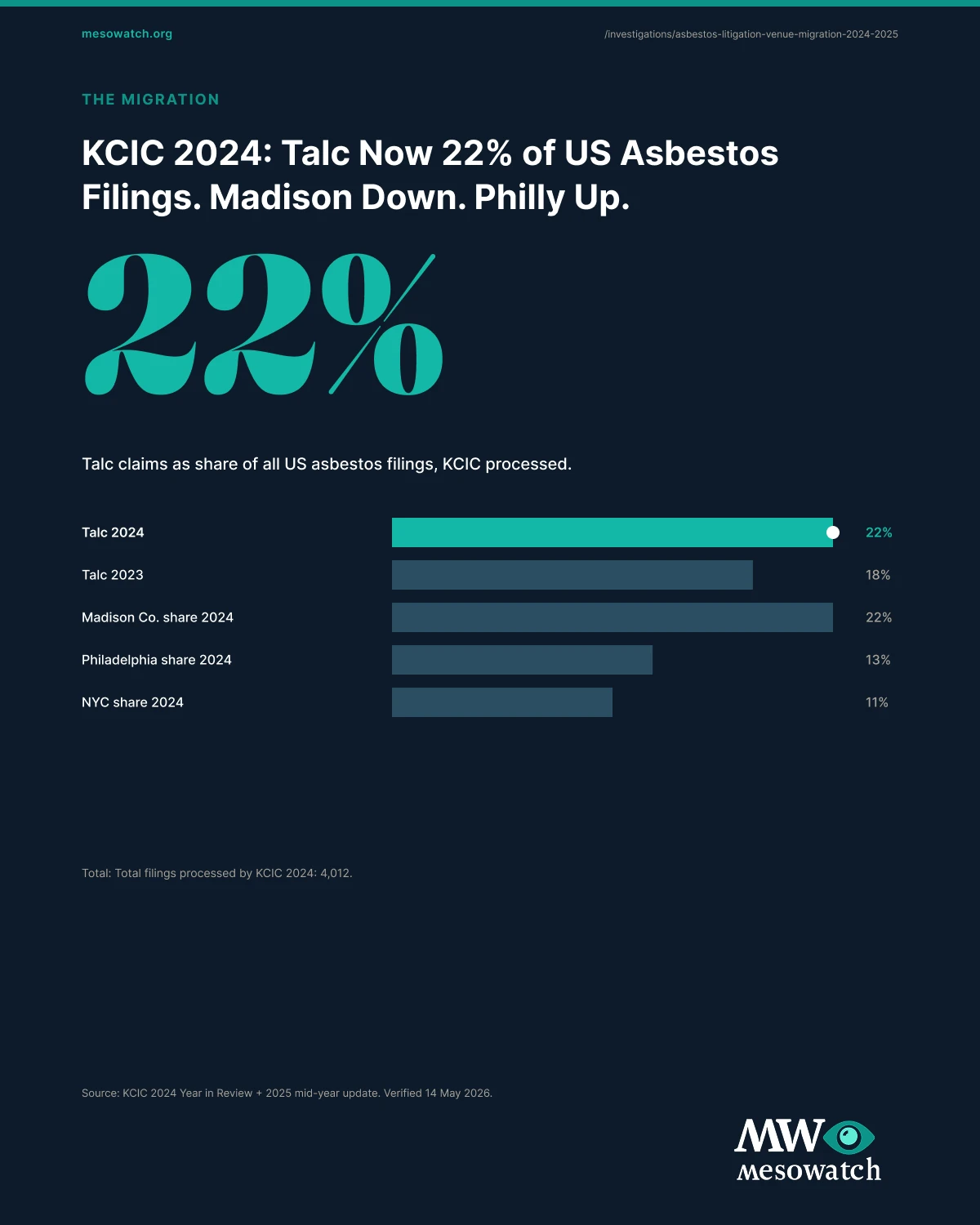
Talc allegations appeared in 19.1% of 2024 asbestos filings, 751 of 3,931, up 17.9% year over year. Talc is a growing share of the docket, but it remains a minority of it, and KCIC’s talc series covers mesothelioma and lung cancer while excluding talc-ovarian claims. For how that share concentrates in mesothelioma specifically, see talc’s share of mesothelioma lawsuits.
The Source, Stated Honestly
There is no government count of national asbestos filings. KCIC’s annual report is the benchmark by default, not by audit. KCIC is a consulting firm that processes claims for many of the largest defendant companies, and its completeness figure is its own self-estimate.
Through that work, KCIC estimates that it receives and processes at least 90% of all complaints alleging personal injuries due to asbestos exposure.
That single proprietary source is the inherent limitation of every national asbestos-filing story, including this one. The honest move is to state it plainly and to report only what the KCIC report itself prints.
A Closing Thesis
The asbestos litigation map of 2024 is not being redrawn. It is being compressed. A flat national total, 3,931 filings, hides a docket where 85% of cases run through 15 courts, two Illinois counties hold 43% of everything, and five plaintiff firms file more than half of all asbestos suits in the country, with one firm alone filing one in five.
The complementary Madison County filings investigation carries the single-venue history; this one carries the national concentration. Each stands on the figures the KCIC report actually prints.
Corrections, 2026-05-17. (1) An earlier version of this report gave the 2024 US asbestos filing total as 4,012 and attributed it to a KCIC press release; the cited report contains no such figure. The primary count is 3,931, from the KCIC 2024 Asbestos Litigation Year in Review PDF. (2) An earlier version put the 2024 talc share at 22%; that figure is from a KCIC 2025 mid-year update, not the 2024 report. The verified 2024 figure is 19.1% (751 of 3,931). (3) An earlier version carried a top-10 / 75% jurisdiction-concentration stat that is not in the cited primary report; it was removed.
Reader Q&A
Frequently Asked Questions
How many US asbestos lawsuits were filed in 2024?
Per KCIC's 2024 Asbestos Litigation Year in Review, 3,931 US asbestos personal-injury lawsuits were filed in 2024 (processed as of January 31, 2025), essentially flat against 3,929 in 2023. The count comes directly from the report PDF.
What does 'concentration, not migration' mean here?
The asbestos docket is not spreading out to new venues. It is consolidating in a small number of courts and a small number of firms. Per the KCIC 2024 report, the top 15 jurisdictions accounted for 85% of all filings, and Madison County (882, 22%) and St. Clair County (820, 21%) in Illinois together took 43% of the entire national docket. On the plaintiff side, the top 5 firms filed 51% of all US asbestos cases and the top 15 firms filed 74%. That is concentration, and it is the finding.
Which plaintiff firms file the most asbestos cases?
Per the KCIC 2024 Year in Review firm table, The Gori Law Firm filed 788 cases, about 20% of the entire US asbestos docket and roughly twice the next firm. Simmons Hanly Conroy filed 393, Weitz and Luxenberg 327, and Maune Raichle Hartley French and Mudd 303. Those four plus the fifth-ranked firm account for 51% of all national filings. No other public source consolidates the national plaintiff-firm distribution; this comes directly from the KCIC report.
Why is Madison County, Illinois the top US asbestos venue?
Illinois venue law under 735 ILCS 5/2-101 permits filing in any county where a defendant has its principal place of business or is alleged to have committed the tort. National asbestos defendants have Illinois business contacts, so an out-of-state plaintiff can often file in Madison County if a named defendant sold products into Illinois. Madison County runs a dedicated asbestos docket. Per the KCIC 2024 report, Madison recorded 882 asbestos filings (22% of the national total) and 809 mesothelioma filings, about 42% of all US mesothelioma filings. The U.S. Supreme Court's 2017 Bristol-Myers Squibb decision limited specific personal jurisdiction over out-of-state claims but did not displace Madison's position in this data.
What is the mesothelioma versus lung-cancer split?
Per the KCIC 2024 Year in Review, 2024 saw 1,907 mesothelioma filings (down 1.7% from 1,940) and 1,644 lung-cancer filings (up 4.2% from 1,577). Mesothelioma remains the largest single disease category in the asbestos docket, but lung-cancer filings grew while mesothelioma filings slightly declined.
How does KCIC count US asbestos filings, and how complete is it?
KCIC is a consulting firm that processes asbestos and toxic-tort claims for many of the largest US defendant companies. Its 2023 Year in Review states that KCIC 'receives and processes at least 90% of all complaints alleging personal injuries due to asbestos exposure.' That is KCIC's own self-estimate, and KCIC is a single proprietary defense-side source, which is the inherent limitation of all national asbestos filing data: there is no government national docket count, so KCIC's annual PDF is the benchmark by default, not by independent audit.
Where can someone with mesothelioma file a case?
Venue depends on the specific facts: where exposure occurred, which defendants are named, where those defendants have business activity, and where the person lived or worked. An attorney who handles mesothelioma cases can assess which venues are available for a given exposure history. Filing in a high-volume venue is one factor among several; strength of evidence, defendant solvency, and trust-fund eligibility affect case value more than venue alone. The complementary Madison County asbestos filings investigation covers the single-venue history in depth.

The full asbestos litigation is concentrating, not moving report, in one image.
Every claim sources to a primary government regulator or named investigative outlet. The composite is free to embed with credit. No modification of the image.
Press inquiries: editorial@mesowatch.org (MesoWatch Editorial Team)
Want to reach the desk, request the dataset, or subscribe to data drops? Jump to the newsroom