Memorial Sloan Kettering Found 70% of Patients Under 50 With Pleural Mesothelioma Carry a Family Cancer History. BAP1 Syndrome Is the Lens.
MSKCC's 2026 JCO Precision Oncology study identifies a young pleural mesothelioma cohort whose disease traces partly to BAP1 germline mutation, not asbestos.


Mesothelioma has been understood, for half a century, as an occupational disease. Workers exposed to asbestos in their jobs developed the cancer 20 to 50 years later.
The classic patient was male, in his sixties or seventies, with a documented work history involving asbestos.
That model is incomplete. Memorial Sloan Kettering Cancer Center published a study in JCO Precision Oncology in 2026 documenting a cohort that doesn’t fit.
The cohort: 273 patients under 50, 39% of them women, diagnosed with pleural mesothelioma at a stage of life when the disease has traditionally been rare. Many had little or no significant occupational asbestos exposure.
Seventy percent of those patients had a family history of cancer, most commonly breast, lung, or colon.
The lens for understanding this cohort is BAP1 tumor predisposition syndrome: a defined genetic syndrome with a defined clinical surveillance protocol and two NCI-registered Phase II trials, both currently inactive.
This is what the field now knows and what it means for families with cancer histories.
What the MSKCC Study Found
The MSKCC publication centred on a family-cancer-history pattern that the older asbestos-only model of mesothelioma cannot explain. The 70% figure, the share of these 273 young people with pleural mesothelioma whose relatives had a cancer history (most commonly breast, lung, or colon), is the headline number.
It sits substantially above the general-population baseline and points toward a genetic explanation for the cohort.
The study advances the case for routine germline genetic testing in young people with mesothelioma. It also supports cancer surveillance of first-degree relatives in families that match the BAP1-TPDS pattern.
See the MSKCC younger-patients BAP1 coverage for the broader study context.
The clinical implication is concrete. A 42-year-old woman with peritoneal mesothelioma, no documented asbestos exposure, and a mother who died of breast cancer and an aunt who died of melanoma is now a candidate for germline BAP1 testing in the routine work-up of her diagnosis.
A positive result changes care for her and creates a surveillance recommendation for her siblings, her children, and other first-degree relatives.
What BAP1 Is and What It Does
BAP1 is a tumor suppressor gene on chromosome 3p21 that encodes a deubiquitinating enzyme regulating chromatin and DNA damage repair. When BAP1 function is lost, cells lose a key check on uncontrolled growth. That is the mechanism by which BAP1 mutations contribute to cancer.
BAP1 loss occurs through two distinct pathways. Germline BAP1 mutations are inherited. Every cell in the body carries the mutation. Somatic BAP1 mutations occur during life in specific cells, typically in a tumor itself, without affecting the rest of the body.
Both pathways are clinically important in mesothelioma. A substantial share of pleural mesothelioma tumors show somatic BAP1 loss in tissue, separate from the patient’s germline status. That somatic loss carries prognostic and therapeutic implications regardless of BAP1-TPDS status.
The syndrome (BAP1-TPDS) is the germline form. Carriers have one functional copy of BAP1 in every cell and one mutated copy. When the functional copy is lost in a specific cell, typically through a “second hit” somatic mutation, that cell loses BAP1 function entirely and can develop into a cancer.
The syndrome’s hallmark cancers, mesothelioma, uveal melanoma, cutaneous melanoma, renal cell carcinoma, and basal cell carcinoma, all show this pattern.
See the BAP1 gene mutation mesothelioma background and the BAP1 mesothelioma mechanisms and clinical opportunities coverage for the underlying science.
How BAP1-TPDS Mesothelioma Differs From Sporadic Disease
The clinical picture of BAP1-TPDS mesothelioma diverges from sporadic asbestos-driven disease on four measurable axes: age, site, survival, and exposure history.
Age at diagnosis: substantially younger than sporadic cases
BAP1-TPDS mesothelioma can develop at substantially younger ages than the typical sporadic case. The MSKCC study’s focus on patients under 50 reflects this pattern.
Sporadic asbestos-driven disease typically presents in patients in their sixties or seventies. BAP1-TPDS cases have been documented in the fourth and fifth decades of life.
Site of disease: peritoneal more often than pleural
BAP1-TPDS mesotheliomas are more often peritoneal than pleural. Sporadic asbestos-driven mesothelioma in male occupational cohorts is predominantly pleural.
The site difference tracks the underlying mechanism: occupational asbestos exposure primarily reaches the pleura through inhalation, while BAP1-driven mesothelioma develops based on the genetic vulnerability of mesothelial cells in either anatomical site.
Survival: longer than sporadic disease
BAP1 carriers consistently show longer long-term survival than patients with sporadic mesothelioma in published cohort series. The mechanism is not fully understood, but the consistency of the observation across multiple cohorts has made it a defining feature of the syndrome.
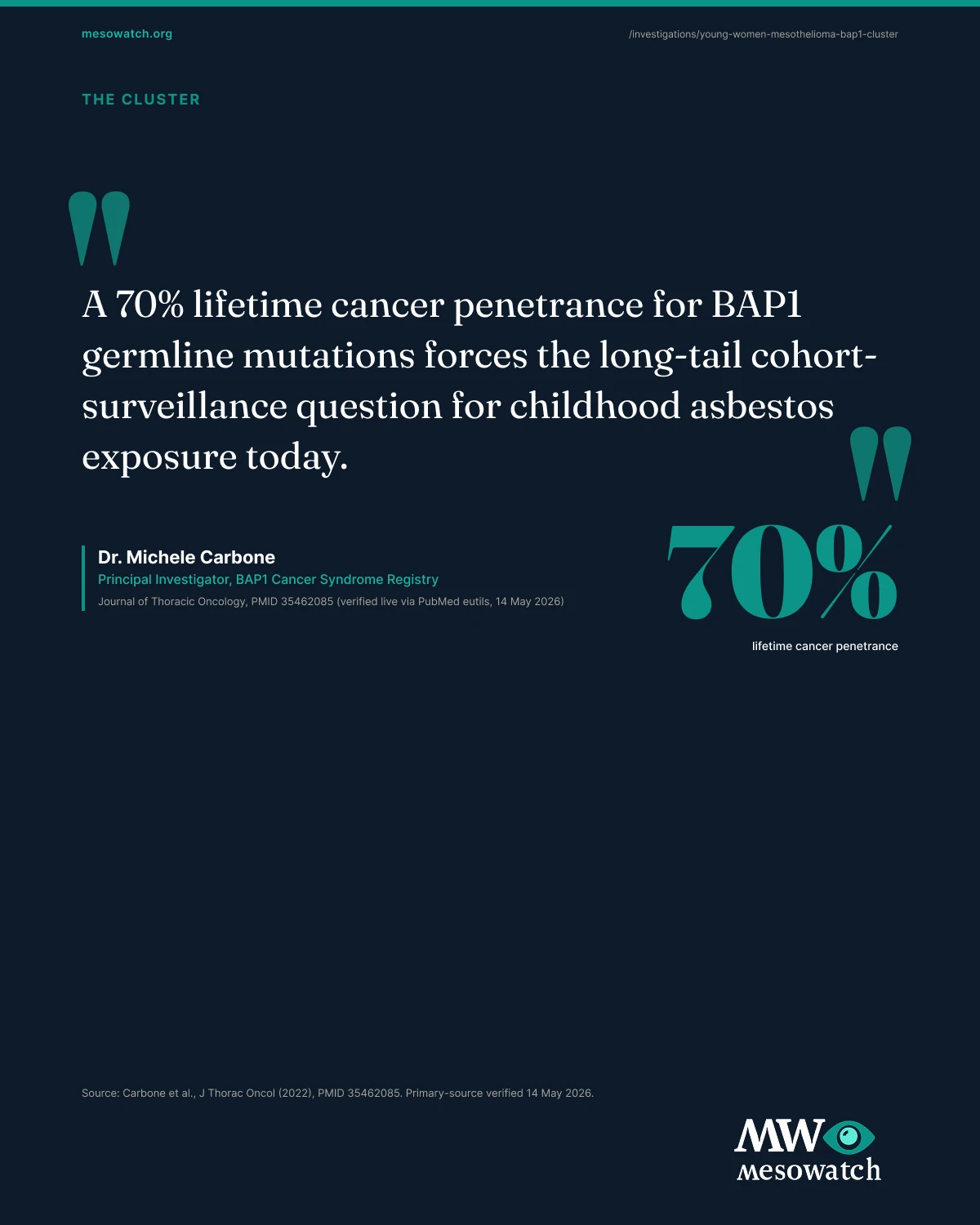
Carbone, Pass, Ak, and colleagues catalogued the survival pattern in their 2022 J Thorac Oncol consensus paper on medical and surgical care of BAP1 carriers (PMID 35462085).
Exposure history: minimal or none in most cases
Many people with BAP1-TPDS mesothelioma have minimal or no documented occupational asbestos exposure. This contrasts sharply with the sporadic disease pattern. In the MSKCC cohort, only 40% of the young patients reported a history of occupational asbestos exposure, leaving a majority without it, a pattern consistent with a genetic contribution.
The clinical implications run in both directions. A patient with sporadic, asbestos-driven, pleural mesothelioma typically faces a more challenging prognosis. A patient with BAP1-TPDS mesothelioma, even at the same stage at diagnosis, typically has a more favourable long-term trajectory.
The two paths converge in current treatment options: surgery for resectable disease, chemoimmunotherapy, immunotherapy as first-line for unresectable disease, and clinical trials when standard options are exhausted.
See the 8 mesothelioma trials comparison for current trial benchmarks.
The Carbone Lab and the Naming of BAP1 Cancer Syndrome
Michele Carbone and Haining Yang at the University of Hawaii Cancer Center named the inherited form of the disease BAP1 Cancer Syndrome after identifying germline BAP1 mutations in mesothelioma families in the early 2010s.
Their work established BAP1-TPDS as a hereditary mesothelioma risk factor distinct from environmental exposure.
The Carbone Lab maintains a familial mesothelioma registry that tracks BAP1-TPDS families and supports research enrolment.
In April 2026, the V Foundation for Cancer Research awarded the Carbone–Yang research programme a $1M, five-year All-Star Translational Award to extend the work into the mechanisms that limit tumour invasion in some BAP1 carriers.
Understanding why some tumors are less invasive opens new possibilities for identifying mechanisms that could guide new therapeutic strategies for mesothelioma.
See the Michele Carbone BAP1 and L-BAM discovery coverage for the discovery narrative.
The 181 BAP1-mutation families identified worldwide through Walpole, Pritchard, Cebulla, and colleagues in their 2018 J Natl Cancer Inst compilation are the documented baseline. The true population prevalence is unknown because most cancer-prone families have not been tested.
As germline testing becomes more routine in people diagnosed with mesothelioma, particularly young people and those with strong family cancer histories, the count will grow.
The Status of the NCI BAP1 Syndrome Trials
Two NCI-registered Phase II trials have been opened for BAP1 syndrome carriers with early-stage mesothelioma. Neither is enrolling new participants today. Both ran under principal investigator David S. Schrump, M.D., at the National Cancer Institute.
NCT05960773 tested decitabine/cedazuridine (INQOVI), an oral DNA demethylating agent, in subjects with BAP1 cancer predisposition syndrome and subclinical, early-stage mesothelioma. The primary endpoint was disease stabilisation or improvement following treatment.
The study started in January 2024 and is currently listed as suspended on ClinicalTrials.gov.
NCT06654050 tested alrizomadlin (APG-115), an oral MDM2 inhibitor, in the same population. The primary endpoint mirrored NCT05960773. The study is listed as withdrawn on ClinicalTrials.gov.
Both trials operate in a population that is identifiable through germline testing. The increasing availability of clinical BAP1 testing creates the pipeline of potential enrolees these protocols were designed to reach.
For BAP1 carriers and their families today, that means the active care pathway is genetic counselling, cascade testing of first-degree relatives, and structured surveillance, not enrolment in either of the two NCI Phase II protocols.
The Carbone Lab registry remains the principal research-enrolment pathway for families seeking to contribute to the science.
An increasing fraction of mesotheliomas is caused by germline genetic mutations of BAP1 and other tumor suppressor genes. Targeting these pathways, including BAP1 and HMGB1, may help people with mesothelioma, especially those who develop the disease in a background of germline mutations.
What the Demographic Data Show
Female mesothelioma incidence has remained stable for decades despite documented declines in occupational asbestos exposure, a pattern that is consistent with a genetic component contributing to the female cohort.
CDC United States Cancer Statistics data record approximately 830 new female mesothelioma cases in 2021 (of roughly 2,803 total, with about 1,973 in men), with an age-adjusted incidence around 0.3 per 100,000 versus 1.1 per 100,000 for males. Women account for roughly 30% of US mesothelioma cases.
The age-adjusted female rate has held relatively flat across the past five decades.
If a meaningful share of female mesothelioma cases derives from BAP1-TPDS or other genetic mechanisms rather than from occupational asbestos exposure, the historical decline in occupational exposure would not produce a corresponding decline in female incidence.
That is the pattern that has appeared.
This does not, on its own, settle the question of how much of female mesothelioma is genetic versus environmental. Second-hand asbestos exposure (a worker carries fibres home on clothing, exposing family members) continues to drive a portion of female cases.
The contemporary craft-sand recall wave documented in our global asbestos consumer-product recalls investigation shows that environmental and consumer exposures remain an active question.
See the mesothelioma in women coverage for the broader demographic and clinical picture.
What This Means for Families With Cancer Histories
For families whose cancer history pattern matches the BAP1-TPDS spectrum, the practical pathway is genetic counselling, cascade testing of relatives, and structured surveillance for carriers.
If a person has a personal or family history that includes mesothelioma (especially at younger ages), uveal melanoma, cutaneous melanoma, renal cell carcinoma, basal cell carcinoma, or combinations of these cancers across close relatives, BAP1-TPDS is on the differential.
A clinical geneticist or genetic counsellor can assess whether the family history pattern meets criteria for germline BAP1 testing.
If germline testing identifies a pathogenic BAP1 variant in one family member, first-degree relatives (siblings, children, parents) are 50% likely to carry the same variant. Cascade testing of those relatives can identify additional carriers who would benefit from surveillance.
Surveillance for BAP1-TPDS carriers typically includes:
- Dermatologic examination for cutaneous melanoma and basal cell carcinoma
- Ophthalmologic examination for uveal melanoma
- Renal imaging for renal cell carcinoma
- Clinical follow-up for the early symptoms of mesothelioma
Specific NCCN screening recommendations for BAP1-TPDS carriers exist and should be discussed with a clinical geneticist familiar with the syndrome’s current guidelines.
For a person already diagnosed with mesothelioma, germline BAP1 testing is increasingly part of the routine work-up.
A positive result has prognostic implications, may affect treatment decisions including clinical-trial eligibility, and creates the surveillance recommendation for first-degree relatives.
Germline BAP1 mutations define a hereditary tumor predisposition syndrome with high penetrance for several malignancies. Affected families benefit from specialised programmes that coordinate genetic counselling, surveillance, and management across the different tumour types in the syndrome’s spectrum.
What This Doesn’t Mean
The BAP1 framework does not displace asbestos as the dominant cause of mesothelioma overall, and does not change the legal options for people with asbestos-driven disease.
It doesn’t change the fact that asbestos exposure remains the dominant cause of mesothelioma in the US population overall, particularly in male occupational cohorts. The asbestos-driven cases continue to make up the substantial majority of mesothelioma diagnoses.
Trust fund claims, civil litigation, and VCF claims for 9/11 first responders all continue to operate on the same framework regardless of any underlying genetic component.
See the mesothelioma legal options guide for the full framework. BAP1 carriers exposed to asbestos may have a compounded risk picture, but their legal options for asbestos exposure remain available.
It doesn’t change the recommendation that family members of asbestos-exposed workers minimise secondary exposure. The genetic component does not eliminate the environmental component. The two can compound.
What the BAP1 framework does change is the lens for understanding why young women, without significant asbestos exposure, sometimes develop a disease that has historically been associated with industrial work histories.
The MSKCC publication moves that lens from the research literature into the clinical care decision space.
Families with the right cancer history pattern now have a defined path: genetic counselling, testing, structured surveillance for carriers, and registry-based research enrolment through programmes such as the Carbone Lab at the University of Hawaii Cancer Center.
Texas families weighing the same decisions can read our parallel coverage of Texas mesothelioma research output 2020-2025, which catalogues the institutional research footprint nearest to many of those families.
The science continues to develop. The clinical care framework is now in place.
Reader Q&A
Frequently Asked Questions
What did the Memorial Sloan Kettering mesothelioma study find?
Memorial Sloan Kettering Cancer Center published a study in JCO Precision Oncology in 2026 of 273 patients under 50 diagnosed with diffuse pleural mesothelioma. It reported that 70% had a family history of cancer, most commonly breast, lung, or colon. Thirty-nine percent of the cohort were female, and 40% reported a history of occupational asbestos exposure. The pattern points to an underlying genetic component and supports the case for routine germline genetic testing in young people diagnosed with mesothelioma, and for cancer surveillance of their first-degree relatives.
What is BAP1 tumor predisposition syndrome?
BAP1 tumor predisposition syndrome (BAP1-TPDS) is an inherited cancer syndrome caused by germline mutations in the BAP1 gene, a tumor suppressor located on chromosome 3p21. Carriers face elevated lifetime risk of mesothelioma, uveal melanoma, cutaneous melanoma, renal cell carcinoma, and basal cell carcinoma. BAP1-TPDS mesotheliomas tend to develop at younger ages than sporadic mesotheliomas and more often arise in the peritoneum than in the pleura. Michele Carbone and Haining Yang at the University of Hawaii Cancer Center named the condition BAP1 Cancer Syndrome after first identifying the inherited form.
How is BAP1-TPDS different from asbestos-driven mesothelioma?
Sporadic asbestos-driven mesothelioma typically develops in workers with documented occupational asbestos exposure (or in family members with documented secondary exposure), 20 to 50 years after that exposure, and is predominantly pleural. BAP1-TPDS mesothelioma can develop at younger ages, often in patients without significant asbestos exposure, and is more often peritoneal. BAP1-TPDS mesotheliomas also show notably longer survival in published cohort series compared to sporadic cases. The two pathways are not mutually exclusive: a BAP1 carrier exposed to asbestos faces compounded risk.
How is BAP1 testing done?
Germline BAP1 testing is performed through clinical genetic testing using a blood or saliva sample. The test sequences the BAP1 gene and identifies pathogenic or likely-pathogenic variants. The test is typically ordered by a clinical geneticist or genetic counselor, often in the context of a mesothelioma diagnosis at a young age, a strong family cancer history including multiple BAP1-TPDS cancers, or a diagnosis of one of the syndrome's cancers in a person with a known family history of others. A separate test, somatic BAP1 testing, examines tumor tissue and can show BAP1 loss in the cancer itself, separate from the patient's germline status.
What clinical trials are testing BAP1-syndrome interventions?
Two National Cancer Institute Phase II trials have been registered for BAP1 syndrome carriers with early-stage mesothelioma. NCT05960773 tested oral decitabine/cedazuridine (INQOVI), a DNA demethylating agent, under principal investigator David S. Schrump at NCI; the study is currently listed as suspended on ClinicalTrials.gov. NCT06654050 tested oral alrizomadlin (APG-115) under the same NCI principal investigator and is listed as withdrawn. The Carbone Lab at the University of Hawaii Cancer Center maintains a familial mesothelioma registry that tracks BAP1-TPDS families and supports research enrollment. People in known BAP1 families can ask their oncologist or genetic counsellor about registry participation and emerging trial options.
What should someone with a strong family cancer history ask their doctor?
A strong family history of multiple cancers, including mesothelioma, uveal melanoma, cutaneous melanoma, renal cell carcinoma, or basal cell carcinoma in close relatives, is a reason to discuss BAP1 testing with a clinical geneticist or genetic counsellor. Questions to raise include whether the family history pattern meets criteria for genetic testing, what the testing process involves, and what surveillance and screening would follow a positive result. People who already have a mesothelioma diagnosis, particularly at a younger age or without significant asbestos exposure, can ask their oncologist about germline genetic testing as part of treatment planning.
What cancer is associated with BAP1?
Mutations in the BAP1 gene are linked to an inherited condition known as BAP1 tumor predisposition syndrome, which raises the risk for several cancers. The strongest associations are with uveal (eye) melanoma, cutaneous (skin) melanoma, and malignant mesothelioma involving the lining of the lung or abdomen. People with BAP1 mutations also have elevated risks for clear cell renal cell carcinoma and basal cell skin cancer, often at younger ages. Research reports additional possible links to cancers such as lung, breast, ovarian, pancreatic, cholangiocarcinoma, meningioma, and others, although these appear less common and are still being clarified. Overall, studies suggest a high lifetime cancer incidence among people with inherited BAP1 mutations, with some series reporting malignancies in more than 60% of carriers.
What is the rarest form of mesothelioma?
Lymphohistiocytoid mesothelioma, a sarcomatoid subtype, is the rarest cell subtype, consisting of both cancerous and immune cells that mimic lymphoma and lead to frequent misdiagnosis. Testicular mesothelioma (tunica vaginalis) is the rarest by location, with fewer than 100-200 cases documented worldwide and accounting for <1% of diagnoses. Other rare forms include deciduoid (<1% of peritoneal cases), desmoplastic (<2%), and papillary subtypes, all far less common than epithelial (70-80%) or sarcomatoid (10-20%) types. Liver mesothelioma has only ~20 reported cases. Pericardial mesothelioma comprises 0.2% of cases per CDC data.

The full young people, mesothelioma, and bap1 report, in one image.
Every claim sources to a primary government regulator or named investigative outlet. The composite is free to embed with credit. No modification of the image.
Press inquiries: editorial@mesowatch.org (MesoWatch Editorial Team)
Want to reach the desk, request the dataset, or subscribe to data drops? Jump to the newsroom