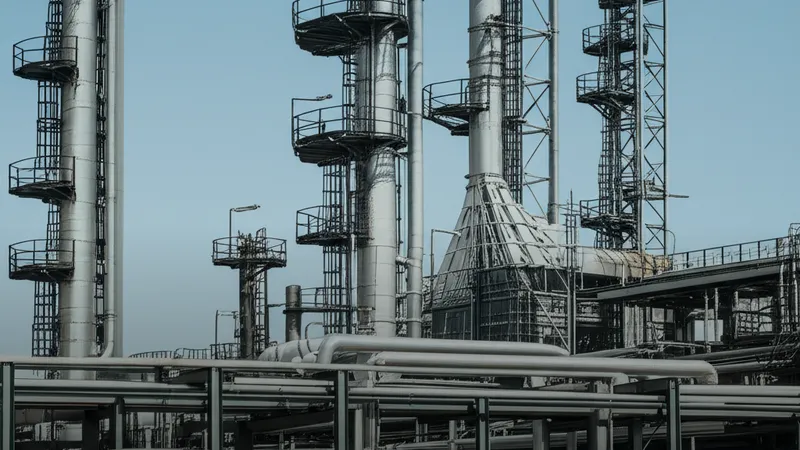
Oil refineries have been called “asbestos factories in themselves” due to the vast quantities of the material used throughout these facilities. Epidemiological studies have documented mesothelioma rates 2-5 times higher among refinery workers compared to the general population, with certain job categories showing even greater risk elevation.
The American Petroleum Institute estimates that approximately 60,000 workers are directly employed at U.S. refineries, with additional contract workers performing maintenance and turnaround operations. Many of these facilities were constructed during peak asbestos use decades and continue to contain legacy materials.
Why Refineries Used So Much Asbestos
Oil refining involves extreme temperatures, pressures, and flammable materials that made asbestos an essential material:
Process temperatures: Crude oil is heated to 650-750°F during initial distillation. Catalytic cracking operates at 900-1000°F. These temperatures required insulation that could withstand thermal stress while protecting workers and equipment.
Fire protection: Refineries present extreme fire hazards. Asbestos fireproofing was applied to structural steel, equipment supports, and protective barriers throughout facilities.
Steam systems: Refineries consume massive amounts of steam for heating, stripping, and power generation. Steam systems operating at 300-600°F were insulated with asbestos pipe covering.
Equipment insulation: Distillation towers, heat exchangers, reactors, tanks, and hundreds of miles of piping in a typical refinery were insulated with asbestos-containing materials.
A typical large refinery built before 1980 contained an estimated thousands of tons of asbestos insulation and fireproofing.
Research on Refinery Worker Mesothelioma
Multiple studies have documented elevated mesothelioma risk among oil and petrochemical workers:
Divine and Barron (1987): A study of 15,000 Texaco refinery workers found overall cancer mortality significantly elevated, with mesothelioma cases documented in maintenance workers and operators.
Sathiakumar et al. (1995): Analysis of Shell Oil refinery workers found standardized mortality ratio of 2.4 for mesothelioma among maintenance employees.
Tsai et al. (2001): Study of Louisiana petrochemical workers documented mesothelioma mortality 2.8 times higher than expected based on state rates.
Meijers et al. (1990): Dutch refinery study found relative risk of 4.3 for pleural cancer among workers with documented asbestos exposure.
Wong and Raabe (2000): Meta-analysis of petroleum industry mortality studies confirmed “consistent excess risk” for mesothelioma across multiple facilities and countries.
The National Institute for Occupational Safety and Health (NIOSH) has classified refinery work as a high-risk occupation for asbestos-related disease based on this accumulated evidence.
Asbestos-Containing Materials in Refineries
Comprehensive industrial hygiene surveys have identified asbestos in numerous refinery applications:
| Component | Asbestos Content | Typical Location |
|---|---|---|
| Pipe insulation | 15-50% | Throughout facility |
| Vessel insulation | 20-50% | Distillation, reactors |
| Fireproofing | 10-25% | Structural steel |
| Gaskets | 60-90% | Flanges, equipment |
| Packing | 50-80% | Pumps, valves |
| Refractory cement | 15-25% | Furnaces, heaters |
| Roof felt | 10-15% | Buildings |
| Floor tile | 5-25% | Control rooms, offices |
Equipment that required frequent maintenance, such as heat exchangers, pumps, and valves, concentrated exposure during repair operations.
High-Risk Job Classifications
Insulators: Refinery insulators who applied, repaired, and removed asbestos insulation faced the highest exposure levels. Studies show mesothelioma SMRs of 5-10 among industrial insulators.
Pipefitters: Workers who installed, repaired, and maintained piping systems encountered asbestos in pipe insulation and gaskets. Cutting and fabricating pipe involved disturbing asbestos wrap.
Boilermakers: Refinery boilermakers who worked on process heaters, boilers, and fired equipment handled asbestos refractory and insulation throughout their careers.
Maintenance mechanics: General maintenance workers performed varied tasks throughout refineries, accumulating exposure from multiple sources during repair and modification work.
Operators: Process operators who monitored equipment and conducted routine inspections accumulated environmental exposure from deteriorating insulation and nearby maintenance activities.
Turnaround workers: Contract workers brought in during scheduled shutdowns performed concentrated maintenance activities with high asbestos exposure potential.
Laborers: Cleanup crews who swept up insulation debris and assisted other trades accumulated exposure from handling asbestos waste.
Exposure During Turnarounds
Refinery turnarounds (scheduled shutdowns for maintenance) presented particularly high exposure risks:
Scope of work: Turnarounds involve opening equipment, replacing components, and performing maintenance throughout the facility simultaneously. Thousands of workers may be on site during major turnarounds.
Time pressure: Turnarounds are scheduled for specific durations, creating pressure to complete work quickly. Safety shortcuts may occur under deadline pressure.
Concentrated exposure: Multiple crafts working simultaneously in confined areas can create extremely high airborne fiber concentrations. Studies have measured fiber counts 10-50 times above OSHA limits during poorly controlled turnaround activities.
Contract workers: Many turnaround workers are employed by contractors rather than the refinery directly. These workers may have less familiarity with facility-specific hazards and safety procedures.
A 2015 OSHA enforcement action against a Texas refinery documented asbestos violations during turnaround operations, with fines exceeding $200,000 for failure to protect workers.
Despite decades of removal efforts, asbestos remains in many refineries. In equipment insulation, gaskets, hidden materials, and deteriorating insulation. Workers can encounter it unexpectedly during maintenance. The EPA’s 2024 chrysotile ban has a 12-year phase-out, so some use continues.
Historical Exposure Patterns
1930s-1960s: Early refineries built during this period used asbestos extensively. Workers received no warnings or protection. Asbestos dust was visible in work areas.
1960s-1980s: Peak asbestos use in refining. Many of today’s operating refineries were built or expanded during this period. Documentation of asbestos disease among refinery workers began accumulating.
1980s-2000s: Regulations required asbestos management and worker protection. Many refineries began asbestos removal programs. However, legacy materials remained extensive.
2000s-present: Most refineries have formal asbestos management programs. Exposure continues during maintenance of older equipment and facilities. Removal projects proceed gradually.
Ongoing Exposure Risks
Despite decades of removal efforts, asbestos remains in many refineries:
Equipment insulation: Older process equipment still containing original insulation requires maintenance. Disturbing this insulation releases fibers.
Gaskets and packing: Some refineries continued using asbestos gaskets into the 2000s due to high-temperature requirements. Replacement of these components creates exposure.
Hidden materials: Asbestos may be concealed within walls, ceilings, and equipment enclosures. Workers can encounter it unexpectedly during modifications.
Deterioration: Aging insulation that remains in place may be releasing fibers continuously as it degrades.
The EPA’s 2024 ban on chrysotile asbestos affects some refinery applications, but a 12-year phase-out period means some use will continue.
Regulatory Oversight
Refineries are subject to multiple regulatory frameworks:
OSHA Asbestos Standards: The general industry standard (29 CFR 1910.1001) and construction standard (29 CFR 1926.1101) apply to different refinery activities. Permissible exposure limit is 0.1 fibers/cc.
EPA NESHAP: The National Emission Standards for Hazardous Air Pollutants require notification before demolition or renovation that may disturb asbestos. Refineries must manage asbestos waste according to specific requirements.
Process Safety Management: OSHA’s PSM standard (29 CFR 1910.119) requires hazard assessments and management of change procedures that may address asbestos identification.
State regulations: Some states have additional requirements for asbestos management in industrial facilities.
OSHA enforcement data shows refinery asbestos violations result in penalties averaging $25,000-100,000 per citation, with serious violations sometimes exceeding $250,000.
Documenting Refinery Exposure
Refinery workers should maintain records of:
- Employers (refineries and contractors) and dates of employment
- Job classifications and specific duties
- Units and areas worked in
- Equipment maintained or operated
- Products and materials handled (insulation brands, gasket manufacturers)
- Safety equipment provided
- Training received regarding asbestos
- Known asbestos removal projects during employment
Contract workers should document all facilities where they performed work, as exposure may have occurred at multiple refineries.
Legal and Compensation Options
Refinery workers diagnosed with mesothelioma may pursue multiple compensation sources:
Product liability: Manufacturers of asbestos insulation, gaskets, packing, and other products used in refineries may be liable. Major defendants include Johns Manville, Owens Corning, and numerous gasket manufacturers.
Asbestos trust funds: Many asbestos product manufacturers have established trusts through bankruptcy. Refinery workers may file claims with multiple trusts based on products documented in their work history.
Premises liability: Refinery owners who failed to protect workers from known asbestos hazards may be liable. This applies to both direct employees and contract workers.
Third-party contractor claims: Contract workers may have claims against both the refinery and their direct employer depending on circumstances.
Workers’ compensation: Direct refinery employees may file occupational disease claims, though remedies are typically more limited than litigation.
Related Articles
- High-Risk Occupations for Asbestos
- Boilermakers and Asbestos
- HVAC Technicians
- Plumbers and Pipefitters
- Asbestos Trust Funds
Why are oil refinery workers at such high risk?▼
Refineries used massive amounts of asbestos due to extreme temperatures (up to 1000°F), fire hazards, steam systems, and equipment insulation needs. A typical pre-1980 refinery contained thousands of tons of asbestos. Studies show mesothelioma rates 2-5x higher than the general population among refinery workers.
Which refinery jobs had highest exposure?▼
Insulators faced the highest exposure (mesothelioma SMRs of 5-10). Pipefitters, boilermakers, maintenance mechanics, and turnaround workers also had significant exposure. Even operators accumulated environmental exposure from deteriorating insulation and nearby maintenance.
What about turnaround workers?▼
Turnaround periods (scheduled shutdowns) presented particularly high exposure. Studies measured fiber counts 10-50 times above OSHA limits during poorly controlled turnaround activities. Time pressure, concentrated work, and contract workers unfamiliar with site hazards increased risk.
What compensation is available for refinery workers?▼
Multiple sources: product liability claims against asbestos manufacturers, asbestos trust funds (major defendants include Johns Manville, Owens Corning, gasket manufacturers), premises liability claims against refinery owners, third-party contractor claims, and workers’ compensation.