112 years of smelting in El Paso. $1.79B bankruptcy. Zero peer-reviewed mesothelioma cohort study of the workers.
ASARCO El Paso smelted from 1887 until 1999, then entered the largest US environmental bankruptcy. The smelter-worker mesothelioma cohort is still unpublished.

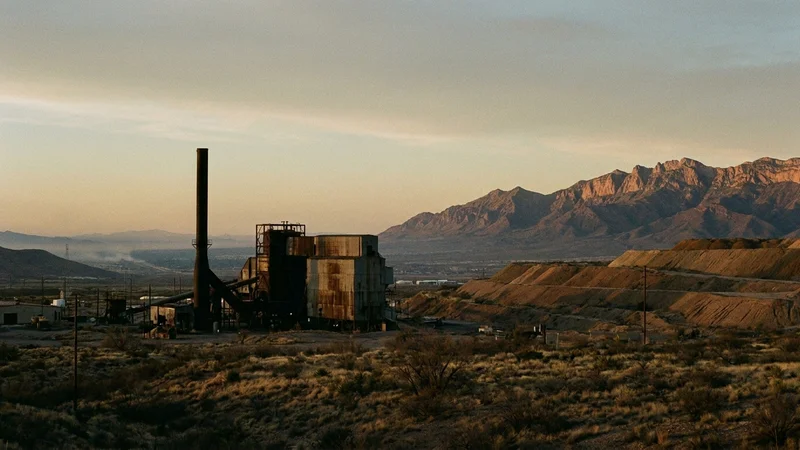
ASARCO operated a copper, lead, and zinc smelter in El Paso for roughly 112 years, then moved through the largest environmental bankruptcy in United States history and left a $52 million Texas custodial trust on a 458-acre site in west central El Paso County.
The smelter ran from 1887 until ASARCO suspended operations in 1999. The plant then sat idle for years before the company filed Chapter 11 in 2005. The property sits less than a mile from the University of Texas at El Paso and within sight of the international border with Ciudad Juárez.
ASARCO LLC filed for Chapter 11 bankruptcy protection on August 9, 2005 in the United States Bankruptcy Court for the Southern District of Texas, Corpus Christi Division, Case No. 05-21207. The Second Amended Joint Plan of Reorganization was confirmed on November 13, 2009.
The Department of Justice characterized the $1.79 billion environmental settlement as “the largest environmental bankruptcy in U.S. history.”
The federal court records of the closure are complete. The Texas Commission on Environmental Quality documentation is on the agency’s website.
The Texas Department of State Health Services 2017 cancer cluster assessment is in the DSHS environmental epidemiology archive. The workforce cohort study is not.
A 112-Year Operation
The El Paso smelter was founded around 1887. It processed copper, lead, and zinc ores for the better part of three industrial eras until ASARCO suspended operations in 1999.
The plant ran for roughly 112 years. It supplied raw materials to industrial customers through the buildup decades of the late 19th century, the war-economy decades of the early-to-mid 20th century, and the de-industrialisation decades that followed.
Workforce composition shifted across the decades. Early operations relied on largely manual labor.
Post-World War II operations were a mix of skilled trades and operators: insulators, pipefitters, boilermakers, electricians, millwrights, maintenance crews, and laborers performing cleanup after insulation removal.
The smelter sat in a neighborhood that grew up around it. Smeltertown, on the west side of the property, was a primarily Mexican-American residential settlement built directly adjacent to the smelter operation.
It was displaced in the 1970s following the discovery of elevated lead levels in children living in the surrounding area.
The El Paso lead poisoning study, conducted by the Centers for Disease Control and El Paso city health authorities in the early 1970s, documented blood lead levels in children near the smelter.
The study informed subsequent regulatory action on smelter emissions and stands as one of the earliest documented community lead-exposure cases tied to a US non-ferrous smelter.
ASARCO suspended operations at the El Paso plant in February 1999. The plant sat idle for years before the company filed Chapter 11 in 2005. Following the 2009 settlement and the formation of the custodial trust, the smelter and associated industrial structures were demolished, with the smokestacks brought down on April 13, 2013.
The property today is held by the trust pending final cleanup and reuse determinations.
The Bankruptcy Settlement
ASARCO LLC filed Chapter 11 on August 9, 2005, and the bankruptcy resolved over four years with the largest environmental settlement of its kind in United States history.
The case was consolidated in the Southern District of Texas, Corpus Christi Division, under Case No. 05-21207. The Second Amended Joint Plan of Reorganization was confirmed by the bankruptcy court on November 13, 2009.
The $1.79 Billion Environmental Recovery
The $1.79 billion environmental settlement covered cleanup obligations at multiple ASARCO sites across the western United States. The Department of Justice press release described it as the largest environmental bankruptcy in United States history.
The settlement was achieved through coordinated work among the US Environmental Protection Agency, the US Department of Justice, and state environmental agencies in the affected states.
The Section 524(g) Asbestos Trust
The bankruptcy structure separated environmental obligations from asbestos personal injury claims.
Asbestos personal injury claims were channeled to a Section 524(g) trust under 11 USC 524(g), the federal statute that allows companies with substantial asbestos liability to consolidate present and future personal injury claims into a single trust that survives the bankruptcy.
The 524(g) trust handles claims separately from the environmental custodial trusts established for site cleanup.
The trust-fund mechanism is the same one used in the broader asbestos trust-fund payout landscape that governs claims at Owens Corning, Celotex, and Manville-successor trusts.
In its December 10, 2009 announcement of the settlement, the Department of Justice characterized the $1.79 billion resolution as the largest environmental bankruptcy in United States history.
The TCEQ Custodial Trust
The El Paso property is held in a custodial trust under Texas Commission on Environmental Quality oversight, funded with over $52 million through a Consent Decree filed March 19, 2009 and approved by the court on June 5, 2009. The US Environmental Protection Agency is a signatory.
Why Custodial Trust and Not Superfund
The custodial trust mechanism is distinct from the federal Superfund National Priorities List process.
Federal Superfund cleanup proceeds under the Comprehensive Environmental Response, Compensation, and Liability Act (CERCLA) through a sequence of remedial investigation, feasibility study, and Record of Decision, with EPA as the lead agency for NPL sites.
Custodial trust cleanup proceeds under bankruptcy court order. The trustee performs cleanup work funded by the trust corpus and overseen by state and federal agencies. The El Paso site sits in the second framework rather than the first.
What the Trust Pays For
The El Paso custodial trust governs site remediation work that includes:
- Soil remediation across the 458-acre footprint
- Demolition of remaining smelter infrastructure
- Containment of arsenic and lead-contaminated material
- Long-term institutional controls on the property
- Oversight reporting to TCEQ and EPA
The TCEQ documentation of the site references the custodial trust structure and identifies the property as in active remediation.
The Negative DSHS Finding
The Texas Department of State Health Services examined cancer occurrence in west central El Paso County in 2017 and did not identify a statistically significant cluster.
The assessment, prompted by community concerns about cancer rates in the neighborhoods surrounding the former ASARCO property, covered data from 2010 through 2014.
The methodology followed the joint Centers for Disease Control and Council of State and Territorial Epidemiologists 2013 Guidelines for Investigating Suspected Cancer Clusters and the DSHS protocol updated January 15, 2016.
What the Assessment Examined
The DSHS investigation looked at overall cancer incidence in the geographic area and reviewed kidney cancer concerns in particular. The investigation did not identify a statistically significant cancer cluster in west central El Paso County across the period examined.
It did not progress to steps 3 or 4 of the CDC/CSTE guidelines, which would involve additional epidemiologic analysis such as case-control studies or focused exposure assessment.
Why the Finding Does Not Settle the Question
A negative cluster finding does not mean exposure did not occur. It means the methodology used by DSHS at the geographic and time-period scale examined did not detect cancer incidence above what would be statistically expected for a comparable Texas population.
The assessment is one piece of the picture. It is not a comprehensive evaluation of every health outcome associated with the smelter operation.
It does not encompass mesothelioma specifically because mesothelioma incidence at the census-tract scale is too sparse to support cluster methodology of the kind DSHS used.
Mesothelioma is a low-incidence cancer with an incidence rate of roughly 0.6 per 100,000 per year nationally per CDC US Cancer Statistics. Detecting an excess at neighborhood scale requires a different analytic frame than the population-incidence comparison DSHS ran.
The assessment itself notes that this step-two analysis cannot determine the cause of any cancer and that only a small fraction of cancer-cluster inquiries proceed through all of the guideline steps. By design, an initial screening compares incidence at population scale. It does not rule out a disease excess that a more focused, hypothesis-driven cohort or case-control study might detect, and the El Paso assessment did not reach those later steps.
The Cohort That Doesn’t Exist
A targeted search of PubMed and PubMed Central for a peer-reviewed mesothelioma or pleural disease cohort study of ASARCO smelter workers returns no matches. There is no dedicated published cohort that would inform a quantitative exposure assessment for the El Paso worker population.
This is itself the finding worth reporting.
The Analog Cohorts in the Literature
The closest analog cohorts are studies of shipyard workers, refinery workers, and asbestos manufacturing workers, not non-ferrous smelter workers. Two anchor the comparison:
Krstev 2007 (US Coast Guard Shipyard)
The Krstev et al. 2007 US Coast Guard shipyard cohort, published in Occupational and Environmental Medicine (PMID 17881470), followed 4,702 workers employed at the Baltimore Coast Guard yard from 1950 to 1964.
It reported a standardized mortality ratio of 5.07 for mesothelioma overall and 6.27 for workers with 10 or more years of employment.
Sanden 1992 (European Shipyard)
The Sanden et al. 1992 European Respiratory Journal cohort (PMID 1572439) followed 3,893 shipyard workers and found 11 observed pleural mesothelioma cases against 1.5 expected, a sevenfold elevation.
These cohorts establish the asbestos-mesothelioma relationship in industrial trades. They do not stand in for the El Paso worker population.
What a Smelter Worker Was Exposed To
Non-ferrous smelters used asbestos-containing materials extensively before the OSHA general industry asbestos standard (29 CFR 1910.1001) took effect in 1972. The standard industrial-asbestos applications of the era include:
- Thermal pipe insulation on steam, condensate, and process lines
- Boiler lagging on the package and water-tube units
- Gaskets at flanged joints across high-temperature systems
- Fireproofing on structural steel inside the cell-house and reverberatory furnace buildings
- Equipment insulation on tanks, furnaces, dryers, and heat exchangers
The same applications used at refineries and shipyards were used at smelters.
Worker categories at the El Paso smelter that would have had direct asbestos exposure include insulators, pipefitters, boilermakers, electricians, maintenance crews, and laborers performing cleanup after insulation removal.
What remains absent is a published cohort that quantifies that exposure for the specific El Paso workforce.
The 750-Mile Drive
El Paso sits 750 miles by driving distance from the highest-volume mesothelioma clinical research program in Texas.
The MD Anderson mesothelioma trial access gap investigation documents the geographic concentration of NCI-designated mesothelioma research in Texas.
El Paso is the furthest major Texas metro from the Houston cancer center. The driving distances families face from West Texas, the Panhandle, and the Permian Basin all run through the same geography.
For an El Paso family navigating a mesothelioma diagnosis, the geography compounds the medical complexity. Specialist consultation, surgical evaluation, and clinical trial access are concentrated in Houston.
Mays Cancer Center: The Closer Option
The Mays Cancer Center at UT Health San Antonio holds NCI Clinical Cancer Center designation and is the closest NCI center to El Paso, at approximately 550 miles.
The Mays Cancer Center supports thoracic and pleural mesothelioma cases through its Lung Cancer Program. The deepest mesothelioma clinical trial portfolio in Texas, however, sits at MD Anderson in Houston.
Why Geography Compounds the Cohort Question
The geography is not separate from the cohort question. The same distances that constrain a worker’s access to a specialist consultation today constrain the formation of a research cohort that would document the worker population’s exposure history.
The smelter operated for roughly 112 years. The records of those workers, their occupational histories, and their health outcomes are dispersed across personal records, family papers, and the institutional memory of the former workforce.
Building a cohort study at this point requires the kind of focused community-based research that the El Paso area has not yet seen for the ASARCO smelter population specifically.
The 112-year smelter generated complete federal court records of its closure. The cohort that worked it has no peer-reviewed record. That is not an accident. It reflects which questions the federal Superfund and bankruptcy systems were designed to answer, and which questions occupational epidemiology requires separate funding and effort to address.
What This Pattern Means
The federal court records of the closure are complete. The medical and legal records of the closure exist. The workforce cohort study does not.
The asymmetry is not an accident. It reflects which questions the federal Superfund and bankruptcy systems were designed to answer and which questions occupational epidemiology requires separate funding and effort to address.
The Second Amended Joint Plan of Reorganization is on the docket of the Southern District of Texas. The Consent Decree funding the El Paso custodial trust is on the same docket.
The TCEQ trust documentation is on the agency’s website. The 2017 DSHS cancer cluster assessment is in the DSHS environmental epidemiology archive.
The bankruptcy resolution closed in 2009. The EPA chrysotile rule one year after covers the federal regulatory shift that closed one chrysotile pathway in 2024 but did not address the legacy-exposure question that El Paso poses.
The bankruptcy framework also did not address it. The DSHS cluster framework could not address it. None of the three were designed to.
What the Practical Avenues Are
For ASARCO El Paso workers and their families today, the practical avenues are:
- The Section 524(g) asbestos trust for personal injury claims
- The Texas Cancer Registry’s TxCanViz tool for state-level incidence context
- The broader trust fund landscape for workers with multi-site occupational exposure histories
- Texas asbestos verdicts and settlements records for jury awards that establish exposure thresholds
- Asbestos trust funds for Texas workers overview for procedural specifics
The geographic constraint on specialist care remains. The 750-mile distance to Houston is the same distance whether the diagnosis arrives in 2026 or in 2036.
The records will be there. The cohort study, for now, will not.
Reader Q&A
Frequently Asked Questions
Was the ASARCO El Paso smelter on the EPA Superfund National Priorities List?
Primary EPA sources do not document the ASARCO El Paso smelter as an NPL-listed Superfund site. The property is managed through a state environmental custodial trust established under the 2009 ASARCO bankruptcy settlement, with Texas Commission on Environmental Quality oversight and the US Environmental Protection Agency as a signatory. The custodial trust is the cleanup mechanism rather than a federal Superfund Record of Decision. EPA documentation of the bankruptcy settlement notes the El Paso site received more than $52 million in trust funding.
How long did ASARCO operate the El Paso smelter?
The smelter was founded around 1887, and EPA documentation describes it as a non-ferrous smelter dating to the late 1880s. The plant processed copper, lead, and zinc ores for roughly 112 years. ASARCO suspended operations at the El Paso plant in February 1999, and the site sat idle for several years before ASARCO LLC filed for Chapter 11 bankruptcy in August 2005. The property was conveyed to the custodial trust through the 2009 settlement, and the smelter was demolished on April 13, 2013. The 458-acre property sits in west central El Paso County, less than a mile from the international border with Ciudad Juárez.
What was the 2009 ASARCO bankruptcy settlement?
ASARCO LLC filed for Chapter 11 bankruptcy on August 9, 2005 in the United States Bankruptcy Court for the Southern District of Texas, Corpus Christi Division, Case No. 05-21207. The Second Amended Joint Plan of Reorganization was confirmed on November 13, 2009. Environmental cleanup obligations across multiple ASARCO sites totaled $1.79 billion, which the United States Department of Justice characterized as the largest environmental bankruptcy in United States history. The El Paso custodial trust received over $52 million under a Consent Decree filed March 19, 2009 and approved June 5, 2009. Separately, asbestos personal injury claims were channeled to a Section 524(g) trust per 11 USC 524(g), distinct from the environmental settlement.
What was Smeltertown and what happened to it?
Smeltertown was a primarily Mexican-American residential community built directly adjacent to the ASARCO smelter on the El Paso side of the Rio Grande. It was displaced in the 1970s after the El Paso lead poisoning study, conducted by the Centers for Disease Control and El Paso city health authorities in the early 1970s, documented elevated blood lead levels in children living near the smelter. The investigation informed subsequent regulatory action on smelter emissions and remains one of the earliest documented community lead-exposure cases tied to a US non-ferrous smelter.
Did Texas DSHS investigate a cancer cluster near the ASARCO site?
Yes. The Texas Department of State Health Services conducted a cancer cluster assessment for west central El Paso County covering the period 2010 to 2014, prompted by community concerns about cancer occurrence in neighborhoods near the former smelter. The investigation followed the CDC and Council of State and Territorial Epidemiologists (CSTE) 2013 Guidelines for Investigating Suspected Cancer Clusters, and DSHS protocol updated January 15, 2016. The assessment examined overall cancer incidence and reviewed kidney cancer concerns in particular. It did not identify a statistically significant cancer cluster. The investigation did not progress to steps 3 or 4 of the CDC/CSTE guidelines, which would involve additional epidemiologic analysis.
Is there a peer-reviewed mesothelioma cohort study of ASARCO smelter workers?
A targeted search of PubMed and PubMed Central for a dedicated ASARCO smelter worker mesothelioma or pleural disease cohort study returned no matches. The closest analog cohorts in the published occupational health literature are the Krstev et al. 2007 US Coast Guard shipyard cohort (PMID 17881470) covering 4,702 workers and reporting an SMR of 5.07 for mesothelioma overall, and the Sanden et al. 1992 European Respiratory Journal cohort (PMID 1572439) of 3,893 shipyard workers reporting 11 observed pleural mesothelioma cases against 1.5 expected. The non-ferrous smelter cohort that would inform the El Paso worker population is absent from the literature.
How does arsenic exposure at ASARCO El Paso relate to the asbestos question?
Arsenic and asbestos are documented co-contaminants at non-ferrous smelter sites. ATSDR's toxicological profile for asbestos and the agency's arsenic profile both identify smelter workers and adjacent communities as exposure cohorts of interest. At El Paso, the public-health record centers on lead and arsenic, which were the documented airborne contaminants in the 1970s CDC investigation. The asbestos question is structural: the same era of industrial-asbestos insulation (thermal lagging on furnaces, boilers, dryers, and pipe runs) that defined US smelters before the 1972 OSHA standard applied at El Paso as well. The arsenic and lead records exist. The asbestos exposure record for the worker cohort has not been built.
What can ASARCO El Paso workers or their families do today?
Workers with a documented occupational exposure history at the ASARCO El Paso smelter who develop mesothelioma may be eligible to file claims with the ASARCO Section 524(g) asbestos trust established under the 2009 bankruptcy. The trust handles personal injury claims separately from the environmental custodial trust that funded property cleanup. Texas Civil Practice and Remedies Code Section 16.003 applies a 2-year statute of limitations to mesothelioma personal injury claims, with the limitations period running from the date of diagnosis under the discovery rule. The Texas Department of State Health Services Texas Cancer Registry tracks mesothelioma incidence statewide; families seeking clinical care may consult the MesoWatch investigation on the geographic concentration of mesothelioma clinical trials in Texas for travel and trial access guidance.

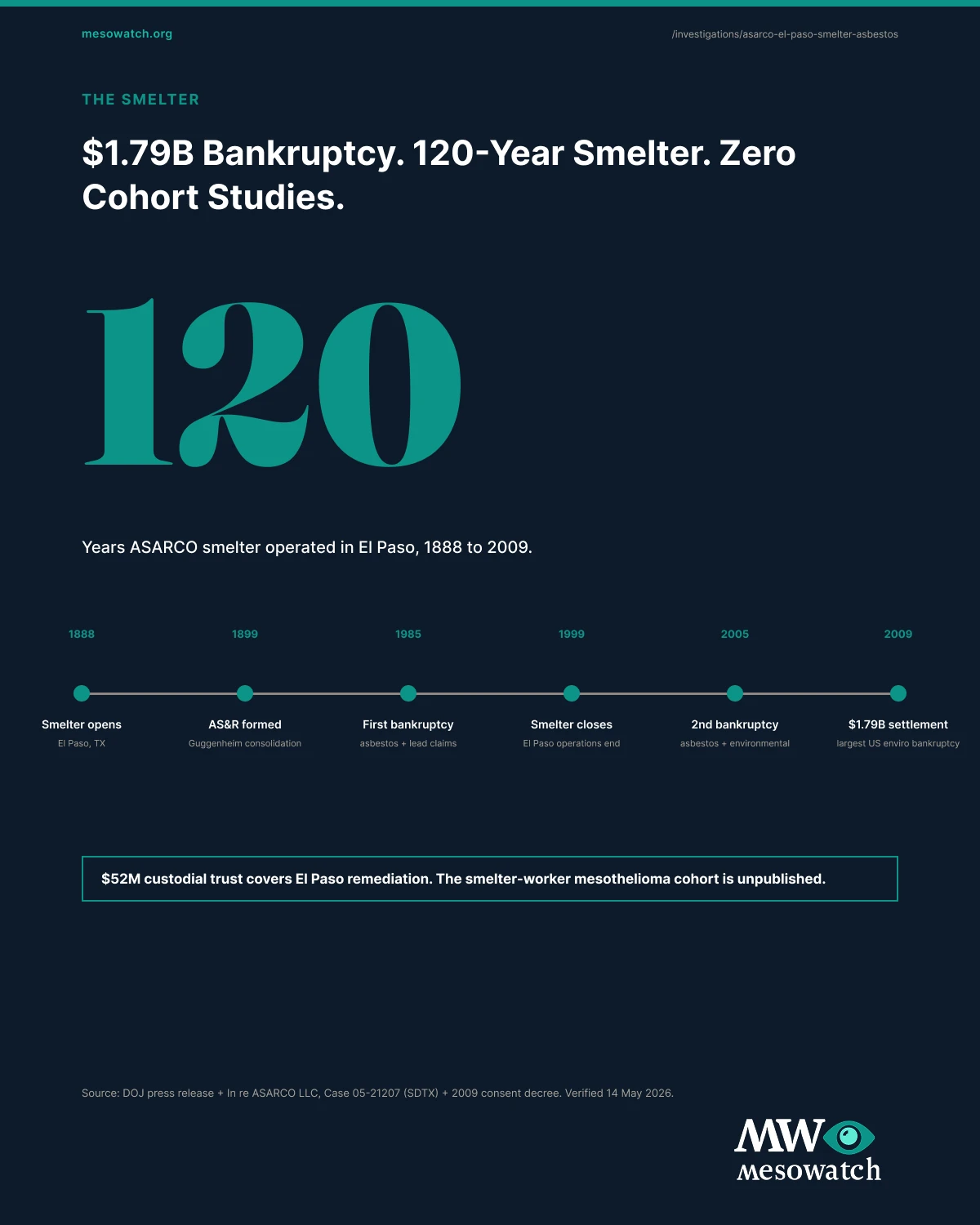
The full asarco el paso report, in one image.
Every claim sources to a primary government regulator or named investigative outlet. The composite is free to embed with credit. No modification of the image.
Press inquiries: editorial@mesowatch.org (MesoWatch Editorial Team)
Want to reach the desk, request the dataset, or subscribe to data drops? Jump to the newsroom