Texas Has 87 Active Installations in DoD Cleanup, 93 Formerly Used Defense Sites. The Program Does Not Count Asbestos.
DoD's own restoration accounting puts Texas military cleanup past $2.6B across 87 active installations, 9 BRAC, 93 FUDS. None of it disaggregates asbestos.


The Texas Military Asbestos Record: A $2.6 Billion Cleanup Backlog That Never Names Asbestos
The Department of Defense keeps a public ledger of its environmental cleanup. For Texas, that ledger is one of the heaviest in the country, and it never once says the word asbestos.
The Defense Environmental Restoration Program publishes a state-by-state status table. The most recent edition, current as of September 30, 2024, records for Texas: 87 active installations with open Installation Restoration Program cleanup sites, 9 BRAC (closed-base) locations, and 93 Formerly Used Defense Sites.
The estimated cost to finish that work runs past $2.6 billion across the three categories.
What the table does not do is separate asbestos from every other contaminant. There is no line for it. There is no published, per-installation asbestos inventory anywhere in the federal record.
For a state whose military building stock was largely raised before the 1972 OSHA asbestos standard, the one exposure that defines the mesothelioma risk is the one the accounting will not name.
That gap, and a second one in how veterans are told their benefits work, is what this investigation maps.
The Cleanup Ledger
The DERP table is the closest thing to a public scoreboard of military environmental liability, and Texas sits near the top of it.
The program splits its accounting into three buckets. Active installations are still-operating bases. BRAC locations are bases closed under Base Realignment and Closure rounds. Formerly Used Defense Sites are properties the military once held and has since let go. Texas carries a substantial load in all three.
Active installations: 87 with open cleanup
For still-operating Texas bases, the FY2024 table records 87 installations with open Installation Restoration Program (IRP) sites and 19 with Military Munitions Response Program (MMRP) sites. The IRP site count totals 1,111, of which 92 are still in investigation and 44 in active cleanup. The estimated cost to complete is about $838 million.
BRAC: a $1.0 billion closed-base bill
The closed Texas installations carry 9 locations with open IRP sites, 1,212 IRP sites in total, and an estimated $1.0 billion cost to complete. Kelly Air Force Base in San Antonio, closed in the 2001 BRAC round, is part of this closed-base universe and had documented asbestos in its WWII-era physical plant.
FUDS: 93 sites and the demolition work class
The Formerly Used Defense Sites bucket records 93 Texas installations with open IRP sites and 145 with MMRP sites, at an estimated $789 million to complete. The MMRP work class matters here: munitions-response and site-clearance work routinely involves demolishing pre-1980 structures, the exact activity that disturbs intact asbestos-containing material.
One claim this investigation will not make is a national ranking. The same DERP table shows California larger than Texas on every IRP metric. The point is not that Texas is first.
The point is that a multi-billion-dollar Texas military cleanup is fully documented at the state level while the asbestos share of it is documented nowhere.
The Texas Base Map
Joint Base San Antonio is the largest military complex in Texas, created in October 2010 when the Department of Defense consolidated three independent installations into one footprint. Each of the three carries its own pre-1980 building history.
Lackland Air Force Base: the WWII frame-building cohort
Lackland’s earliest physical plant traces to June 1941 construction as the Kelly Field annex. The base history records frame buildings with asbestos siding for the rapid wartime expansion. The base became the San Antonio Aviation Cadet Center in July 1942 and the Air Force’s basic military training hub after the war.
From 1966 to 1970, four 1,000-person dormitories were built in steel and brick. The older temporary WWII frame and asbestos-siding structures stayed in use until removal began in 1976, per the JBSA-Lackland fact sheet.
Fort Sam Houston: 19th-century construction still in operation
Fort Sam Houston dates to 1845 and is the historical home of the US Army Medical Department. Its 19th and early 20th century construction includes the Quadrangle (1879) and the Long Barracks (1888).
The post hosts Brooke Army Medical Center and the Defense Health Agency headquarters, with pre-1980 building stock layered over more than 130 years.
Randolph AFB: 1928 origin
Randolph AFB, founded in 1928, was the “West Point of the Air” for cadet flight training. Its Spanish Colonial Revival administrative buildings and original hangars date to the late 1920s and early 1930s. The base hosts Air Education and Training Command.
Beyond JBSA: the rest of the installation map
Texas hosts at least eight other major Department of Defense installations, each with its own founding date and pre-1980 building stock:
- Fort Cavazos (formerly Fort Hood, renamed May 2023) near Killeen. Established 1942.
- Fort Bliss in El Paso. Established 1848, expanded heavily during World War II.
- Sheppard Air Force Base in Wichita Falls. Established 1941.
- Dyess Air Force Base in Abilene. Tye Army Airfield 1942, Dyess from 1956.
- Goodfellow Air Force Base in San Angelo. Established 1940.
- Laughlin Air Force Base in Del Rio. Established 1942.
- Naval Air Station Corpus Christi. Established 1941, with a shipyard-adjacent exposure cohort along Corpus Christi Bay.
- Naval Air Station Kingsville. Established 1942.
- NAS JRB Fort Worth (predecessor Carswell AFB, 1941). See Fort Worth-area mesothelioma counsel.
- Red River Army Depot in Texarkana. Established 1941.
Bases raised in the 1940 to 1942 WWII buildup used asbestos-containing materials extensively across barracks, hangars, steam plants, and infrastructure. Bases predating 1940, including Fort Sam Houston and Fort Bliss, add 19th and early 20th century structures with their own asbestos history.
The latency period between first exposure to asbestos and the development of mesothelioma can range from 20 to 50 years.
What the Pre-1980 Construction Means
The OSHA general industry asbestos standard (29 CFR 1910.1001) took effect in 1972, and federal facilities were covered from the start. But asbestos-containing materials already installed in pre-1972 construction stayed in place for decades, removed only as buildings were renovated, demolished, or disturbed by major work.
Documented applications at pre-1980 military bases span nearly every building system: thermal pipe insulation, boiler plant lagging, structural fireproofing, vinyl asbestos floor tile, asbestos cement panels and siding, popcorn ceilings, gaskets, electrical insulation, and roofing. Base steam plants used asbestos insulation extensively on hot piping and boilers.
The occupational specialties with the highest documented asbestos exposure cluster in the maintenance and construction trades, not the combat-arms cohort:
- Building maintenance personnel and boiler plant operators
- Pipefitters, plumbers, electricians, and carpenters
- Sheet metal workers and HVAC technicians
- Construction battalion (Seabees) and military civil engineering units
- Aircraft maintenance personnel and vehicle mechanics
Personnel housed in older WWII-era barracks had ambient exposure even without a trade assignment, and family members were exposed to take-home asbestos dust carried home on work clothing.
The Benefits Misconception
The most repeated statement about veterans and mesothelioma is wrong, and the error pushes people toward the wrong claim. Across advocacy and law-firm pages, mesothelioma is described as a VA “presumptive” condition. It is not.
Mesothelioma does not appear on the 38 CFR 3.309 presumptive lists. The PACT Act of 2022 (Public Law 117-168) did not add it. The VA’s own presumptive service-connection materials reference mesothelioma only as an exclusion from the Agent Orange soft-tissue sarcoma category.
The actual pathway is direct service connection under 38 CFR 3.303, developed under the VA Adjudication Manual M21-1 asbestos guidance.
That route turns on three things: documented in-service asbestos exposure consistent with the veteran’s military occupational specialty and duty history, a current mesothelioma diagnosis, and a medical nexus opinion linking the disease to the service exposure.
The distinction is not academic. A presumptive condition shifts the burden off the veteran. A direct service-connection claim does not, which is precisely why the documented exposure history at these pre-1980 Texas installations matters to the evidentiary record.
Once service connection is granted, mesothelioma is rated 100% under 38 CFR 4.97, Diagnostic Code 6819, which carries full disability compensation, VA healthcare, and, where a death is service-connected, Dependency and Indemnity Compensation for a surviving spouse.
The VA Beneficiary Travel program reimburses approved travel for service-connected care, which can be significant for veterans traveling from West Texas to the Houston specialty bench.
Soft-tissue sarcoma, other than osteosarcoma, chondrosarcoma, Kaposi’s sarcoma, or mesothelioma.
A Closing Thesis
Two public records define the Texas military asbestos question, and both are organized so the answer never quite appears.
The Defense Environmental Restoration Program documents a Texas cleanup backlog past $2.6 billion across 87 active installations, 9 BRAC locations, and 93 Formerly Used Defense Sites, with the costliest work class being the demolition program that disturbs old construction. Asbestos is in that work. The accounting just does not count it as asbestos.
The benefits record has the opposite problem: it is widely described in a way that is simply incorrect. Mesothelioma is not a VA presumptive. It is a direct service-connection claim, which makes the documented exposure history at these aging Texas installations the load-bearing evidence rather than a formality.
What a Texas veteran, or a family member, cannot get from any single public source is the join of the two: which installation, which building era, which trade, and therefore which exposure record supports a claim that the VA will not presume.
The broader Texas mesothelioma picture shows where the diagnosed cases are concentrating. The military layer of it is documented in fragments that the federal government has chosen not to add up.
Corrections, 2026-05-17. An earlier version asserted a veteran share of US mesothelioma cases and described mesothelioma as a VA presumptive condition; neither traced to a primary source, and both were removed. Mesothelioma is adjudicated as direct service connection under 38 CFR 3.303, not as a presumptive.
Reader Q&A
Frequently Asked Questions
Which Texas military bases have the most pre-1980 asbestos exposure history?
The installations with the largest pre-1980 building footprint include Lackland Air Force Base (built starting 1941 as a Kelly Field annex, with WWII-era frame buildings using asbestos siding per the base history), Fort Sam Houston (founded 1845, with 19th and early 20th century construction), Randolph Air Force Base (founded 1928), Fort Bliss (founded 1848 in El Paso, with substantial WWII expansion), Fort Cavazos (formerly Fort Hood, founded 1942 near Killeen), Sheppard Air Force Base (founded 1941 in Wichita Falls), Dyess Air Force Base (Tye Army Airfield 1942, Abilene), Goodfellow Air Force Base (founded 1940, San Angelo), Laughlin Air Force Base (founded 1942, Del Rio), and Naval Air Station Corpus Christi (founded 1941). Each carries pre-1980 building stock that may contain legacy asbestos in pipe insulation, boiler lagging, fireproofing, gaskets, vinyl asbestos floor tile, and roofing.
Is mesothelioma a presumptive service-connected condition for veterans?
No. This is a common and consequential misconception. Mesothelioma is not named on the 38 CFR 3.309 presumptive lists, and the PACT Act of 2022 (Public Law 117-168) did not create a presumptive for mesothelioma. The VA's own presumptive service-connection materials list mesothelioma only as an exclusion from the Agent Orange soft-tissue sarcoma category. Asbestos-related mesothelioma in veterans is adjudicated as direct service connection under 38 CFR 3.303, using the VA Adjudication Manual M21-1 asbestos development guidance: documented in-service asbestos exposure, a current diagnosis, and a medical nexus opinion linking the two. Once service connection is established, mesothelioma carries a 100% disability rating under 38 CFR 4.97, Diagnostic Code 6819.
What is the Defense Environmental Restoration Program, and what does it show for Texas?
The Defense Environmental Restoration Program (DERP) is the DoD's accounting of environmental cleanup at active installations, closed (BRAC) installations, and Formerly Used Defense Sites (FUDS). The FY2024 status table (data as of September 30, 2024) records, for Texas: 87 active installations with open Installation Restoration Program (IRP) sites and 19 with Military Munitions Response Program (MMRP) sites; 9 BRAC installations with IRP sites; and 93 FUDS with IRP sites plus 145 with MMRP sites. The estimated cost to complete is roughly $838 million for active installations, about $1.0 billion for BRAC, and about $789 million for FUDS. The table does not disaggregate asbestos from other contaminants, so the public record does not say how much of this work is asbestos abatement.
What asbestos-containing materials were used at military bases?
Documented applications at pre-1980 military bases include thermal pipe insulation, boiler plant insulation and lagging, fireproofing on structural members, vinyl asbestos floor tile, asbestos cement panels and siding, popcorn ceilings, gaskets at piping and valve assemblies, electrical insulation, and roofing. Frame buildings constructed in the 1930s and 1940s commonly used asbestos siding, as documented at Lackland Air Force Base. Steam plants used asbestos insulation extensively on hot piping, boilers, and valves. Naval air station infrastructure carried asbestos into aircraft maintenance areas.
Which military jobs had the highest asbestos exposure?
Exposure clustered in the maintenance and construction trades rather than the combat-arms cohort: building maintenance personnel, boiler plant operators, pipefitters, electricians, plumbers, carpenters, sheet metal workers, HVAC technicians, construction battalion (Seabees) personnel, military civil engineering units, aircraft maintenance personnel, and vehicle mechanics. Personnel housed in older WWII-era barracks had ambient exposure even without a trade assignment. Family members were exposed to take-home asbestos dust carried home on work clothing.
What about contractors and family members at Texas bases?
Civilian contractors who worked on base construction, maintenance, or renovation may have been exposed to the same asbestos-containing materials as servicemembers. Civilian and family-member asbestos claims are typically brought against the manufacturers of the asbestos products used at the site, and against asbestos bankruptcy trusts established under 11 USC 524(g), subject to the Texas two-year limitations period that runs from diagnosis under the discovery rule (Texas Civil Practice and Remedies Code Section 16.003). Take-home exposure cases, where a family member inhaled fibers carried home on a worker's clothing, have been litigated in Texas and elsewhere. An attorney who handles asbestos cases can identify which trusts and manufacturers apply to a specific exposure history.
How long after Texas military asbestos exposure can mesothelioma appear?
The Agency for Toxic Substances and Disease Registry documents a latency of 20 to 50 years between first asbestos fiber inhalation and mesothelioma diagnosis. A veteran who served at a Texas base in the 1960s, 1970s, or 1980s may not develop diagnosable disease until the 2000s, 2010s, or 2020s. The Texas two-year limitations period runs from diagnosis under the discovery rule (Texas Civil Practice and Remedies Code Section 16.003), not from the date of exposure, so a long latency does not by itself bar a civil claim.
Where can Texas veterans with mesothelioma get specialty care?
The NCI-designated cancer centers in Texas that treat mesothelioma include MD Anderson Cancer Center in Houston, the Dan L. Duncan Comprehensive Cancer Center at Baylor in Houston, the Harold C. Simmons Comprehensive Cancer Center at UT Southwestern in Dallas, and the Mays Cancer Center at UT Health San Antonio. The VA medical system can refer service-connected veterans for treatment, and the VA Beneficiary Travel program reimburses approved travel for service-connected care. Distance is a real constraint: the trial and specialty bench concentrates in Houston, which MesoWatch has mapped separately in its reporting on the Texas mesothelioma trial desert.

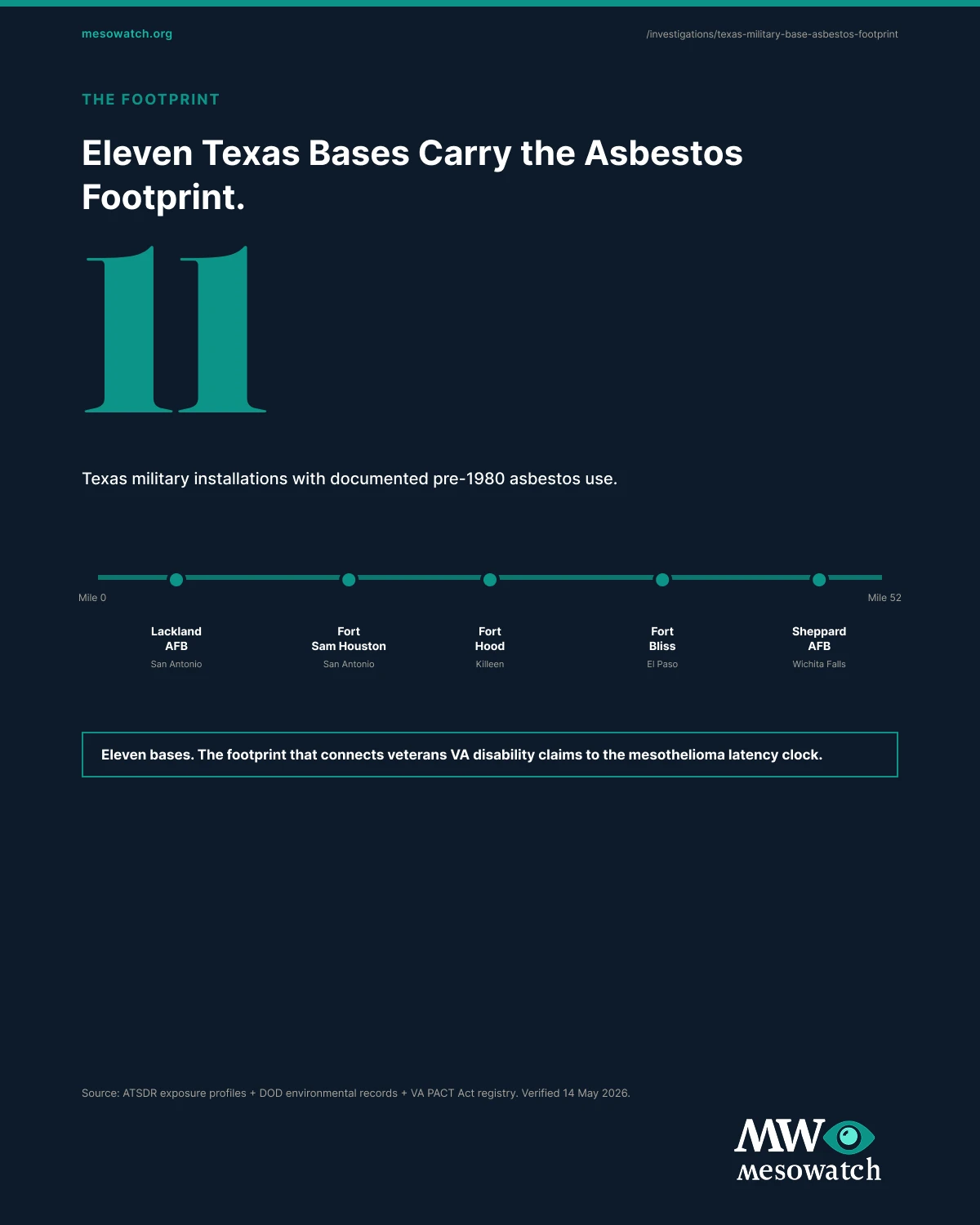
The full texas's $2.6b cleanup never names asbestos report, in one image.
Every claim sources to a primary government regulator or named investigative outlet. The composite is free to embed with credit. No modification of the image.
Press inquiries: editorial@mesowatch.org (MesoWatch Editorial Team)
Want to reach the desk, request the dataset, or subscribe to data drops? Jump to the newsroom