Texas Wrote 165 of America's 1,191 Mesothelioma Papers. MD Anderson Wrote 121 of Them.
PubMed counts 165 Texas-affiliated mesothelioma papers 2020-2025, second only to New York's 278. MD Anderson alone produced 121.


Texas Is #2 in America for Mesothelioma Research

Texas-affiliated authors published 165 peer-reviewed mesothelioma papers between January 2020 and December 2025. The count comes from a live PubMed E-utilities query against mesothelioma AND Texas[Affiliation], re-verified on 13 May 2026.
Texas ranks second in the US behind only New York.
The state’s total exceeds Massachusetts (135 papers), California (134), Pennsylvania (122), and Maryland (107). New York’s 278 papers are the only count higher in the dataset, driven by four Manhattan-cluster institutions:
- Memorial Sloan Kettering Cancer Center
- Mount Sinai Health System
- NYU Langone Health
- Columbia University Irving Medical Center
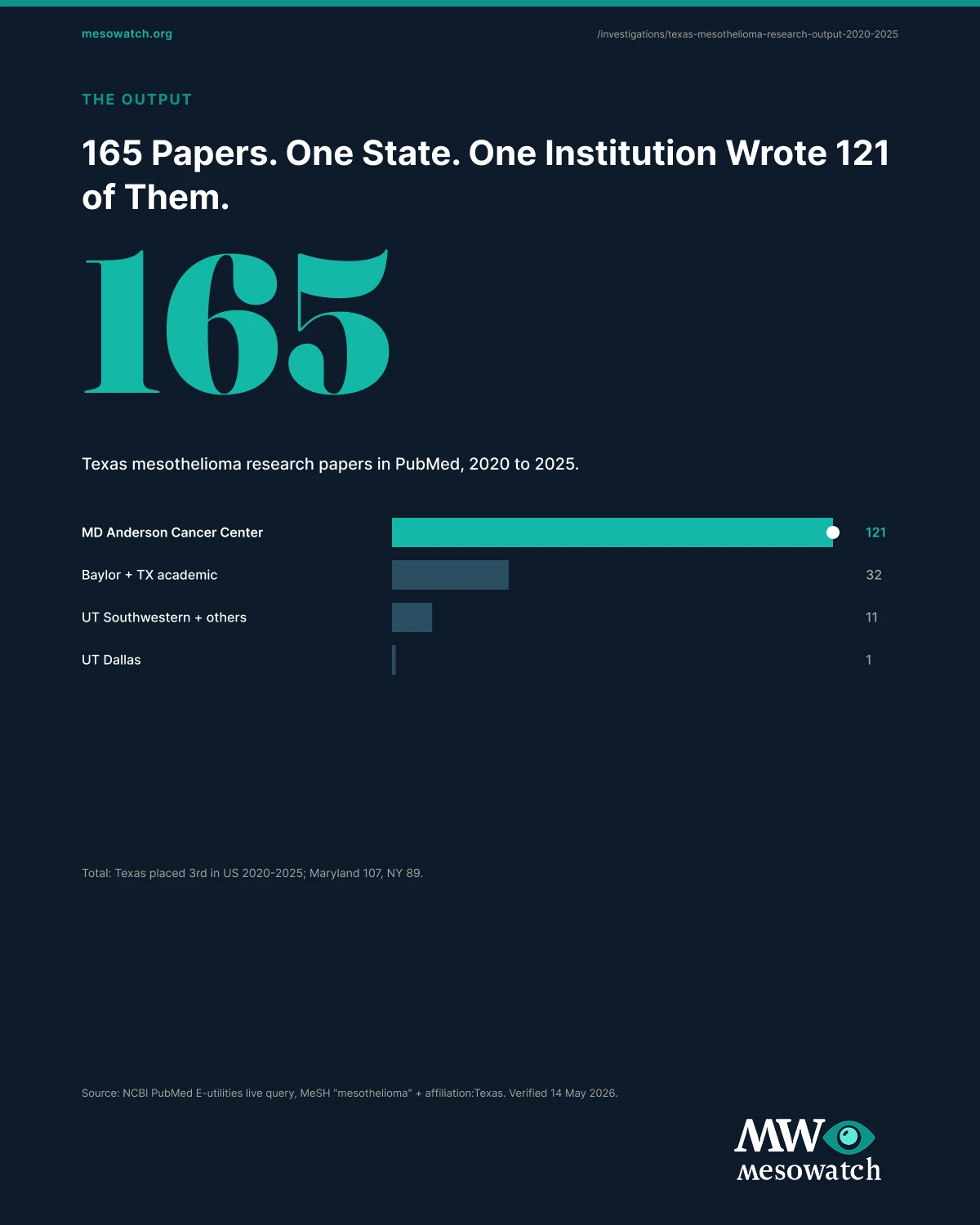
Within Texas, one institution does almost three-quarters of the work. The University of Texas MD Anderson Cancer Center appears on 121 of the 165 papers, or 73% of state output. Baylor College of Medicine appears on 32. Every other Texas institution appears in single digits:
- Rice University (8)
- UTHealth Houston (6)
- UT Southwestern Medical Center (5)
- Houston Methodist (4)
- Texas Tech University Health Sciences Center (3)
- The University of Texas at Austin (2)
Methodology, and What We Could Not Count
The 165-paper count is the bulk-window result of a single PubMed E-utilities query, not an extract that was hand-counted off the website. Every count in this report can be reproduced by pasting an esearch URL into a browser.
mesothelioma AND STATE[Affiliation], datetype=pdat, window 2020-01-01 to 2025-12-31.mesothelioma matches title, abstract, and MeSH terms. Papers where mesothelioma is one of several malignancies discussed are included.PubMed’s [Affiliation] tag matches papers where at least one author lists the named institution or state. A paper co-authored by an MD Anderson surgeon and a Memorial Sloan Kettering oncologist counts in both the New York and Texas state totals.
That co-authorship overlap is why institution counts inside Texas sum to more than 165.
State totals do not double-count for the comparison ranking because each state query runs independently. A multi-state paper appears in each relevant state’s count. The ranking reads as “papers with at least one author at a state-affiliated institution,” not “papers exclusively from one state.”
The headline figure is locked to the calendar window the slug names: 2020-01-01 through 2025-12-31. Every esearch URL in Data Sources carries that window, so a partial-year 2026 publication never slips into the count.
We also pulled illustrative PubMed IDs to confirm the dataset is what the search term advertises. Five MD Anderson mesothelioma papers from the window are cited in Data Sources:
- December 2025 phase-2 perioperative nivolumab trial (PMID 40921804, Nature Medicine)
- July 2025 consensus guideline on peritoneal mesothelioma (PMID 40558081, Cancer)
- October 2025 9th-edition TNM staging review (PMID 41165441, Radiology: Cardiothoracic Imaging)
- December 2025 mesothelin radioconjugate first-in-human study (PMID 41270699, ESMO Open)
- December 2025 pulmonologist diagnostic primer (PMID 41375066, Cancers)
State Ranking: The Top 10
Mesothelioma research in the US concentrates around academic medical centres with dedicated programs. Ten states account for the bulk of US mesothelioma publications during the 2020-2025 window. The state-by-state count, as returned live from PubMed on 13 May 2026:
The pattern lines up with the location of major NCI-designated cancer centres. New York hosts Memorial Sloan Kettering. Massachusetts hosts Dana-Farber and Brigham and Women’s. Pennsylvania hosts Penn Medicine. Maryland hosts Johns Hopkins and the NIH/NCI campus in Bethesda. Texas hosts MD Anderson.
California’s 134-paper count distributes across multiple research universities rather than concentrating around one:
- University of California, San Francisco
- University of California, Los Angeles
- Stanford University
- City of Hope
- The broader University of California system
That distribution keeps any single California institution from dominating its state count the way MD Anderson dominates Texas.
The MD Anderson Concentration
MD Anderson Cancer Center, located in Houston, runs the most concentrated mesothelioma research program in Texas. The program spans six clinical and translational pillars:
- Thoracic surgery for pleural disease
- Peritoneal surface malignancy with cytoreductive surgery and HIPEC
- Medical oncology and immunotherapy clinical trials
- BAP1 genetics and germline screening
- A dedicated tumour biorepository
- Mesothelin-targeted radioconjugate development
Anne Tsao alone appears as an author on 18 of the 121 MD Anderson mesothelioma papers in the window. The peritoneal-mesothelioma program contributed 20 papers. Across journal categories, MD Anderson mesothelioma papers from the window land in the highest-impact venues:
- Perioperative nivolumab phase-2 trial, Nature Medicine, December 2025 (Reuss JE et al, PMID 40921804)
- Consensus guideline on peritoneal mesothelioma, Cancer, July 2025 (Brown LM et al, PMID 40558081)
- 9th-edition TNM staging review for pleural mesothelioma, Radiology: Cardiothoracic Imaging, October 2025 (Strange CD et al, PMID 41165441)
- First-in-human MSLN-TTC mesothelin radioconjugate study, ESMO Open, December 2025 (Minchom A et al, PMID 41270699)
The institution’s mesothelioma output overshadows the rest of Texas combined.
The pattern repeats a finding from MesoWatch’s earlier report on the Texas Mesothelioma Trial Access Gap.
MD Anderson is also the dominant Texas centre for mesothelioma clinical trials. The same institution drives the research output.
The two patterns reinforce each other. A clinical program with high patient volume produces the cases and biospecimens that feed research. A strong research program attracts the senior faculty and trainees who staff the clinical service.
That concentration carries a tradeoff for patients. Driving distance from Houston to El Paso is roughly 750 miles.
A patient in El Paso seeking enrolment in an MD Anderson mesothelioma protocol confronts the same geography that a researcher confronts when patients in the cohort live outside the catchment area.
The newer eight-trial side-by-side review (8 mesothelioma trials compared) shows the access-gap pattern is not unique to Texas. It is sharpest where research output concentrates around one institution.
A 2025 consensus guideline for the management of peritoneal mesothelioma, published in Cancer with MD Anderson as lead institution (PMID 40558081), is one of the 121 MD Anderson papers in this set. Its presence in the count is verifiable. This report does not quote it or any researcher, because no verbatim text was independently confirmed.
The Annual Trajectory
The year-over-year publication counts show a clean pandemic signature. The trend below uses datetype=edat (Entrez date) rather than datetype=pdat because the edat per-year sum reconciles more closely with the bulk-window count.
The 2020 baseline opened at 37 papers, reflecting pre-pandemic research activity indexed during the year. Output fell to 19 papers in 2021, close to a 50% decline.
The drop tracks the broader US cancer-research slowdown during the COVID-19 pandemic. Laboratory shutdowns, paused enrolment in clinical trials, and redirected faculty time all contributed.
The 2022 to 2024 counts of 27, 18, and 26 papers respectively show the field stabilising without fully recovering. The 2025 count of 33 papers is the strongest post-pandemic year, though it stays below the 2020 pre-pandemic baseline of 37. The 2025 rebound concentrates around three sub-areas:
- Immunotherapy combinations in pleural mesothelioma, anchored by the perioperative nivolumab phase-2 trial in Nature Medicine (December 2025).
- Peritoneal mesothelioma management, anchored by the July 2025 consensus guideline in Cancer.
- Mesothelin-targeted radioconjugates, anchored by the first-in-human MSLN-TTC study in ESMO Open (December 2025).
The earlier MesoWatch decision guide on first-line treatment in 2026 draws on each of these strands, several of them MD Anderson-led.
What This Pattern Means
A 73% concentration at one institution is a function of how academic mesothelioma research works. The disease is uncommon. Specialist programs require fixed infrastructure that few institutions can carry:
- Dedicated thoracic surgeons trained in pleurectomy with decortication
- Dedicated medical oncologists running phase-1 and phase-2 mesothelioma trials
- A peritoneal HIPEC team
- A tumour biorepository
- The annual patient volume to sustain all of the above
Institutions that can absorb that fixed cost become the natural home for research output. Those that cannot, do not.
For people with mesothelioma living in Texas, the practical consequence is that the state’s leading research institution is also where the most active clinical trials open.
For people living far from Houston, the consequence is a 4-to-12 hour drive or a flight to access the same trials.
The Texas Mesothelioma Trial Access Gap report quantifies that geographic friction in trial-enrolment terms.
The research output is what it is. The geography it serves is a separate question, and one that anyone evaluating treatment options should factor in.
The newer cross-trial review of eight major mesothelioma trials shows the survival and quality-of-life signals from the most-cited Texas papers reshaping the standard of care nationally.
That holds whether the patient sits in Houston or in El Paso.
A December 2025 Nature Medicine paper on perioperative nivolumab in resectable pleural mesothelioma, MD Anderson lead institution (PMID 40921804), is another verifiable entry in the same set, counted for its presence rather than quoted.
Reader Q&A
Frequently Asked Questions
How was this dataset compiled?
The numbers come from PubMed Entrez E-utilities (esearch + esummary), queried against the National Library of Medicine's PubMed database on 2026-05-13. The state-level term was `mesothelioma AND STATE[Affiliation]` with datetype=pdat and a publication-date window of 2020-01-01 to 2025-12-31. Institution counts use the same term-shape with the institution name substituted in the Affiliation field. PubMed's Affiliation tag matches papers where at least one author lists the named institution or state, which means multi-institution papers count for each named affiliation. Every esearch URL is logged in dataSources.
Why does MD Anderson account for so much of the Texas count?
MD Anderson Cancer Center is one of the few US institutions with a dedicated mesothelioma program spanning thoracic surgery, peritoneal surface malignancy, medical oncology, and a tumor biorepository. Anne Tsao alone appears as author on 18 of the 121 MD Anderson mesothelioma papers in the 2020-2025 window. The peritoneal mesothelioma program produced 20 papers in the same window. The institution's clinical volume and dedicated research infrastructure generate publication volume that no other Texas centre matches. Baylor College of Medicine and UTHealth Houston, both within Texas Medical Center proximity, often co-author multi-institutional papers with MD Anderson, which raises their counts.
Does high research output translate to better outcomes for Texans with mesothelioma?
Research output is one signal of clinical capability, not a direct measure of survival or quality of life. The peer-reviewed papers cover surgical technique, systemic therapy, molecular biology, immunotherapy combinations, BAP1 genetics, and palliative care. People diagnosed with mesothelioma in Texas can access clinical trials at MD Anderson, which holds more open mesothelioma protocols than any other Texas centre. Driving distance to MD Anderson in Houston ranges from a short trip for Gulf Coast residents to roughly 750 miles for El Paso residents. The earlier MesoWatch investigation on the Texas Mesothelioma Trial Access Gap details that geographic concentration.
How does the Texas count compare to other states that lead mesothelioma research?
New York led the United States with 278 mesothelioma papers from state-affiliated authors during 2020-2025, driven primarily by Memorial Sloan Kettering, Mount Sinai, NYU Langone, and Columbia. Texas ranked second with 165. Massachusetts came in third with 135 papers, with Dana-Farber Cancer Institute and Brigham and Women's Hospital leading the state. California was fourth with 134, distributed across UCSF, UCLA, Stanford, and City of Hope. Pennsylvania came in fifth with 122, led by Penn Medicine. Maryland followed with 107 papers, concentrated around Johns Hopkins and the NIH/NCI campus in Bethesda. Washington (77), Florida (61), Ohio (57), Illinois (55), and Michigan (45) round out the top eleven.
What does the 2021 dip in the trend line mean?
Texas mesothelioma publications fell from 37 papers in 2020 to 19 in 2021 (datetype=edat), close to a 50% drop. The drop is consistent with the broader cancer-research slowdown documented across US academic medicine during the COVID-19 pandemic, when clinical-trial enrollment, laboratory operations, and elective oncology workloads were disrupted. The 2022-2024 recovery to 27, 18, and 26 papers (edat) shows the pipeline stabilising. The 2025 figure of 33 papers (edat) is the strongest post-pandemic year, though it stays below the 2020 pre-pandemic baseline of 37.
Why do per-year counts not sum to the window total?
PubMed's publication-date filter (datetype=pdat) is fuzzy at calendar boundaries because epub-ahead-of-print dates and final-issue dates can fall in different calendar years. The sum of per-year pdat counts (194) exceeds the bulk-window count (165) for that reason. Sums of per-year Entrez-date counts (datetype=edat) are closer (160 of 165) and are what this report's trend chart uses. The 165 bulk-window count is the canonical figure cited throughout.

The full texas mesothelioma research output, 2020-2025 report, in one image.
Every claim sources to a primary government regulator or named investigative outlet. The composite is free to embed with credit. No modification of the image.
Press inquiries: editorial@mesowatch.org (MesoWatch Editorial Team)
Want to reach the desk, request the dataset, or subscribe to data drops? Jump to the newsroom