The Import Ban Took Effect May 2024. USGS Shows US Chrysotile Imports Were Already Zero the Year Before.
EPA's chrysotile import ban took effect May 28, 2024. USGS trade data show US imports had already collapsed to ~0 in 2023, with 8 chlor-alkali plants left.

EPA’s prohibition on importing chrysotile asbestos took effect on May 28, 2024. The federal government’s own trade data show the imports had already stopped the year before.
Per the US Geological Survey’s Mineral Commodity Summaries 2024, US chrysotile imports for consumption were about 41 metric tons in 2021, 224 metric tons in 2022, and effectively zero in 2023. USGS footnote 4 reports no chrysotile imported in the first 9 months of 2023. Estimated consumption fell from 290 metric tons in 2022 to 150 in 2023.
The headline of the rule is a twelve-year phase-out. The reality the trade data describe is an industry that had nearly finished leaving before the deadline clock started.
That gap, between the codified timeline and the market it governs, is what this investigation maps. It is not an argument that the rule does not matter. It is a measurement of what the rule actually still has to phase out, which is much smaller than the twelve-year headline implies.
What the Rule Actually Codifies
The rule’s compliance schedule is not a single 2036 date. It is a staircase of condition-specific deadlines, most of which have already passed. The codified text at 40 CFR Part 751 Subpart E is exact, and the exact dates matter, because the prior version of this report had several of them wrong.
The import and manufacture of chrysotile for chlor-alkali was prohibited after May 28, 2024. The consumer-visible categories went next: oilfield brake blocks, aftermarket automotive brakes and linings, other vehicle friction products, and other gaskets were all prohibited after November 25, 2024, the same date an interim workplace exposure limit of 0.005 fibers per cubic centimeter took effect.
Sheet gaskets for chemical production end after May 27, 2026. Sheet gaskets for titanium dioxide and most nuclear material processing run to May 28, 2029, with a narrow Savannah River Site nuclear exception to December 31, 2037.
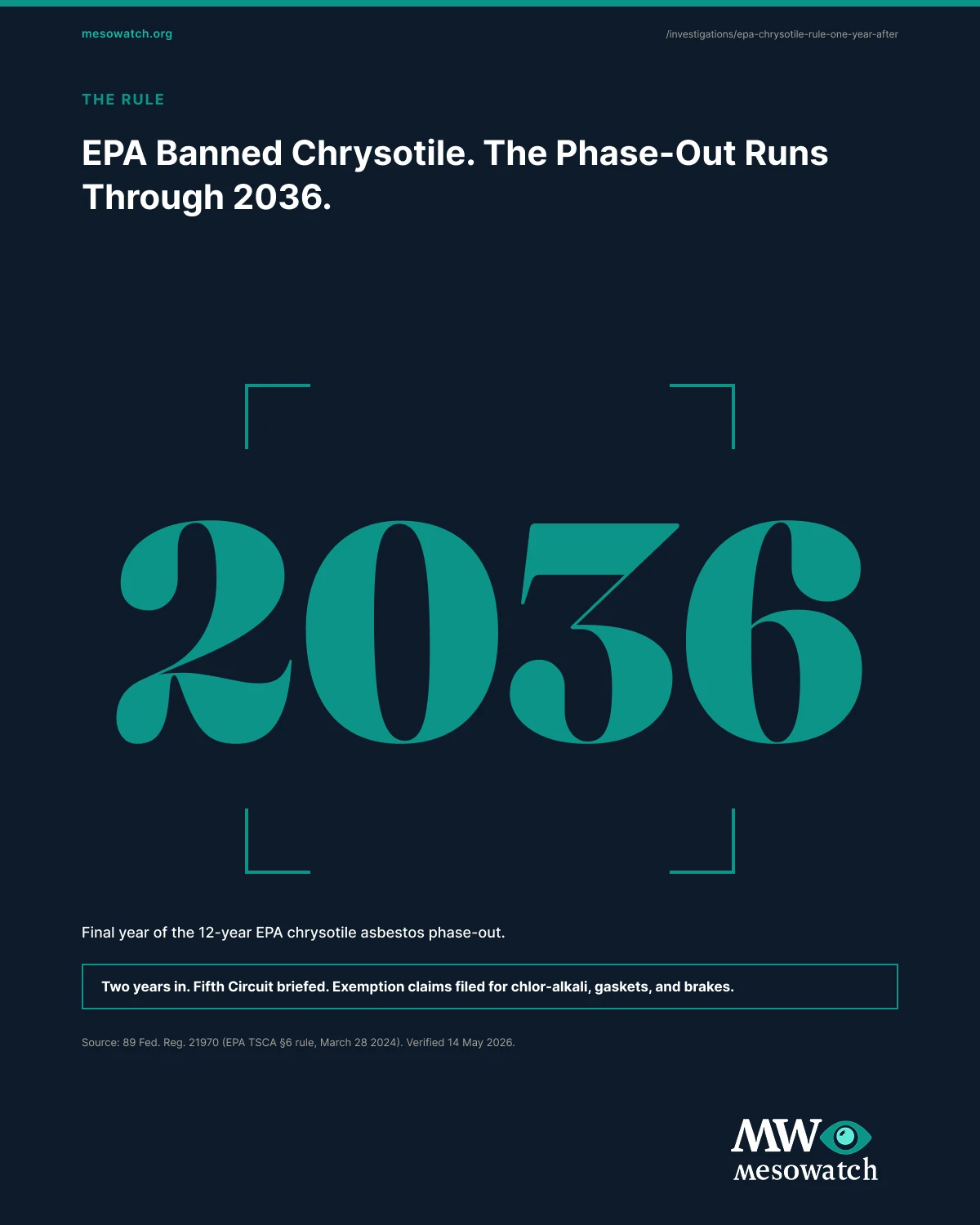
The chlor-alkali processing-and-use phase-out is the one the public discussion fixates on. Its baseline is May 28, 2029. An operator running more than one qualifying facility may keep two of them until May 25, 2032. An operator running more than two may keep a single legacy facility until May 26, 2036. That single-facility carve-out is the source of the “twelve-year” headline. It governs, at most, one plant.
EPA determined that chrysotile asbestos presents an unreasonable risk of injury to human health under the conditions of use.
The Industry the Deadline Governs
The reason the twelve-year schedule reads as long and the trade data read as zero is that they describe two different things. The schedule governs the legal right to keep operating specific equipment. The trade data describe whether anyone is still bringing the material in.
Per the rule’s own cost analysis (89 FR 21970), eight chlor-alkali facilities owned by three firms still used asbestos diaphragm-cell technology, representing about one-third of US chlor-alkali production capacity. Those facilities are old, a documented age range of roughly 42 to 83 years in the rule record.
This investigation does not name the individual plants or their owners’ transition timelines. The prior version did, with facility-by-facility detail, dates, and percentages that do not appear in the rule’s primary text and could not be primary-sourced. A claim that two named companies were closing specific plants on specific dates is exactly the kind of precision that has to trace to a filing, and here it did not.
What the primary record supports is narrower and still pointed: a small number of aging facilities, a sector that was about one-third asbestos-diaphragm by capacity, and an import pipeline that USGS shows had already gone to zero before the prohibition’s effective date.
What This Report Will Not Claim
A rule like this generates litigation, and the prior version of this article described a specific federal appellate briefing and oral-argument schedule. None of it could be verified against a primary court docket in this reporting pass, so none of it appears here.
Petitions for review of the rule were filed. That is the limit of what this investigation states about the challenge, because asserting a case caption, a briefing status, or an argument date without the primary docket is precisely the failure mode this rewrite exists to correct. The same applies to any post-rule exemption requests and to any agency reconsideration: not primary-verified here, therefore not asserted.
Readers who need the current legal status should go to the rule’s docket, EPA-HQ-OPPT-2021-0057, and the federal appellate docket directly. A health-and-safety publication that cannot verify a litigation posture should say so, not narrate one. MesoWatch has since verified the current posture against the federal docket in a separate report on the Fifth Circuit challenge to the chrysotile rule.
A Closing Thesis
The honest one-sentence version of this story is a juxtaposition of two federal records. EPA codified a phase-out that runs, at its longest, to May 26, 2036. USGS recorded that US chrysotile imports for consumption had already fallen to zero in 2023.
Both are primary. Together they say the rule’s function is less to force a rapid exit than to legally close a door an industry had already mostly walked through, while holding a single legacy facility’s deadline more than a decade out.
For people with mesothelioma whose exposure traces to historical chrysotile use, none of this changes the legal landscape. The rule is forward-looking. Cases continue in state and federal courts, and the Section 524(g) trusts continue to process claims. The disease burden runs on the 20-to-50-year latency of exposures that happened long before any 2036 deadline. The LA wildfire asbestos follow-up and the ASARCO El Paso smelter investigations track where that older exposure record is still surfacing.
Reader Q&A
Frequently Asked Questions
What does the EPA chrysotile rule actually prohibit, and when was it issued?
The final rule, 'Asbestos Part 1; Chrysotile Asbestos; Regulation of Certain Conditions of Use Under TSCA Section 6(h),' was published in the Federal Register on March 28, 2024 (89 FR 21970, FR Doc 2024-05972, RIN 2070-AK86, docket EPA-HQ-OPPT-2021-0057) and took effect May 28, 2024. It prohibits manufacture (including import), processing, distribution in commerce, commercial use, and disposal of chrysotile asbestos for six evaluated conditions of use: chlor-alkali diaphragms, sheet gaskets in chemical production, oilfield brake blocks, aftermarket automotive brakes and linings, other vehicle friction products, and other gaskets. EPA found these conditions pose an unreasonable risk to human health under TSCA Section 6.
What is the exact phase-out schedule?
The codified deadlines in 40 CFR Part 751 Subpart E are specific. Chlor-alkali manufacture and import: prohibited after May 28, 2024. Oilfield brake blocks, aftermarket automotive brakes and linings, other vehicle friction products, and other gaskets: prohibited after November 25, 2024. Sheet gaskets for chemical production: after May 27, 2026. Sheet gaskets for titanium dioxide and nuclear material processing: until May 28, 2029, with the Savannah River Site nuclear exception running to December 31, 2037. Chlor-alkali processing and use: baseline May 28, 2029; a two-facility operator carve-out to May 25, 2032; and a single legacy facility allowed to run until May 26, 2036. An interim workplace exposure limit of 0.005 fibers per cubic centimeter (8-hour TWA) began November 25, 2024.
How much chrysotile was the US actually still importing?
Per the US Geological Survey Mineral Commodity Summaries 2024, US chrysotile imports for consumption were approximately 41 metric tons in 2021, 224 metric tons in 2022, and effectively zero in 2023 (USGS footnote 4 reports no chrysotile imported in the first 9 months of 2023). Estimated consumption fell from 290 metric tons in 2022 to 150 metric tons in 2023. The import market had already collapsed the year before the import prohibition took effect. The chlor-alkali sector was the last significant user: per the rule's own cost analysis, eight facilities owned by three firms still used asbestos diaphragms, representing about one-third of US chlor-alkali production capacity.
What is the public-health stake?
Chrysotile is the only form of asbestos that was still legally manufactured, imported, or used in US commerce when the rule issued. EPA's finding under TSCA Section 6 was that the evaluated conditions of use pose an unreasonable risk of injury to health, including mesothelioma and lung, ovarian, and laryngeal cancer. Mesothelioma latency runs 20 to 50 years from initial fiber inhalation per ATSDR, so the benefit of ending ongoing use compounds over decades while the disease burden from historical exposure continues to surface.
What does the rule mean for people already diagnosed with mesothelioma?
The rule is forward-looking and does not affect liability for past exposure. Mesothelioma cases tied to historical chrysotile exposure remain in active state and federal litigation, and trust funds established under Section 524(g) of the Bankruptcy Code continue to process claims from workers exposed to chrysotile-containing products. The rule changes the going-forward exposure picture; it does not change the legal options for past exposure.
Was the rule challenged in court?
Petitions for review of the rule were filed. This investigation does not state the litigation's current posture, schedule, or outcome because that could not be verified against a primary court docket in this reporting pass. Readers seeking the current status should consult the rule's docket, EPA-HQ-OPPT-2021-0057, and the federal appellate docket directly rather than rely on a secondary characterization.

The full epa banned chrysotile imports in 2024. the trade data show they had already hit zero in 2023 report, in one image.
Every claim sources to a primary government regulator or named investigative outlet. The composite is free to embed with credit. No modification of the image.
Press inquiries: [email protected] (Emily Nguyen)
Want to reach the desk, request the dataset, or subscribe to data drops? Jump to the newsroom