Asbestos in Children's Sand: Eight Countries, No US Action
Tremolite asbestos in play sand has triggered recalls across eight countries since late 2025. US regulators have not tested or recalled any products.

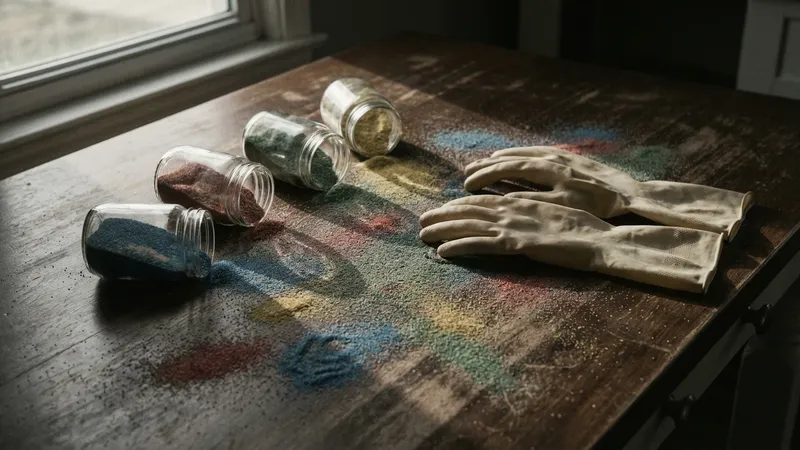
A wave of product recalls and school closures across at least eight countries has exposed a common source of asbestos contamination: colored sand sold for children’s arts, crafts, and sensory play. Since late 2025, testing in Australia, New Zealand, the United Kingdom, France, Germany, Ireland, Malta, and Canada has confirmed tremolite asbestos in sand products used by children in homes, schools, and childcare centers.
All contaminated products trace to sand imported from Chinese manufacturers. On April 1, 2026, the Asbestos Disease Awareness Organization (ADAO) urged US regulators, including the Consumer Product Safety Commission and the EPA, to test comparable products sold in the United States. As of this writing, no US recalls have been issued, and a January 2026 Houston shelf walkthrough found recalled brands still stocked. The eight-country snapshot in this piece has since expanded; the full picture lives in our investigation tracing the supply chain to a single Chinese quarry across 12 countries and 80-plus recalls.
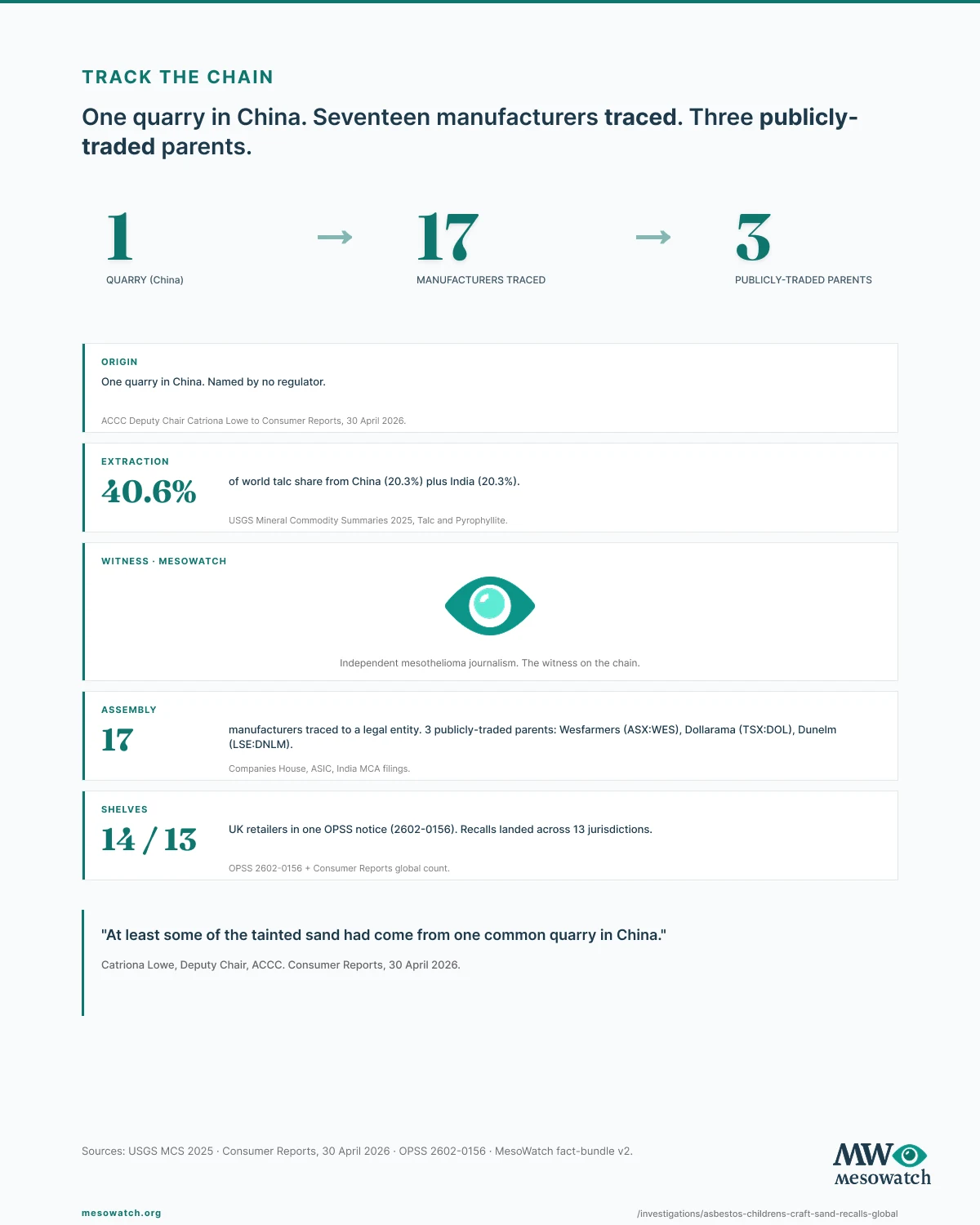
Eight Countries, One Supply Chain
The contaminated products share a common profile: imported colored sand, sold for craft activities, sand art kits, stretchy figures, and sensory play. In each country, the discovery followed laboratory testing or complaints from parents and teachers. The crisis began in November 2025 when Australian lab technicians discovered asbestos by accident during routine calibration.
Australia and New Zealand
The largest impact has been in Australia and New Zealand, where more than 450 schools and childcare centers closed temporarily after tremolite asbestos was found in colored craft sand imported from China. The closures, which began in late 2025, prompted cleanup operations and supply chain investigations that continued into 2026.
Australia has the highest per capita rate of historical asbestos use in the world and remains among the countries with the highest annual mesothelioma diagnosis rates, with roughly 800 to 900 new cases per year. The sand contamination adds a new consumer pathway to a country already grappling with occupational and environmental legacy exposure.
United Kingdom
As of March 2026, the UK’s Office for Product Safety and Standards has recalled 21 or more children’s products containing asbestos-contaminated sand, with new additions continuing. Major retailers affected include Tesco, Marks and Spencer, Matalan, Asda, Hobbycraft, B&M, Argos, Aldi, and Smyths Toys.
Follow-up testing identified tremolite asbestos fibers in the sand component of several product lines, prompting a broader review of children’s sand toys across UK retail channels.
Canada
Health Canada issued its own recall in March 2026, targeting children’s craft sand and candle-making kits found to contain asbestos. The recall covered products sold at retail and online, with instructions for consumers to stop using the products immediately and return them for a refund.
Why Children Are Especially Vulnerable
Children face higher risks from asbestos exposure than adults for several reasons. Their lungs are still developing, they breathe at a faster rate relative to body size, and they are more likely to put materials in their mouths or work closely over a craft project without ventilation.
The latency period for mesothelioma and other asbestos-related diseases is typically 20 to 50 years. A child exposed to asbestos fibers today may not develop symptoms until middle age or later, making early exposure particularly concerning because of the decades of potential disease development ahead.
Regulatory Gaps
Asbestos is banned in more than 70 countries, including Australia (since 2003), the UK, and Canada. The United States does not have a comprehensive ban, though the EPA finalized new restrictions in 2024.
Despite these bans, contamination in imported products continues to reach consumers. Asbestos occurs naturally alongside minerals like talc and is difficult to detect without specialized testing. Standard product safety screening does not always include asbestos analysis, and enforcement varies by country and product category.
The sand contamination cases highlight a gap between import regulations and actual product testing. In each of the four countries, the asbestos was discovered after the products had already reached retail shelves, schools, and homes.
If you have children’s sand art kits, craft sand, or sensory sand products at home, check the recall lists from your country’s consumer safety authority. In the US, the Consumer Product Safety Commission (CPSC) maintains a recall database at cpsc.gov. In the UK, check the Office for Product Safety and Standards. In Canada, check Health Canada’s recall database. In Australia, check the ACCC Product Safety website.
The Pattern Going Forward
The global scope of the contamination suggests that the issue extends beyond any single product or supplier. As long as asbestos occurs naturally in mineral deposits used for consumer products, and as long as testing is not required before import, similar contamination events are likely to recur.
For families affected by asbestos exposure through any pathway, understanding how exposure leads to disease and what screening options are available remains the most practical next step.
See Also
The eight-country snapshot in this piece has since expanded to 12. For the running tally with retailer-level attribution and the post-publication country counts, see Asbestos Product Recalls 2026: A Running Global Tally. For the UK-specific recall list with OPSS reference numbers, see UK Recalls 21+ Toys Over Asbestos in Sand Products. The cornerstone investigation behind these news pages tracing the wave back to a single Chinese quarry lives at Global Asbestos Consumer-Product Recalls: 80 Notices, 12 Countries, One Quarry.
References
BBC News. (2026-04-06). Schools shut over asbestos in kids' play sand.
https://www.bbc.com/news/articles/c0qpvq3v3xeo
Reuters. (2025-11-17). Asbestos contamination forces schools in Australia, New Zealand to close.
https://www.reuters.com/world/asia-pacific/asbestos-contamination-forces-schools-australia-new-zealand-close-2025-11-17/
Asbestos Disease Awareness Organization. (2026-04-01). ADAO Urges CPSC and EPA to Test Children's Sand Products for Asbestos.
https://www.asbestosdiseaseawareness.org/newsroom/blogs/release-cpsc-epa-kids-toys/
Reader Q&A
Frequently Asked Questions
What type of asbestos was found in the sand?
How were children exposed?
Should parents be worried about past use of these products?
Are sand products sold in the United States affected?
How can I check if a product has been recalled?
Which president did No child leave behind?
President George W. Bush signed the No Child Left Behind Act into law on January 8, 2002. The bipartisan legislation reauthorized the Elementary and Secondary Education Act, emphasizing school accountability for student performance and targeting aid to disadvantaged students. It aimed to improve educational outcomes across diverse student backgrounds while preserving local control.
Are schools switching to 4 day weeks?
Over 2,100 public schools across 26 states operated on a four-day schedule as of the 2024-25 school year, up from 1,600 schools in 24 states six years prior. This marks a more than 600% increase since 1999, primarily in rural districts seeking teacher retention, cost savings of about 2% per student, and better attendance. Recent examples include Tucson Unified School District’s 2026 pilot at one high school and West Virginia’s new law allowing flexibility for four-day weeks, though studies show small to moderate negative impacts on achievement, equivalent to 2-7 weeks less growth per year. Some states like Missouri and Louisiana impose restrictions or incentives for five-day weeks. Districts often extend daily instructional time by about 50 minutes to offset the lost day.
What is the biggest problem facing schools today?
Teacher shortages represent the most acute crisis in U.S. schools, with over 400,000 classrooms vacant or staffed by uncertified or underqualified educators, exacerbating learning gaps especially in special education and low-income districts. National reading and math proficiency remains low, with only 28% of 8th graders proficient in math per recent NAEP assessments, compounded by chronic absenteeism and failure to recover pre-pandemic levels. These staffing issues drive high educator burnout, larger class sizes, and declining outcomes, hitting under-resourced communities hardest.