Asbestos Product Recalls 2026: A Running Global Tally
Every asbestos-contaminated product recall in 2026, tracked by country, retailer, and product type. Why the U.S. has been slow to act.

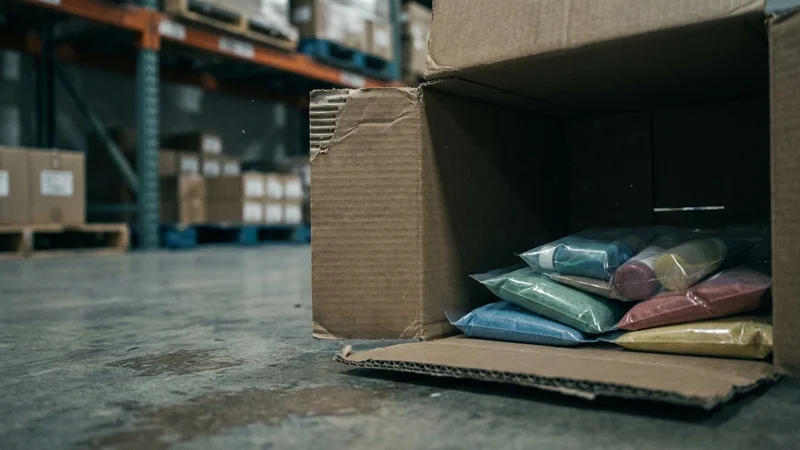
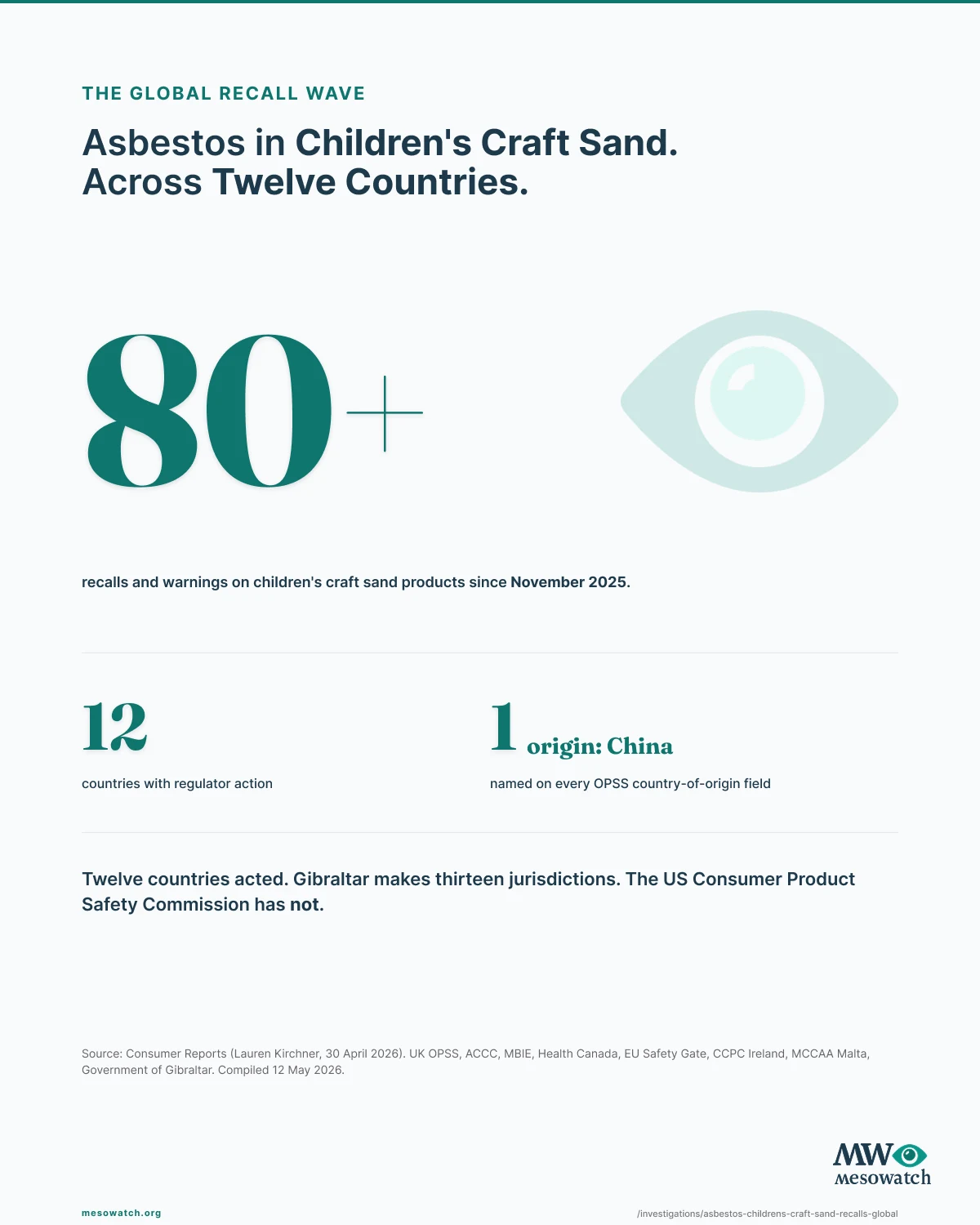
Consumer Reports investigative reporter Lauren Kirchner counted the recalls on 30 April 2026: at least 80 separate recalls or warnings, across at least 12 countries, for children’s toys and craft kits made with sand that regulators suspect contains asbestos. The UK Office for Product Safety and Standards has logged 37 of those notices in the 2026 wave alone.
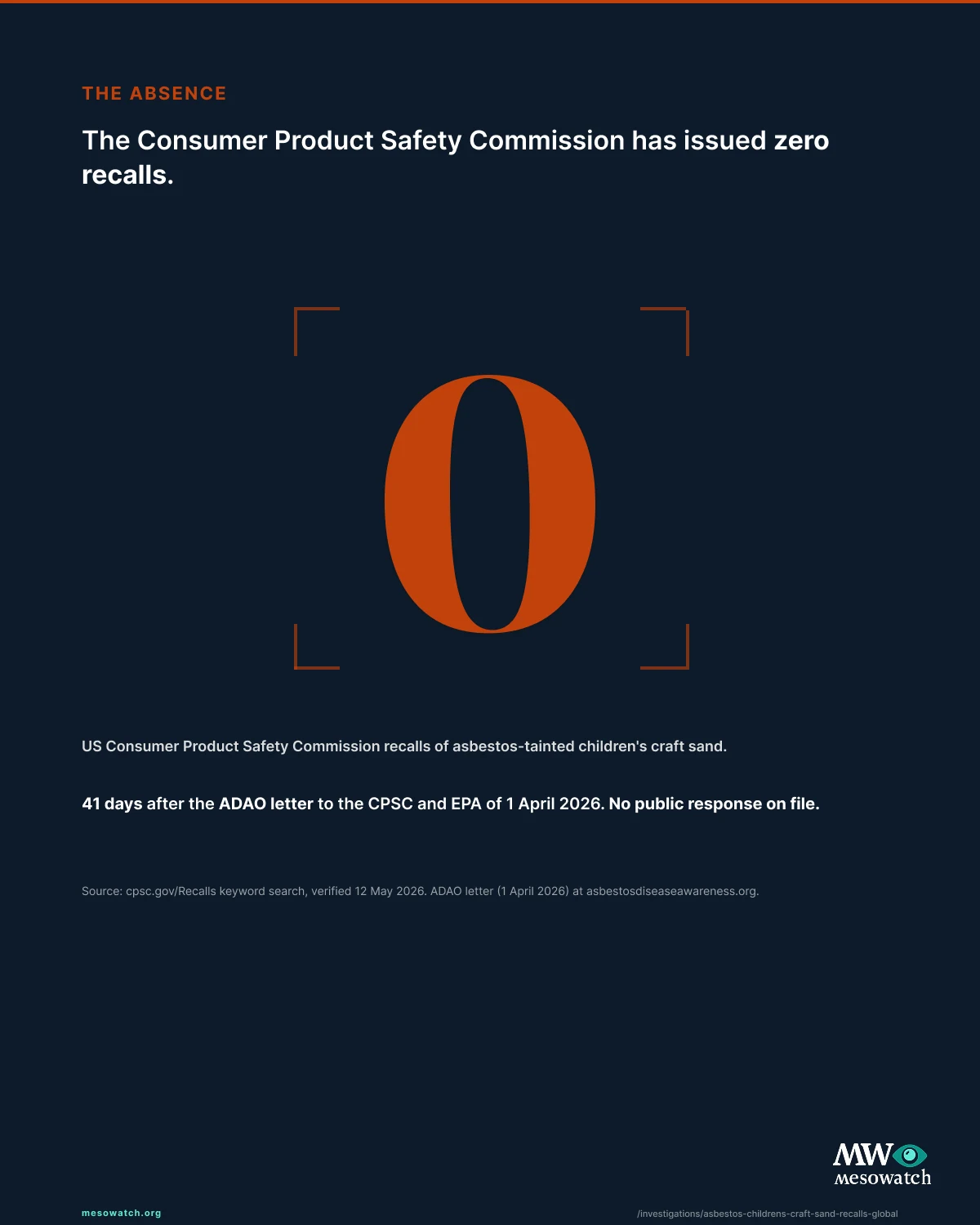
The United States has issued zero. The Asbestos Disease Awareness Organization wrote to the CPSC and the Environmental Protection Agency on 1 April 2026 asking both agencies to test the same product lines on American shelves. No public response was on file 41 days later.
This page is a running tally of what has been recalled, where, and what is still being sold under other labels.
For the deeper supply-chain narrative behind these numbers, including the single Chinese quarry named by the Australian Competition and Consumer Commission, see the cornerstone investigation that aggregates all 80-plus recalls.
The Products
The core issue is children’s craft and sensory play products that contain colored sand. Laboratory testing in multiple countries has found tremolite asbestos, and in some cases actinolite or chrysotile, in sand imported from Chinese suppliers.
The contaminated products share several characteristics:
- Imported from Chinese manufacturers
- Marketed for children ages 3 and up
- Sold through mass-market online platforms (Amazon, eBay) and chain retailers
- Low price points, often under $20
- Packaged with educational or craft claims
| Category | Example Products | Asbestos Type Found |
|---|---|---|
| Sand art kits | Colour Day Sand Art Activity Kit | Tremolite |
| Sensory play sand | Kinetic-style craft sand | Tremolite, actinolite |
| Candle-making kits | Paw Patrol candle kit (Addo Play) | Tremolite |
| Decorative craft sand | Colour Forge sand, ORB sand toys | Tremolite |
| Hobbycraft DIY kits | Various craft brands | Tremolite |
Country-by-Country Recall Tally
Twelve countries acted, per Consumer Reports’ canonical count. A thirteenth jurisdiction, Gibraltar, was added via the EU Safety Gate cascade. The full list, in order of first recall:
- United Kingdom, Australia, New Zealand
- Canada, France, Germany
- Ireland, Malta, Italy
- Japan, the Netherlands, Luxembourg, Gibraltar
| Country | Recalls (YTD) | Agency | Major Retailers Affected |
|---|---|---|---|
| United Kingdom | 37 | OPSS | Amazon, eBay, Tesco, Marks & Spencer, Matalan, Asda, Hobbycraft, Smyths, B&M, Argos, Aldi, Sainsbury's, Dunelm, John Lewis |
| Australia | 6 lines | ACCC | Kmart, Officeworks, The Reject Shop, Modern Teaching Aids |
| New Zealand | 4+ | MBIE | Discount stores nationwide, City Beach NZ |
| Canada | 1 consolidated | Health Canada | Addo Play retail and online channels |
| France | Nationwide suspension | DGCCRF | Category-wide pending testing |
| Germany | EU Safety Gate trigger | BAuA | Temu marketplace (PDD Holdings) |
| Ireland | Multiple | CCPC | Dedicated asbestos-recall portal |
| Malta | 7-toy consolidated | MCCAA | Stretcherz, Out To Impress, ORB Funkee, plus 4 more |
| Italy | 1+ | EU Safety Gate | Notified 17 March 2026 |
| Japan | Warning issued | METI | Non-EU national action |
| Netherlands | EU Safety Gate | NVWA | Referenced in IBAS compilation |
| Luxembourg | EU Safety Gate | ILNAS | Paired with Germany cluster |
| Gibraltar | 30 March 2026 | EU Safety Gate | Thirteenth named jurisdiction |
| United States | 0 | CPSC | None (no action taken) |
United Kingdom
The UK has been the most active regulator, with the Office for Product Safety and Standards (OPSS) issuing 37 asbestos-tagged recalls in the 2026 wave from 27 January to 7 May. OPSS published an advisory on March 2, 2026, recommending that retailers test sand-containing consumer goods using scanning and transmission electron microscopy (SEM/TEM) methods.
Eleven of the 37 UK notices list KTL as the manufacturer of record. Nine of those 11 were published on a single date, 18 March 2026; the remaining two on 20 March and 24 March 2026. Addo Play Limited carries five notices. Hobbycraft holds three own-brand notices. Together with Texet, those four entities account for 21 of the 37 UK notices, or 57% of the British wave.
Major UK recalls announced in 2026 include:
- Hobbycraft Giant Box of Craft (OPSS 2601-0364)
- Stretcherz Stretch Squad and Slammerz (OPSS 2602-0156, 14 named retailers)
- Addo Play Out To Impress Creative Candles Kit
- Colour Day Sand Art Activity Kit (Amazon and eBay)
- Colour Forge decorative sand, ORB Funkee sand toys
- Galt Nature Craft Kit, Dunelm Novelty Doorstops
- Smyths Toys Dig Products, Crayola Discovery Craft Box
Affected retailers were instructed to remove the products from shelves, notify customers, and offer refunds. OPSS maintains a public list of recalled products on its official website.
Product safety is of the utmost importance to Hobbycraft. Following independent testing of a children’s sand product previously sold by Hobbycraft, traces of asbestos have been identified in a limited number of samples. The product was removed from sale immediately after concerns were raised, and there is no evidence of any injury or harm to customers.
Hobbycraft’s statement to ITV News is the only named, on-the-record retailer response from a UK high-street chain in the entire 2026 wave. Tesco, ASDA, Sainsbury’s, Smyths Toys, B&M, Aldi, Argos, Marks and Spencer, Matalan, and Home Bargains did not issue named-byline responses we located in the public record.
Australia and New Zealand
Australia and New Zealand have faced the most severe operational impact, with school and childcare closures across both jurisdictions since November 2025. Reuters reported that more than 70 schools in Australia and New Zealand had closed by 17 November 2025 for asbestos cleaning, including 69 in the Australian Capital Territory. Higher figures of 450 Australian and 150 New Zealand facilities that have circulated in earlier coverage are under re-verification.
The ACCC issued six recall lines in November 2025 and January 2026. Two of them, Kmart Australia (anko-brand Magic Sand and Sandcastle Building Set) and Officeworks (Kadink Decorative Sand), trace to a single ASX-listed parent: Wesfarmers Limited (ASX: WES). Reuters reported tremolite and chrysotile detection in the Australian samples that triggered the Educational Colours recall.
Australia sees approximately 800 to 900 new mesothelioma cases per year, historically among the highest per-capita rates in the world due to legacy asbestos mining at Wittenoom and widespread use of asbestos in construction. The country’s regulatory response to the new contamination has been aggressive, partly because of this historical sensitivity.
At least some of the tainted sand had come from one common quarry in China.
Canada
Health Canada issued one consolidated recall on 16 March 2026, covering two Addo Play product lines. The notice covers Out To Impress Sand Art (recall identifier 318-19149-C) and Out To Impress Creative Candles (318-19180-C). Consumers were advised to stop using the products and return them for refunds.
United States
As of 12 May 2026, the U.S. Consumer Product Safety Commission (CPSC) has not issued any recalls of craft sand products for asbestos contamination. Recent CPSC recalls have addressed unrelated product hazards such as iron supplements, bed rails, and steam cleaners.
The Asbestos Disease Awareness Organization (ADAO) sent a formal letter to CPSC and EPA on April 1, 2026, requesting that U.S. agencies test craft sand products sold on Amazon, eBay, and in sandbox sand aisles at retail stores. As of publication, no public response has been issued.
No parent should have to wonder if the toys their children play with are laced with asbestos.
Why the U.S. Gap Matters
The U.S. absence from the recall list does not mean contaminated products are unavailable in the country. Several of the same brands recalled internationally are listed on U.S. Amazon and eBay, often shipped directly from the same overseas suppliers. The supply chain that delivered asbestos-contaminated sand to UK retailers is the same one that serves the U.S. online marketplace.
CPSC’s recall authority is primarily reactive. The agency investigates consumer complaints, coordinates with manufacturers on voluntary recalls, and issues mandatory orders when necessary. It does not routinely test imported consumer products before they reach shelves. The absence of a recall reflects the absence of an investigation, not the absence of risk.
The EPA has broader authority over asbestos as a substance but limited direct authority over consumer products. The 2024 federal rule banning ongoing chrysotile asbestos uses did not address imported consumer goods contaminated with tremolite, actinolite, or other non-chrysotile forms.
If you have purchased children’s craft sand, sand art kits, sensory play sand, or similar products in 2024, 2025, or 2026, check whether the brand or product appears on any of the international recall lists. OPSS (UK), Health Canada, and Product Safety Australia maintain public recall databases. If you have a recalled product, stop using it, follow the disposal guidance on the recall notice (typically double-bagging and wet-cleaning surfaces), and contact the retailer for a refund.
The Health Risk
Tremolite asbestos, the type most commonly identified in the contaminated sand, is classified as a human carcinogen by the International Agency for Research on Cancer (IARC). There is no safe level of exposure. Tremolite fibers, once inhaled, can remain in lung tissue indefinitely and contribute to:
- Mesothelioma (typically 20 to 60 years after exposure)
- Lung cancer
- Asbestosis (a fibrotic lung disease)
- Pleural plaques and thickening
Children may be particularly vulnerable because their lungs are still developing, they breathe at higher rates relative to body size, and they have more years ahead for latent diseases to emerge. There is no medical test that can confirm past asbestos exposure in children or predict who will develop disease later in life.
What Parents Should Do
The practical steps available to families are limited but worth taking. For the deeper supply-chain reporting that motivates each step, see the cornerstone investigation tracing the wave back to a single Chinese quarry.
-
Check your products against international recall lists. The UK OPSS database, Health Canada recalls, and Product Safety Australia are freely searchable online.
-
Stop using any suspect products. If a product is recalled in another country or sold by the same manufacturer, stop using it even if no U.S. recall exists.
-
Dispose safely. Double-bag recalled sand products in plastic bags, wet-wipe surfaces where the sand was used, and follow disposal guidance from the relevant recall notice. Do not vacuum or sweep dry.
-
Document the purchase and use. Keep receipts, product photos, and notes on who used the product and for how long. Documentation becomes valuable if health concerns emerge later.
-
File a complaint with CPSC. Consumer complaints are what trigger most CPSC investigations. Reporting a recalled foreign product sold in the U.S. contributes to the case for domestic action.
-
Follow ADAO advocacy. The Asbestos Disease Awareness Organization has been the most active U.S. advocate for craft sand testing. Monitoring their updates is the fastest way to learn about any new CPSC action.
See Also
For the country-by-country reporting that fed this tally, see the UK’s 21-plus product recall list with OPSS reference numbers, the original Hobbycraft testing that opened the British wave, and the Australia and New Zealand school-closure response that opened the global cycle. The cornerstone investigation behind this page lives at Global Asbestos Consumer-Product Recalls: 80 Notices, 12 Countries, One Quarry.
References
Consumer Reports. Asbestos in Children's Play Sand Triggers Recalls in at Least a Dozen Countries (Lauren Kirchner, 30 April 2026).
https://www.consumerreports.org/babies-kids/toy-recalls/asbestos-in-childrens-play-sand-triggers-recalls-overseas-a9563932560/
UK Office for Product Safety and Standards. Product safety alerts, reports and recalls (asbestos keyword search).
https://www.gov.uk/product-safety-alerts-reports-recalls?keywords=asbestos
Australian Competition and Consumer Commission. Customers warned of recalled children's sand due to asbestos risks (Catriona Lowe statement).
https://www.accc.gov.au/media-release/customers-warned-of-recalled-children%E2%80%99s-sand-due-to-asbestos-risks
New Zealand Ministry of Business, Innovation and Employment. Two further recalls for asbestos contaminated coloured sand products.
https://www.mbie.govt.nz/about/news/two-further-recalls-for-asbestos-contaminated-coloured-sand-products
Health Canada. Out To Impress sand art and candles recalled due to possible asbestos contamination (16 March 2026).
https://recalls-rappels.canada.ca/en/alert-recall/out-impress-sand-art-and-candles-recalled-due-possible-asbestos-contamination
Asbestos Disease Awareness Organization. Public health advocates urge US regulators to test children's toys (1 April 2026 letter to CPSC and EPA).
https://www.asbestosdiseaseawareness.org/newsroom/blogs/release-cpsc-epa-kids-toys/
Reuters. Asbestos contamination forces schools in Australia, New Zealand to close (17 November 2025).
https://www.reuters.com/world/asia-pacific/asbestos-contamination-forces-schools-australia-new-zealand-close-2025-11-17/
ITV News. More than 100 children's toys recalled over asbestos risk since January (Kate Dearden, 27 April 2026).
https://www.itv.com/news/2026-04-27/more-than-100-childrens-toys-recalled-over-asbestos-risk-since-january
Ireland Competition and Consumer Protection Commission. Asbestos-related product recalls portal.
https://www.ccpc.ie/consumers/product-safety/child-safety/asbestos-related-product-recalls/
U.S. Consumer Product Safety Commission. CPSC Recalls database (verified zero asbestos craft-sand recalls).
https://www.cpsc.gov/Recalls
Reader Q&A
Frequently Asked Questions
Has the U.S. recalled any asbestos-contaminated products in 2026?
As of 12 May 2026, the U.S. Consumer Product Safety Commission has not issued any recalls for asbestos-contaminated craft sand, sand art kits, or similar products. Twelve other countries have issued recalls or warnings (thirteen counting Gibraltar via the EU Safety Gate cascade), and the Asbestos Disease Awareness Organization has formally requested CPSC and EPA testing of U.S.-sold equivalents.
Is there asbestos in children's coloured sand?
Yes, in the specific products covered by the 80-plus recall wave. Reuters confirmed laboratory detection of tremolite and chrysotile asbestos in the Australian samples that triggered the Educational Colours Rainbow Sand recall. New Zealand’s Ministry of Business, Innovation and Employment confirmed positive asbestos testing across the EC Rainbow Sand and Rainbow Sand Art Toy lines. UK OPSS notices use the phrase “small quantity of asbestos” across 37 separate recalls in 2026.
What products have been recalled for asbestos in 2026?
At least 80 children’s toys and craft kits that contain coloured or stretchy sand have been recalled or carry warnings across at least 12 countries since November 2025, per Consumer Reports. Affected product categories include sand art kits, stretchy sand-filled toys, sandcastle building sets, sensory bins, magic sand, decorative sand bottles, and weighted doorstops filled with sand. Major recalls include Hobbycraft Giant Box of Craft, Addo Play Out To Impress, Stretcherz Stretch Squad, KTL Sensory Science Kit, anko Magic Sand, and Educational Colours Rainbow Sand.
How many UK recalls have there been?
The UK Office for Product Safety and Standards has logged 37 asbestos-tagged recalls in the 2026 wave from 27 January to 7 May 2026. KTL is the manufacturer of record on 11 of them. Nine of those 11 were published on a single date, 18 March 2026; the remaining two on 20 March and 24 March 2026.
Which countries acted, and which did not?
The United Kingdom, Australia, New Zealand, Canada, France, Germany, Ireland, Malta, Italy, Japan, the Netherlands, Luxembourg, and Gibraltar have all issued recalls or warnings. The United States has not. The CPSC database returned zero asbestos craft-sand recalls as of 12 May 2026.
Where did the sand come from?
Every UK Office for Product Safety and Standards notice that lists a country of origin lists China. ACCC Deputy Chair Catriona Lowe told Consumer Reports that “at least some of the tainted sand had come from one common quarry in China.” The specific quarry has not been publicly named.
What should I do if I bought a recalled product?
Stop using the product, follow the disposal guidance on the recall notice (usually double-bagging in plastic), wet-wipe any surfaces where the sand was used, and contact the retailer for a refund. If the product is only recalled in another country, treat it the same way. Do not vacuum or sweep dry.
Is tremolite asbestos dangerous?
Tremolite is classified as a human carcinogen by the International Agency for Research on Cancer. Like other forms of asbestos, it can cause mesothelioma, lung cancer, and asbestosis after inhalation. There is no safe level of exposure, and fibers remain in lung tissue indefinitely.