Hunters Point, Mare Island, and NAS Alameda are each on the EPA Superfund NPL. None has a Bay Area-specific worker cohort study.
Hunters Point and Mare Island naval shipyards carry EPA Superfund records documenting asbestos. No mesothelioma cohort study covers Bay Area Navy workers.

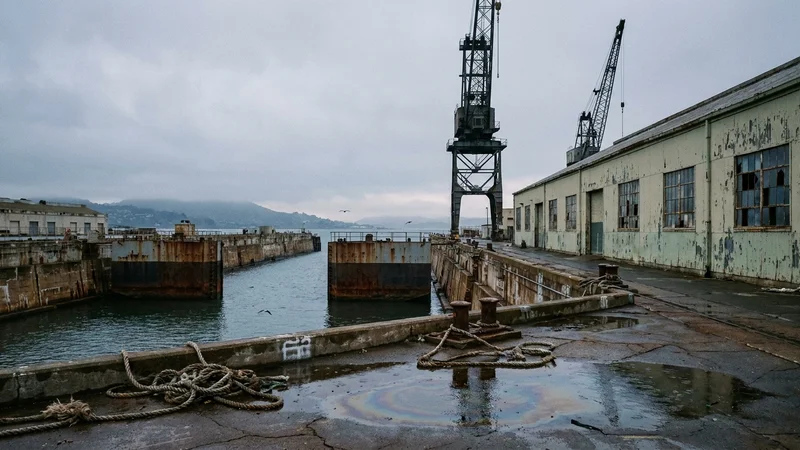
Three closed Navy facilities along the San Francisco Bay each carry an EPA Superfund National Priorities List record documenting asbestos-containing material in buildings, pipe systems, and industrial infrastructure. None has a Bay Area-specific peer-reviewed worker cohort study in the published literature.
That’s the honest picture for the Bay Area equivalent of what Kolonel 1985 documented at Pearl Harbor: the exposure record exists in primary EPA and Navy documents, and the epidemiology paper has not been written or has not been published in PubMed-indexed venues. Each of the three site IDs comes directly from EPA’s Superfund Enterprise Management System, cross-referenced against U.S. Navy historical documentation and a systematic PubMed search. This is what the public record actually contains.
Hunters Point Naval Shipyard
The southernmost of the three Bay Area facilities, and the Superfund site with the most public attention. Hunters Point was acquired by the U.S. Navy in 1940 and operated as a ship repair and fitting-out yard until placed into caretaker status in the 1970s, with final shipyard closure in 1974. Like other Pacific Coast yards of that era it played a role in the Navy’s early Cold War radiological work, which is why current EPA cleanup addresses both asbestos-containing material and radioactive contamination across the site.
EPA Superfund records list the site under ID CA1170090087 and divide it into multiple Operable Units: OU-1, OU-2, OU-2A, OU-2B, OU-2C, OU-3, OU-4, OU-5, plus the offshore Parcel F. EPA’s most recent site status describes land-based parcels as largely in remedy implementation or long-term operations and maintenance, while Parcel F (offshore sediment) remains in the remedial investigation and feasibility study phase.
The asbestos record in the primary EPA Remedial Investigation and ROD documents identifies ACM in three contexts at HPNS: buildings (floor tile, transite, fireproofing), utility corridors (pipe lagging on steam and hot-water lines), and industrial structures (boiler insulation, equipment insulation). EPA describes asbestos removal and abatement as part of the demolition and remedial actions on the land-based parcels. The records do not provide quantitative airborne exposure measurements for specific worker groups.
Mare Island Naval Shipyard
The Pacific Coast’s first Navy yard, and 142 continuous years of shipbuilding and repair. Mare Island was established in 1854 in Vallejo and operated through BRAC closure in 1996. Navy historical records describe Mare Island as building and repairing submarines, destroyer escorts, repair ships, and auxiliary vessels, particularly during World War II and the Cold War. That generational span means the workforce exposed to pre-1980 asbestos-containing material at Mare Island spans the families of multiple Bay Area communities.
EPA lists the site under Superfund ID CA7170024775. Navy Installation Restoration Program documents and EPA RI/FS/ROD text for Mare Island identify ACM in shipyard buildings and utilities, specifically pipe insulation, floor tile, transite cement panels, and other ACM. Asbestos abatement was required during building demolition. The primary records do not provide detailed quantitative descriptions of specific worker exposure tasks comparable to a published case-control study.
A search of PubMed for cohort or case-control studies focused on Mare Island workers, analogous to Kolonel’s 1985 cohort at Pearl Harbor or Rinsky’s 1988 case-control at Portsmouth, returns no published study. Bay Area workers may be included in multi-site cohorts such as the Schubauer-Berigan series of U.S. shipyard worker mortality studies (2011 to 2013), but the publicly available abstracts and main texts of those papers do not separately report results by individual Navy yard.
Naval Air Station Alameda
Bay Area air operations and ship repair, 1940 to 1997. NAS Alameda was commissioned in 1940 and operated as a Naval Air Station supporting aircraft maintenance, overhaul, carrier-based aircraft operations, and ship repair via adjacent naval facilities. Primary Navy environmental documents characterize NAS Alameda mainly as an aviation and support facility rather than a full public shipyard, though ship repair activities did occur there.
EPA Superfund records list NAS Alameda under installation ID CA2170023236, subject to CERCLA cleanup under the Navy’s Installation Restoration Program. Navy and EPA remedial investigation documents report ACM in base buildings and infrastructure, with asbestos abatement requirements during demolition and renovation. The site is also identified in Department of Defense and Navy environmental documentation as containing Munitions and Explosives of Concern (MEC) areas, subject to separate munitions response actions.
Like the other two facilities, NAS Alameda has no peer-reviewed cohort study focused specifically on its workers. The exposure record is in the EPA RI/FS reports; the epidemiology paper has not been published.
The Cohort Gap, Stated as a Gap
A systematic PubMed search for “Hunters Point” OR “Mare Island” OR “Alameda Naval Air Station” combined with “mesothelioma,” “asbestos,” and “cohort” returns zero Bay Area-specific cohort mortality studies. The strongest U.S. Navy-yard mesothelioma signal in the literature remains Kolonel et al. 1985 (Cancer Research, PMID 4016758), studying 7,971 male Pearl Harbor Naval Shipyard workers with mesothelioma at roughly eleven times the Hawaii statewide rate. Pearl Harbor sits 4,800 miles from the Bay Area. The geography does not transfer.
The 2021 Lemen and Landrigan review in International Journal of Environmental Research and Public Health synthesizes elevated mesothelioma and lung cancer risk across multiple naval cohorts but provides no Bay Area-specific or facility-specific risk estimates. The Schubauer-Berigan series of multi-site U.S. shipyard worker mortality studies may include Bay Area workers but does not separately report results by individual yard in publicly available papers.
This is the same fact-check discipline that applied to our Memorial Day 2026 data-gap investigation: we cite what the primary record contains and we state the absence as an absence. There is no Bay Area Kolonel-equivalent. The exposure was real, the documentation is real, but the epi paper is not in the literature.
What the California Cancer Registry Adds, and Doesn’t
The California Cancer Registry publishes age-adjusted mesothelioma incidence rates per 100,000 by county. San Francisco County (Hunters Point), Solano County (Mare Island), and Alameda County (NAS Alameda) each appear in the published statistics. The registry classifies malignant mesothelioma as a reportable cancer.
The registry does not attribute cases to specific workplaces. A Bay Area county-level mesothelioma case in the published statistics could be Navy yard, refinery, construction, or other exposure. Workplace attribution requires either a death-certificate occupation analysis through NCHS restricted-use file access, or individual case-by-case work history reconstruction by treating physicians. Neither is the kind of analysis CCR publishes.
So the public record carries three threads that don’t currently connect: EPA Superfund documentation of the facilities, county-level mesothelioma incidence at the Bay Area registries, and a missing peer-reviewed cohort study that would join them. We can name each thread. We cannot, from the public record alone, deliver a published per-yard mesothelioma incidence rate.
What This Means for Bay Area Navy Veterans
For a veteran stationed at Hunters Point, Mare Island, or NAS Alameda before the mid-1970s who is now diagnosed with mesothelioma, the VA claim proceeds under direct service connection at 38 CFR §3.303, not under PACT Act presumptive coverage. Mesothelioma is not on the 38 CFR §3.309 presumptive list. The 2022 PACT Act did not add it.
The claimant must establish three things: documented in-service asbestos exposure consistent with their rating and duties, a current mesothelioma diagnosis, and a medical nexus opinion linking the two. For Navy ratings at any of the three Bay Area facilities before the mid-1970s, the documented Navy use of asbestos in engine and boiler rooms (per VA War Related Illness and Injury Study Center documentation) makes the exposure element well-supported under the VA’s M21-1 asbestos guidance. It remains a direct-service-connection claim, not an automatic presumption.
Once granted, mesothelioma is rated at 100% under 38 CFR §4.97, Diagnostic Code 6819. The 2026 rate for a single veteran with no dependents is $3,938.58 per month, tax-free, per the VA disability compensation tables.
A Closing Thesis
The strongest thing the public record says about Bay Area Navy yard asbestos exposure is also the most honest. Hunters Point, Mare Island, and NAS Alameda are each on the EPA Superfund National Priorities List. Their respective EPA records (CA1170090087, CA7170024775, CA2170023236) document asbestos-containing material in buildings, pipe systems, and infrastructure. The U.S. Navy’s own historical record confirms ACM use in engine and boiler rooms on pre-mid-1970s ships and yards.
What the public record does not contain is a peer-reviewed cohort mortality study of Bay Area Navy workers analogous to Kolonel 1985 at Pearl Harbor. Multi-site cohorts may include Bay Area workers but do not break them out. The California Cancer Registry sees the mesothelioma cases at the county level but cannot attribute them to specific yards. So Bay Area veterans whose mesothelioma is real, whose service is real, and whose exposure is documented in the EPA record nevertheless proceed claim-by-claim under direct service connection, without the published incidence study that would frame their cohort the way Kolonel framed Pearl Harbor.
The exposure is documented. The epi study has not been done. That is the gap. It is the story.
Reader Q&A
Frequently Asked Questions
What asbestos uses are documented at these yards?
Primary EPA and Navy Superfund records identify ACM in three contexts. Buildings: floor tile, transite cement panels, pipe insulation, fireproofing. Utility corridors: pipe lagging on steam and hot-water lines, valve gaskets. Industrial structures: boiler insulation, machine-shop ductwork, equipment insulation. VA War Related Illness and Injury Study Center documentation states that Navy ships built before the mid-1970s used ACM in engine and boiler rooms, and that veterans who removed damaged asbestos lagging on pipes or used asbestos paste to re-wrap pipes were at risk of exposure. Pipefitters, welders, and boiler operators in Navy shipyards are specifically identified in VA documentation as occupations with substantial exposure risk.
What does the California Cancer Registry show for Bay Area counties?
The California Cancer Registry publishes age-adjusted mesothelioma incidence rates per 100,000 for each California county including San Francisco, Alameda, Solano, and Contra Costa, where the three Navy facilities sit. The registry classifies malignant mesothelioma as a reportable cancer. The registry does not attribute cases to specific workplaces. A Bay Area county-level mesothelioma case in the published statistics could be Navy yard, refinery, construction, or other exposure. Workplace attribution requires either a death-certificate occupation analysis (NCHS restricted-use file access) or individual case-by-case work history reconstruction by treating physicians.
What did Mare Island build?
Mare Island Naval Shipyard in Vallejo was the first U.S. Navy yard on the Pacific Coast, established in 1854 and operated continuously until BRAC closure in 1996. Navy historical records describe Mare Island as building and repairing submarines, destroyer escorts, repair ships, and auxiliary vessels, particularly during World War II and the Cold War. 142 years of continuous Navy ship work means the workforce exposed to pre-1980 asbestos-containing material spans multiple generations of Bay Area families.