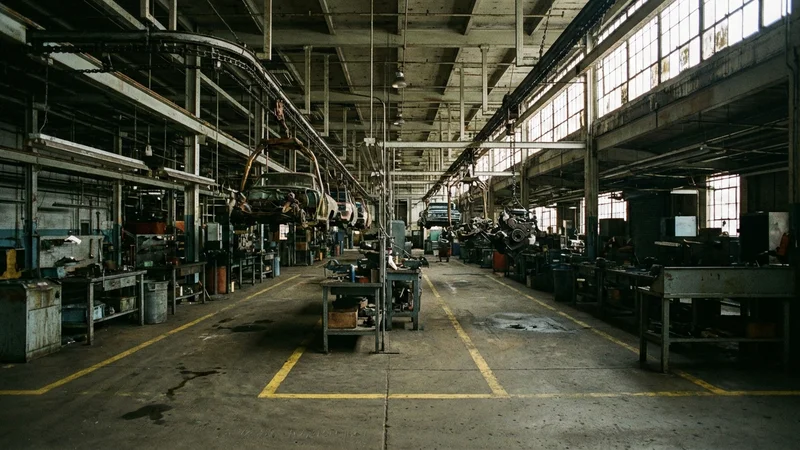
For most of the 20th century, the Detroit metropolitan area was the center of American automobile manufacturing. Ford, General Motors, and Chrysler operated massive assembly plants, foundries, stamping facilities, and parts manufacturing operations across southeastern Michigan, employing hundreds of thousands of workers in facilities where asbestos was a standard industrial material.
The workers are retired or gone. Many of the plants are closed or repurposed. But the diagnoses continue, arriving 30 to 50 years after the last shift, in workers now in their 70s and 80s, and in their family members who never set foot inside a factory.
Ford Motor Company
Ford’s Rouge Complex in Dearborn was the largest integrated factory in the world when it reached full capacity. Built between 1917 and 1928, the complex included a steel mill, glass plant, tire plant, power plant, and assembly lines. At its peak, raw materials entered one end and finished vehicles rolled out the other.
Asbestos was embedded in every layer of the Rouge Complex. It insulated the blast furnaces in the steel mill, the boilers in the power plant, the steam pipes that ran between buildings, and the electrical systems that powered the assembly lines. It appeared in the brake linings and clutch facings that workers manufactured, tested, and installed. It lined the walls and ceilings as fireproofing.
For the workers who spent decades inside this complex, exposure was continuous and inescapable. Insulators and pipefitters handled asbestos materials directly. Millwrights and maintenance crews disturbed it during repairs. Assembly line workers, tool and die makers, and foundry workers breathed the same air in facilities where asbestos dust was simply part of the environment.
Ford also operated additional facilities in Wayne, Wixom, Saline, and other Michigan communities, each with its own asbestos footprint.
General Motors
General Motors’ Michigan footprint was even broader than Ford’s, with major facilities scattered across the state:
In Flint, the Buick City complex, Chevrolet plants, and Fisher Body facilities formed an industrial corridor that employed tens of thousands of workers. GM’s Flint operations included foundries, assembly plants, and parts manufacturing, all using asbestos. In Pontiac, the Pontiac Assembly Plant and related facilities produced vehicles and components using asbestos-containing materials in both manufacturing processes and building infrastructure. In Lansing, Oldsmobile and later Cadillac production facilities relied on the same industrial materials. And in Saginaw, GM’s Saginaw Steering Gear division manufactured steering and suspension components, with asbestos in both the finished products and the factory infrastructure.
GM workers across these facilities encountered asbestos in brake production, clutch manufacturing, insulation maintenance, and the buildings themselves. The foundry workers who cast engine blocks, the machinists who finished brake components, and the maintenance crews who replaced insulation all shared the same exposure.
Chrysler
Chrysler operated major plants in Detroit, Sterling Heights, Warren, and other Metro Detroit communities. The company’s Dodge Main plant in Hamtramck, which operated from 1910 to 1980, was one of the most significant auto manufacturing facilities in the region. Chrysler also ran assembly and parts plants across Ohio’s Toledo corridor, where the same asbestos-containing brake and clutch components, building insulation, pipe lagging, and fireproofing were used.
Workers at Chrysler’s stamping plants, engine plants, and assembly facilities faced the same exposure patterns as workers at Ford and GM. The material was standard across the industry, and none of the Big Three moved to eliminate it from their operations until the late 1970s and 1980s.
The Parts Suppliers
The Big Three were only the tip of the pyramid. Hundreds of parts suppliers across southeastern Michigan manufactured the components that went into American cars and trucks. Companies producing brake pads, clutch facings, gaskets, and insulation products all worked with asbestos-containing materials.
These smaller facilities often had fewer protective measures than the major manufacturers. Workers at parts plants in cities like Livonia, Taylor, Romulus, and Ypsilanti faced concentrated exposure in smaller buildings with less ventilation. Many of these companies are now defunct, but several have established asbestos trust funds to compensate former workers.
Take-Home Exposure
The danger extended beyond the factory gates. Auto workers carried asbestos fibers home on their clothing, hair, and skin. Spouses who laundered work coveralls, children who hugged their parents after a shift, all breathed the same fibers that were accumulating in the workers’ own lungs.
This secondary exposure pathway is particularly well documented in Michigan. Wayne County families have filed claims based on take-home exposure from auto plants, and Michigan courts have recognized that companies knew or should have known about the risk to workers’ families. A Virginia Supreme Court ruling in January 2026 affirming a duty of care for shipyard take-home exposure has further solidified the legal foundation for these claims across state lines.
If you or a family member worked at any of the Big Three auto plants, their suppliers, or related facilities in Michigan, an experienced mesothelioma attorney can help reconstruct the exposure history using employment records, union documents, co-worker testimony, and product databases. Many of these companies and their suppliers are connected to asbestos trust funds that still accept claims.
Brake and Clutch Workers
One group of auto workers faced particularly intense exposure: those who manufactured, tested, and installed brake linings and clutch facings. Chrysotile asbestos was the primary material in automotive friction products for decades. Workers who ground, drilled, or beveled brake pads released clouds of asbestos dust. Mechanics who blew out brake drums with compressed air created airborne fiber concentrations hundreds of times above safe levels.
Michigan’s concentration of brake and clutch manufacturing, including major facilities operated by Bendix, Abex, and Raybestos-Manhattan, created a distinct category of exposure that affected thousands of workers across the state. The same brake products were assembled and installed at Ohio’s Toledo and Cleveland auto plants, extending the same exposure pattern across state lines.
What Remains
The auto industry has largely moved away from asbestos, but the material remains in older buildings, contaminated soils at former plant sites, and most critically, in the lungs of workers who were exposed decades ago. With latency periods of 20 to 60 years, mesothelioma diagnoses continue to emerge from exposures that occurred in the 1960s, 1970s, and 1980s. For those now facing a diagnosis, the current treatment landscape offers immunotherapy combinations and surgical approaches that have improved outcomes in recent years.
Michigan has 2,460 documented mesothelioma diagnoses and 1,915 deaths, with Wayne County leading the state. For the families of workers who built America’s cars, the legacy of asbestos in Detroit’s auto plants is still being measured.
Which Detroit auto plants used asbestos?▼
All of the major auto plants used asbestos extensively. Ford’s Rouge Complex, GM plants across Flint, Pontiac, and Lansing, and Chrysler facilities in Detroit and Sterling Heights all used asbestos in insulation, brake and clutch production, pipe lagging, fireproofing, and building materials. Hundreds of parts suppliers also used asbestos-containing materials.
Can families of auto workers file mesothelioma claims?▼
Yes. Both direct exposure claims and take-home exposure claims are recognized in Michigan courts. Workers who were directly exposed and family members who inhaled fibers from contaminated clothing may have legal options, including trust fund claims and lawsuits.
How long after working in an auto plant can mesothelioma develop?▼
Mesothelioma typically develops 20 to 60 years after asbestos exposure. A worker who was exposed at the Rouge Complex in the 1970s could receive a diagnosis in the 2030s or later. The long latency period means new cases continue to emerge from exposures that occurred decades ago.
Are there asbestos trust funds for Michigan auto workers?▼
Yes. Many companies that manufactured or supplied asbestos products to Michigan auto plants have established bankruptcy trust funds. An experienced attorney can identify which trusts apply to a specific worker’s exposure history. See our Michigan trust fund guide for details.
References
Agency for Toxic Substances and Disease Registry. ATSDR National Asbestos Exposure Map.
https://www.atsdr.cdc.gov/asbestos/sites/national_map/
Centers for Disease Control and Prevention. CDC WONDER Mortality Database.
https://wonder.cdc.gov/
National Cancer Institute. National Cancer Institute SEER Data.
https://seer.cancer.gov/
National Institute for Occupational Safety and Health. NIOSH Workplace Safety and Asbestos.
https://www.cdc.gov/niosh/topics/asbestos/