Chicago Steel Mills: The Southeast Side Asbestos Legacy
How U.S. Steel South Works, Wisconsin Steel, and Republic Steel exposed generations of Chicago workers and families to asbestos.

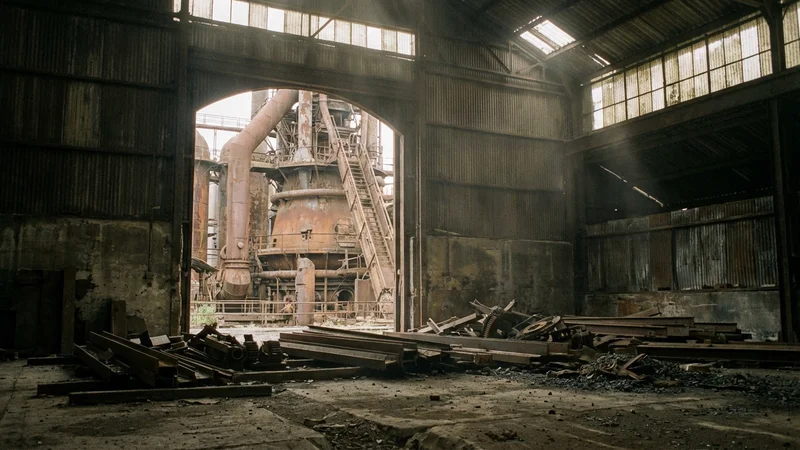
For more than a century, the neighborhoods along Chicago’s Southeast Side, South Chicago, South Deering, East Side, Hegewisch, formed one of the largest steelmaking corridors in the world. The mills that defined these communities also exposed generations of workers to asbestos, a material woven into every layer of steel production.
The workers are gone. Many of the mills are demolished. But the diagnoses continue, arriving 30 to 50 years after the last shift, in workers now in their 70s and 80s, and sometimes in their children and spouses.
U.S. Steel South Works
South Works opened in 1882 on the Calumet River at the southern edge of Lake Michigan. Over the next century it grew from 30 hectares to more than 200, expanded by dumping slag into the lake at a rate of five to 10 acres per year.
At its peak, the mill produced structural steel for railroads, bridges, and skyscrapers, including some of the beams that built downtown Chicago. It employed thousands of workers at a time, drawing from the surrounding neighborhoods of South Chicago, South Deering, and East Side.
Asbestos was everywhere inside South Works. It insulated the blast furnaces that ran at temperatures above 2,000 degrees. It wrapped the pipes that carried steam and chemicals between buildings. It lined the ladles that poured molten metal. It protected the electrical systems and the walls of the soaking pits.
For workers who installed, maintained, or worked near this insulation, exposure was continuous. Insulators, pipefitters, millwrights, electricians, and bricklayers handled asbestos materials directly. But steelworkers on the production floor breathed the same air, and exposure accumulated over years and decades.
South Works closed in 1992. The Chicago Park District acquired the site in 2004, but contamination concerns have complicated redevelopment plans.
Wisconsin Steel
Wisconsin Steel opened in 1875 as the John H. Brown Iron and Steel Company in what would become the South Deering neighborhood. International Harvester acquired the mill in 1902 to secure a steel supply for farm equipment manufacturing.
The mill occupied most of the South Deering neighborhood’s industrial footprint. Like South Works, it used asbestos throughout its operations: in furnace insulation, pipe covering, gaskets, and fireproofing materials. Workers in the same trades, insulators, pipefitters, boilermakers, and maintenance crews, faced the heaviest exposure.
Wisconsin Steel’s closure was sudden. International Harvester sold the mill to Envirodyne Industries in 1977. Three years later, amid a strike, falling demand, and financial problems, the mill shut down without warning on March 28, 1980. Approximately 3,500 workers lost their jobs in a single day, many without severance or benefits.
The workers who spent years breathing asbestos dust inside Wisconsin Steel would not learn the cost for decades.
Republic Steel and the East Side
Republic Steel operated a major mill in the East Side neighborhood, later acquired by LTV Steel. It was the last of the three major Southeast Side mills to close, shutting down in 2002 amid the broader collapse of American steelmaking.
Republic’s workers faced the same asbestos exposure as their counterparts at South Works and Wisconsin Steel. The mill’s maintenance shops, power plant, blast furnaces, and rolling mills all contained asbestos materials. Railroad workers who moved materials in and out of the facility were also exposed. The same pattern played out at steel mills across the industrial Midwest, from Cleveland’s Republic and LTV operations to Gary’s U.S. Steel Works just across the state line in Indiana.
Railroads and Beyond
Chicago’s status as the nation’s railroad hub added another layer of exposure. The B&O Railroad, Chicago and Northwestern Railway, and dozens of other lines operated maintenance and repair facilities across the region. Locomotives, railcars, and station buildings all contained asbestos components.
Beyond steel and rail, factories producing boilers, gaskets, brakes, electrical components, and automotive parts used asbestos in their products and facilities. The Calumet Shipyard, Armour Manufacturing, and chemical plants along the Chicago Sanitary Canal created additional exposure for industrial workers in the area.
Take-Home Exposure
The danger extended beyond the mill gates. Workers carried asbestos fibers home on their clothing, hair, and skin. Spouses who laundered work clothes, children who hugged their parents at the door, all breathed the same fibers that were killing the workers themselves.
Recent Cook County verdicts have recognized this exposure pathway. In December 2023, a jury awarded $30 million to the family of a man who developed peritoneal mesothelioma from take-home exposure via his father’s clothing. His father had worked at a Bridgestone Firestone facility in Decatur, but the legal principle applies equally to steel mill families across the Southeast Side. The Virginia Supreme Court’s 2026 ruling in Quisenberry v. Huntington Ingalls further strengthened the legal foundation for these claims nationwide.
If you or a family member worked at any of the Southeast Side steel mills, railroad facilities, or manufacturing plants, an experienced mesothelioma attorney can help reconstruct the exposure history using employment records, union documents, co-worker testimony, and product databases. Many of these sites are connected to asbestos trust funds that still accept claims.
What Remains
The steel mills are gone, but their footprint remains. South Works is a contested redevelopment site. Wisconsin Steel’s land has been partially remediated. Republic Steel’s East Side property has been cleared.
What also remains are the asbestos fibers deposited in the lungs of workers and their families decades ago. With latency periods of 20 to 60 years, mesothelioma diagnoses continue to emerge from exposures that occurred at these mills in the 1960s, 1970s, and 1980s.
Illinois has extensive documented industrial asbestos exposure, the most of any state in the country. The Southeast Side mills account for a significant share. For the families of workers who built Chicago’s steel industry, the legacy is still being written.
References
Agency for Toxic Substances and Disease Registry. ATSDR National Asbestos Exposure Map.
https://www.atsdr.cdc.gov/asbestos/sites/national_map/
Centers for Disease Control and Prevention. CDC WONDER Mortality Database.
https://wonder.cdc.gov/
Chicago State University. Southeast Side Industrial History.
https://www.csu.edu
Chicago Public Library. Wisconsin Steel and the Crisis of Deindustrialization.
https://www.chipublib.org/blogs/post/wisconsin-steel/
Reader Q&A
Frequently Asked Questions
Which Chicago steel mills used asbestos?
All of the major Southeast Side mills used asbestos extensively. U.S. Steel South Works, Wisconsin Steel, and Republic Steel (later LTV Steel) used it in furnace insulation, pipe covering, gaskets, fireproofing, and electrical systems. Exposure affected insulators, pipefitters, boilermakers, electricians, millwrights, and production workers.
Can families of steel mill workers file mesothelioma claims?
Yes. Both direct exposure claims and take-home exposure claims are recognized in Illinois courts. Workers who were directly exposed and family members who inhaled fibers from contaminated clothing may have legal options, including trust fund claims and lawsuits.
How long after working in a steel mill can mesothelioma develop?
Mesothelioma typically develops 20 to 60 years after asbestos exposure. A worker who was exposed at South Works in the 1970s could receive a diagnosis in the 2030s or later. The long latency period means new cases continue to emerge from exposures that occurred decades ago.
Are there asbestos trust funds for Illinois steel mill workers?
Yes. Many of the companies that manufactured or supplied asbestos products to Illinois steel mills have established bankruptcy trust funds. An experienced attorney can identify which trusts apply to a specific worker’s exposure history.
When was asbestos banned near Chicago, IL?
Asbestos has never been fully banned in the United States, including near Chicago, Illinois. The EPA issued a partial ban in 1989 prohibiting manufacture, import, and distribution of five specific products (corrugated paper, rollboard, commercial paper, specialty paper, and flooring felt) and new uses after August 25, 1989, but a federal court overturned most provisions in 1991. In March 2024, the EPA banned chrysotile asbestos. the last type imported. with a multi-year phase-out, though legacy uses and other forms remain regulated under federal and Illinois state rules. Chicago enforces strict local ordinances (Municipal Code Chapter 11-4) on handling, removal, and disposal of asbestos-containing materials in buildings. Asbestos was commonly used in Illinois buildings until the mid-1970s and occasionally into the late 1980s.
What is the 3 5 7 rule for asbestos sampling?
The 3-5-7 rule, from EPA’s Asbestos Hazard Emergency Response Act (AHERA) under 40 CFR 763.86, sets minimum bulk samples for friable surfacing materials (like acoustic ceilings or spray-on fireproofing) in homogeneous areas: 3 samples for <1,000 sq ft, 5 for 1,000-5,000 sq ft, and 7 for >5,000 sq ft. Samples must be randomly distributed, with the area deemed asbestos-containing if ≥1% asbestos by weight in any sample. The EPA Pink Book recommends 9 samples per area for higher confidence, though 3-5-7 is the regulatory minimum. This applies to U.S. inspections; other materials like joint compound require separate protocols, often 3 samples. People with mesothelioma often trace exposure to undetected asbestos in such materials.
Can I remove asbestos myself in Illinois?
Federal law permits homeowners to remove asbestos from their own single-family residences, but Illinois imposes strict requirements that make DIY removal risky and potentially illegal. The Illinois Environmental Protection Agency (IEPA) and Chicago municipal codes mandate proper containment, wetting, and HEPA filtration practices, and violations can result in fines up to $25,000 per day. Disturbing asbestos improperly releases microscopic fibers that can lodge in the lungs and cause mesothelioma, asbestosis, or lung cancer. In multi-family residences, rental properties, or commercial buildings, only licensed contractors are permitted to perform removal. Cook County requires an asbestos abatement permit filed at least 10 working days before any project begins , and the Illinois Department of Public Health can provide referrals to licensed contractors at (217) 782-3517.
Would a house built in 1976 have asbestos?
Homes built in 1976 have a moderate to high likelihood of containing asbestos in materials like pipe insulation, vinyl floor tiles, adhesives, popcorn ceilings, and drywall joint compound. Asbestos use in U.S. residential construction declined after 1980, with most applications phased out by the mid-1980s, though a 1989 EPA ban was overturned in 1991 and chrysotile asbestos was prohibited in 2024. Stockpiled materials could appear in homes into the 1990s, so presence depends on specific construction and renovation history. Evidence from building records shows 1976 falls in a high-risk period before widespread restrictions.