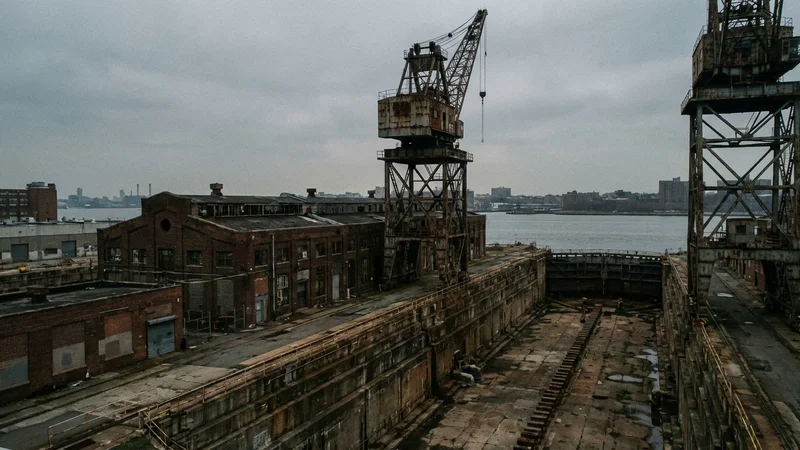
New York City’s mesothelioma burden traces to three distinct exposure histories that overlap in geography and time. The Brooklyn Navy Yard built warships with asbestos in every compartment. The construction trades lined buildings across the five boroughs with asbestos fireproofing and insulation. And on September 11, 2001, the collapse of the Twin Towers released all of it at once.
Each exposure pathway continues to produce new diagnoses. The Navy Yard workers are in their 70s and 80s. The construction tradespeople who renovated mid-century buildings are now in their peak diagnosis years. And the 9/11 cohort, some of whom were in their 20s and 30s at the time, is entering the latency window when mesothelioma typically appears.
The Brooklyn Navy Yard
The New York Naval Shipyard in Brooklyn, commonly known as the Brooklyn Navy Yard, was one of the busiest naval shipyards in the United States from the 1930s through the 1960s. At its peak during World War II, the yard employed more than 70,000 workers building and repairing battleships, aircraft carriers, and other naval vessels.
Asbestos was integral to shipbuilding during this era. Steam and hot water pipes throughout every vessel were wrapped in asbestos insulation; pipefitters and insulators cut, shaped, and applied this material in tight compartments below deck, releasing fibers into confined air. Ship boilers were covered in thick asbestos blankets for heat containment, and boilermakers who installed, maintained, and replaced that lagging had direct, sustained contact with the material. Fireproofing was sprayed on bulkheads, decks, and structural components throughout the ship for fire resistance, exposing adjacent workers to overspray and airborne fibers during application. Pumps, valves, flanges, and mechanical systems relied on asbestos gaskets, so machinists and mechanics who cut and replaced gaskets released fibers as part of routine maintenance. Wiring, switchboards, and electrical panels used asbestos-containing insulation, which electricians handled daily while stripping and installing wiring.
The Navy Yard closed in 1966, but mesothelioma diagnoses among former workers and their families continue. The 20 to 60-year latency period means some workers exposed in the 1950s are only now receiving diagnoses. The same shipyard exposure conditions produced elevated mesothelioma rates at California’s Hunters Point, Mare Island, and Long Beach yards, the Savannah port in Georgia, the Jacksonville yards in Florida, and the Philadelphia Navy Yard in Pennsylvania.
The World Trade Center
The original World Trade Center towers, completed in 1973, contained asbestos fireproofing in the lower floors of the North Tower, asbestos in floor tiles, and asbestos insulation in mechanical systems. When the towers collapsed on September 11, 2001, an estimated 400 tons of asbestos was released into the dust cloud that blanketed Lower Manhattan.
Who Was Exposed
- Firefighters and first responders who entered the debris pile on September 11 and the days that followed
- Police officers who secured the perimeter and worked rescue operations
- Construction and demolition workers who spent months on the cleanup at Ground Zero
- Residents of Lower Manhattan who returned to apartments coated in dust
- Office workers in surrounding buildings who continued working in contaminated environments
- Students and teachers at schools near the disaster site
Ongoing Monitoring
The WTC Health Program, administered by the CDC, monitors more than 100,000 members for 9/11-related health conditions. Mesothelioma is among the cancers covered by the program. Because the latency period for mesothelioma extends to 60 years, new diagnoses from 9/11 exposure are expected to continue through 2060. For an in-depth look at the 9/11 exposure cohort and the trajectory of diagnoses, see our reporting on the ongoing mesothelioma crisis among first responders.
The WTC Victim Compensation Fund provides a separate compensation avenue for people with 9/11-related mesothelioma, operating independently from lawsuits and trust fund claims.
Construction Trades
Beyond the Navy Yard and the WTC, the most pervasive source of asbestos exposure in New York City was the construction industry itself. From the 1940s through the late 1970s, asbestos was a standard building material across the five boroughs.
Spray-on fireproofing was applied to steel structural members in office towers, apartment buildings, and public buildings throughout Manhattan, Brooklyn, and the outer boroughs. Heating, cooling, and plumbing systems in commercial and residential buildings used asbestos pipe wrap and duct insulation. Vinyl-asbestos floor tiles were installed in millions of square feet of commercial and residential space, and drywall finishers and plasterers worked with asbestos-containing joint compound and plaster throughout the postwar construction boom.
Workers across the construction trades, including steamfitters, insulators, electricians, plumbers, sheet metal workers, and demolition crews, were exposed during initial construction, renovation, and demolition. Many of these workers moved between job sites across the city, accumulating exposure from multiple buildings and multiple asbestos products.
Take-Home Exposure
Shipyard workers, construction tradespeople, and 9/11 responders all carried asbestos fibers home on their clothing, hair, and skin. Spouses who laundered work clothes and children in the household were exposed to fibers without ever setting foot on a job site. Take-home exposure is recognized as a valid basis for mesothelioma claims in New York. In January 2026, the Virginia Supreme Court ruled that shipyard employers owe a duty of care to workers’ family members exposed through contaminated clothing, strengthening the legal foundation for secondary exposure claims nationwide.
If you or a family member worked at the Brooklyn Navy Yard, in the NYC construction trades, or at the World Trade Center site after September 11, an experienced mesothelioma attorney can help reconstruct the exposure history. Employment records, union records, military service records, and WTC Health Program enrollment can all help identify exposure sources and responsible parties.
Was the Brooklyn Navy Yard an asbestos exposure site?▼
Yes. The Brooklyn Navy Yard was one of the most significant asbestos exposure sites in the United States. Asbestos was used in pipe insulation, boiler lagging, fireproofing, gaskets, and electrical insulation throughout every vessel built or repaired at the yard. More than 70,000 workers were employed there at peak production.
How much asbestos was in the World Trade Center?▼
The original WTC towers contained asbestos fireproofing in the lower floors of the North Tower, as well as asbestos floor tiles and insulation in mechanical systems. When the towers collapsed on September 11, 2001, an estimated 400 tons of asbestos was released into the surrounding area.
Are 9/11 responders still getting mesothelioma?▼
Yes. Because mesothelioma has a latency period of 20 to 60 years, people exposed to asbestos during and after the WTC collapse are still being diagnosed. The WTC Health Program monitors more than 100,000 people for 9/11-related conditions, and new mesothelioma cases continue to emerge.
What NYC construction jobs involved asbestos?▼
Steamfitters, insulators, electricians, plumbers, sheet metal workers, demolition crews, and general laborers all had regular asbestos exposure during the construction, renovation, and demolition of pre-1980 buildings across the five boroughs. Spray-on fireproofing, pipe insulation, floor tiles, and joint compound all contained asbestos.
Can families of Navy Yard workers still file claims?▼
Yes. Both direct exposure claims and take-home exposure claims remain available. Surviving family members can file wrongful death claims, and family members who were exposed to asbestos through contaminated work clothing may have their own claims. Trust fund claims and lawsuits are both options.
References
Agency for Toxic Substances and Disease Registry. ATSDR National Asbestos Exposure Map.
https://www.atsdr.cdc.gov/asbestos/sites/national_map/
Centers for Disease Control and Prevention. WTC Health Program.
https://www.cdc.gov/wtc/
Centers for Disease Control and Prevention. CDC WONDER Mortality Database.
https://wonder.cdc.gov/